The Last Box in the Apartment
Uma história gratuita em inglês de nível C1 para estudantes, para ler online em 5 idiomas, com opção de ouvir no app gratuito Storyteller.
Over one weekend, a couple who have parted on good terms divide their shared apartment and find that the smallest things are the hardest to split.
Essa foi a prévia! Ouça a história completa no app gratuito Storyteller. Baixar o app
O áudio não está disponível no momento.
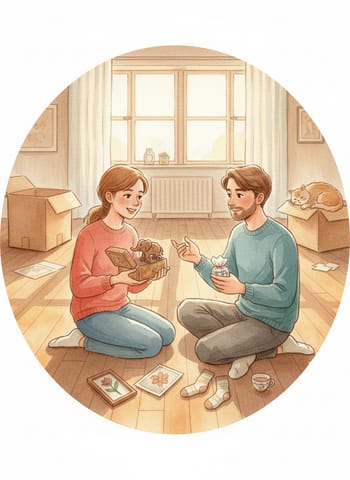
By Saturday noon the apartment has been divided so politely that it feels like a negotiation conducted by people who have never raised their voices. Teresa gets the bookshelves; he gets the stereo. She keeps the good frying pan, he takes the better knives, and the arrangement, announced over takeaway dumplings on Friday night, was so reasonable that neither of them admitted how much it hurt. They parted in March, without villains, which turns out to be the harder thing to pack.
Ao meio-dia de sábado, o apartamento já foi dividido com tanta cortesia que parece uma negociação conduzida por pessoas que nunca elevaram a voz. Teresa fica com as estantes; ele fica com o aparelho de som. Ela mantém a boa frigideira, ele leva as facas melhores, e o acordo, anunciado na sexta à noite sobre dumplings de entrega, foi tão razoável que nenhum dos dois admitiu o quanto doía. Separaram-se em março, sem vilões, o que acaba sendo a coisa mais difícil de embalar.
The objects are not the problem; the sentences attached to them are. "That was your aunt's." "No, she gave it to both of us." The blue lamp, which they bought at a market in the rain after haggling for twenty minutes over a price neither can now remember, goes to him because he works late. The plant, which has survived four moves and a winter of neglect, goes to her because it has always leaned toward her side of the window. Taping the first boxes, Teresa notices that the labels alternate between her handwriting and his, as though they were still a single household being sent somewhere.
Os objetos não são o problema; o problema são as frases presas a eles. "Isso era da sua tia." "Não, ela deu para nós dois." O abajur azul, que compraram numa feira sob a chuva depois de pechinchar vinte minutos por um preço de que nenhum dos dois consegue mais se lembrar, fica com ele porque trabalha até tarde. A planta, que sobreviveu a quatro mudanças e a um inverno de abandono, fica com ela porque sempre se inclinou para o lado dela da janela. Fechando as primeiras caixas com fita, Teresa nota que as etiquetas alternam entre a letra dela e a dele, como se ainda fossem uma única casa sendo despachada para algum lugar.
By Sunday afternoon the rooms have the faintly hollow sound of a place already left, and every voice comes out like an announcement. Only the kitchen drawer remains, the one everybody has and nobody can sort. It holds batteries of uncertain charge, string, a corkscrew, six menus from restaurants that have since closed, and a photo-booth strip of two people trying not to laugh. What Teresa had not expected was that this would be the hardest part. A drawer like that has no owner. It is simply what two people accumulate when they are not paying attention, and nobody ever decided it should be kept. Only now does Teresa see how much of a life is stored in places like this.
Na tarde de domingo, os cômodos têm o som levemente oco de um lugar já deixado, e cada voz sai como um anúncio. Resta apenas a gaveta da cozinha, aquela que todo mundo tem e ninguém consegue organizar. Nela há pilhas de carga incerta, barbante, um saca-rolhas, seis cardápios de restaurantes que já fecharam e uma tira de fotos de cabine de duas pessoas tentando não rir. O que Teresa não esperava era que aquela fosse a parte mais difícil. Uma gaveta dessas não tem dono. É simplesmente o que duas pessoas acumulam quando não estão prestando atenção, e ninguém jamais decidiu que deveria ser guardada. Só agora Teresa vê quanto de uma vida fica guardado em lugares assim.
He lifts out the strip and holds it at arm's length. "Do you want this?"
Ele tira a tira da gaveta e a segura à distância de um braço. "Você quer isto?"
"I assumed you did," Teresa says.
"Achei que você quisesse", diz Teresa.
"That's what I assumed about you," he says, and they both laugh, a short, unconvincing sound. For a moment they stand there holding the question between them like a hot dish. Had they quarrelled, Teresa thinks, this would have been easy: one of them would have stormed out with the pictures, and the other would have thrown out the rest. Instead there is only the afternoon light, and the strip, and the politeness, which has begun to feel like a kind of weather.
"Foi o que eu achei de você", diz ele, e os dois riem, um som curto e pouco convincente. Por um momento ficam ali segurando a pergunta entre os dois como um prato quente. Se tivessem brigado, pensa Teresa, seria fácil: um deles teria saído furioso com as fotos, e o outro teria jogado fora o resto. Em vez disso há só a luz da tarde, a tira e a cortesia, que começou a parecer um tipo de clima.
In the end they cut the strip in two with the kitchen scissors, the last object in the apartment that nobody has claimed. Two frames each. His half has the frame where they are laughing; hers has the one where they are not, which is, she thinks, the more accurate picture and not the one she would have chosen. At the bottom of the drawer there is also a small brass key that neither of them can identify. They try it in the front door, the balcony door, the bicycle lock. It fits nothing.
No fim, cortam a tira ao meio com a tesoura da cozinha, o último objeto do apartamento que ninguém reivindicou. Dois quadros para cada um. A metade dele tem o quadro em que estão rindo; a dela, aquele em que não estão, que é, ela pensa, a imagem mais fiel e não a que teria escolhido. No fundo da gaveta há também uma pequena chave de latão que nenhum dos dois consegue identificar. Experimentam-na na porta da frente, na porta da varanda, no cadeado da bicicleta. Não serve em nada.
"Yours," he says, "since you'll go on wondering."
"Sua", diz ele, "já que você vai continuar se perguntando."
"Mine," she agrees.
"Minha", concorda ela.
She tapes the last box, writes nothing on it, and carries it down to the car. On the stairs she threads the key onto her own ring, between the apartment key she must hand back tonight and the one for her office, where it hangs, small and brass, opening nothing yet.
Ela fecha a última caixa com fita, não escreve nada nela e a carrega até o carro. Na escada, prende a chave no próprio chaveiro, entre a chave do apartamento, que precisa devolver esta noite, e a do escritório, onde ela fica pendurada, pequena e de latão, ainda sem abrir nada.