The Park Chess Hustler
Una historia gratuita en inglés de nivel B2 para estudiantes, para leer en línea en 5 idiomas, con opción de escucharla en la app gratuita Storyteller.
A park chess hustler loses to a silent nine-year-old and, instead of chasing her away, decides to teach her.
¡Ese fue el avance! Escucha la historia completa en la app gratuita Storyteller. Descargar la app
El audio no está disponible en este momento.
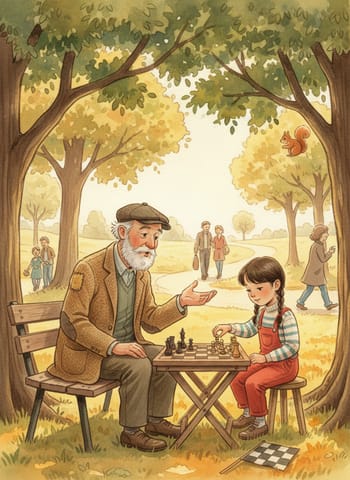
Every Saturday, Asha sets up her folding table under the big plane tree and waits for someone who thinks he is better than he is. Her sign reads, "Speed chess, five minutes, two dollars a game." Her real skill is not chess. It is knowing exactly how much to let a stranger believe.
Todos los sábados, Asha instala su mesa plegable bajo el gran plátano y espera a alguien que se crea mejor de lo que es. Su letrero dice: «Ajedrez rápido, cinco minutos, dos dólares la partida». Su verdadero talento no es el ajedrez. Es saber exactamente cuánto dejar que un desconocido crea.
Today's customer is a man in a very clean jacket who has been explaining his favorite opening to her for ten minutes. She loses the first game on purpose, then wins the next three. He pays, grumbling, and she pockets the money.
El cliente de hoy es un hombre con una chaqueta muy limpia que lleva diez minutos explicándole su apertura favorita. Ella pierde la primera partida a propósito y gana las tres siguientes. Él paga, rezongando, y ella se guarda el dinero.
Then a small girl appears at the edge of the table. She is perhaps nine, with a backpack bigger than her body and a stare that never blinks. She puts down two dollars and sits. She says nothing.
Entonces aparece una niña pequeña al borde de la mesa. Tendrá unos nueve años, con una mochila más grande que su cuerpo y una mirada que no parpadea. Deja dos dólares y se sienta. No dice nada.
Asha, amused, plays quickly and carelessly, as she always does with children. Twelve moves later, her queen is trapped. She stares at the board. "Lucky," she says. The girl shrugs and sets up the pieces again.
Asha, divertida, juega rápido y con descuido, como siempre hace con los niños. Doce jugadas después, su reina está atrapada. Mira fijamente el tablero. «Suerte», dice. La niña se encoge de hombros y vuelve a colocar las piezas.
The second game is slower. Asha concentrates, which she has not done for a paying customer in years. It does not help. The girl takes her rook with a neat little tap and folds her hands in her lap.
La segunda partida es más lenta. Asha se concentra, algo que no ha hecho por un cliente que paga en años. No sirve de nada. La niña le toma la torre con un pequeño y pulcro toque y junta las manos en el regazo.
A tall man hurries across the grass, out of breath. "Jacinta! You can't just run off like that," he says. Then he sees the board and the two dollars in Asha's tray. "Oh no. Has she been playing for money?"
Un hombre alto cruza el césped a toda prisa, sin aliento. «¡Jacinta! No puedes salir corriendo así», dice. Luego ve el tablero y los dos dólares en la bandeja de Asha. «Ay, no. ¿Ha estado jugando por dinero?»
Asha opens her mouth to say yes, and to say something dignified about business. What comes out instead is, "She's beaten me twice."
Asha abre la boca para decir que sí, y para decir algo digno sobre los negocios. Lo que sale en cambio es: «Me ha ganado dos veces».
The man explains, a little apologetically, that his daughter has been reading the same chess book since spring. She will not speak to the coach at school, and she will hardly speak to anyone. They had hoped chess might be a way in.
El hombre explica, un poco apenado, que su hija lleva desde la primavera leyendo el mismo libro de ajedrez. No quiere hablar con el entrenador de la escuela, y apenas habla con nadie. Habían esperado que el ajedrez fuera una vía de entrada.
Asha knows what she should do. A sensible hustler would keep the two dollars and move her table to the far side of the park before the girl returned with friends. If she had any sense, she would do exactly that.
Asha sabe lo que debería hacer. Un buen estafador se quedaría con los dos dólares y trasladaría su mesa al otro lado del parque antes de que la niña volviera con amigos. Si tuviera algo de sentido común, haría exactamente eso.
Instead, she turns the board around. "Your opening was fine," she tells the girl. "But on move six, you took my pawn when you should have developed your knight. You got away with it because I wasn't paying attention."
En cambio, gira el tablero. «Tu apertura estuvo bien», le dice a la niña. «Pero en la jugada seis te llevaste mi peón cuando debiste haber desarrollado tu caballo. Te saliste con la tuya porque yo no estaba prestando atención.»
The girl listens, eyes fixed on the pieces. Then, very slightly, she nods.
La niña escucha, con los ojos fijos en las piezas. Luego, muy levemente, asiente.
"Come back next Saturday," Asha says to the father. "I'll show her a few things the book doesn't say."
«Vuelvan el próximo sábado», le dice Asha al padre. «Le mostraré algunas cosas que el libro no dice.»
"How much would that cost?" he asks.
«¿Cuánto costaría eso?», pregunta él.
Asha looks at the two dollars in her tray. She slides them back across the table. "Nothing. Call it professional curiosity."
Asha mira los dos dólares en su bandeja. Los desliza de vuelta por la mesa. «Nada. Llámelo curiosidad profesional.»
The following Saturday, Jacinta arrives before the table has even been unfolded. By noon, she has beaten three of Asha's regular victims, and Asha has quietly repainted her sign. It now says, "Beat the kid and win four dollars." Nobody has won yet.
El sábado siguiente, Jacinta llega antes de que la mesa siquiera esté desplegada. Para el mediodía, ya ha vencido a tres de las víctimas habituales de Asha, y Asha ha repintado discretamente su letrero. Ahora dice: «Vence a la niña y gana cuatro dólares». Nadie ha ganado todavía.
At the end of the afternoon, the girl pushes a small pile of coins across the table and holds up five fingers.
Al final de la tarde, la niña empuja un pequeño montón de monedas por la mesa y levanta cinco dedos.
"Fifty percent?" Asha laughs. "Where did you learn to negotiate?"
«¿El cincuenta por ciento?», ríe Asha. «¿Dónde aprendiste a negociar?»
Jacinta points at the table and, very quietly, speaks her first word to Asha. "Here."
Jacinta señala la mesa y, muy bajito, pronuncia su primera palabra a Asha. «Aquí.»