The Park Chess Hustler
A free B2-level English story for language learners, readable online in 5 languages, with an option to listen via the free Storyteller app.
A park chess hustler loses to a silent nine-year-old and, instead of chasing her away, decides to teach her.
That was the preview! Hear the full story in the free Storyteller app. Get the app
Audio isn't available right now.
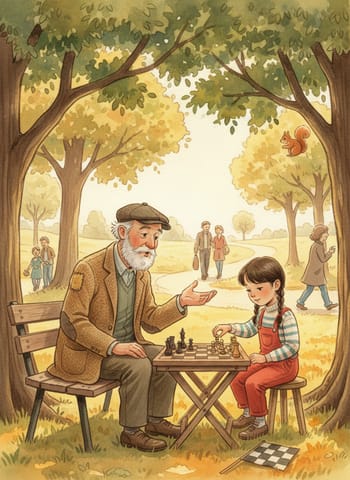
Every Saturday, Asha sets up her folding table under the big plane tree and waits for someone who thinks he is better than he is. Her sign reads, "Speed chess, five minutes, two dollars a game." Her real skill is not chess. It is knowing exactly how much to let a stranger believe.
Today's customer is a man in a very clean jacket who has been explaining his favorite opening to her for ten minutes. She loses the first game on purpose, then wins the next three. He pays, grumbling, and she pockets the money.
Then a small girl appears at the edge of the table. She is perhaps nine, with a backpack bigger than her body and a stare that never blinks. She puts down two dollars and sits. She says nothing.
Asha, amused, plays quickly and carelessly, as she always does with children. Twelve moves later, her queen is trapped. She stares at the board. "Lucky," she says. The girl shrugs and sets up the pieces again.
The second game is slower. Asha concentrates, which she has not done for a paying customer in years. It does not help. The girl takes her rook with a neat little tap and folds her hands in her lap.
A tall man hurries across the grass, out of breath. "Jacinta! You can't just run off like that," he says. Then he sees the board and the two dollars in Asha's tray. "Oh no. Has she been playing for money?"
Asha opens her mouth to say yes, and to say something dignified about business. What comes out instead is, "She's beaten me twice."
The man explains, a little apologetically, that his daughter has been reading the same chess book since spring. She will not speak to the coach at school, and she will hardly speak to anyone. They had hoped chess might be a way in.
Asha knows what she should do. A sensible hustler would keep the two dollars and move her table to the far side of the park before the girl returned with friends. If she had any sense, she would do exactly that.
Instead, she turns the board around. "Your opening was fine," she tells the girl. "But on move six, you took my pawn when you should have developed your knight. You got away with it because I wasn't paying attention."
The girl listens, eyes fixed on the pieces. Then, very slightly, she nods.
"Come back next Saturday," Asha says to the father. "I'll show her a few things the book doesn't say."
"How much would that cost?" he asks.
Asha looks at the two dollars in her tray. She slides them back across the table. "Nothing. Call it professional curiosity."
The following Saturday, Jacinta arrives before the table has even been unfolded. By noon, she has beaten three of Asha's regular victims, and Asha has quietly repainted her sign. It now says, "Beat the kid and win four dollars." Nobody has won yet.
At the end of the afternoon, the girl pushes a small pile of coins across the table and holds up five fingers.
"Fifty percent?" Asha laughs. "Where did you learn to negotiate?"
Jacinta points at the table and, very quietly, speaks her first word to Asha. "Here."