The Community Fridge
Una historia gratuita en inglés de nivel B1 para estudiantes, para leer en línea en 5 idiomas, con opción de escucharla en la app gratuita Storyteller.
Guido wants to limit how much people take from his free fridge, until he learns who is emptying it and why.
¡Ese fue el avance! Escucha la historia completa en la app gratuita Storyteller. Descargar la app
El audio no está disponible en este momento.
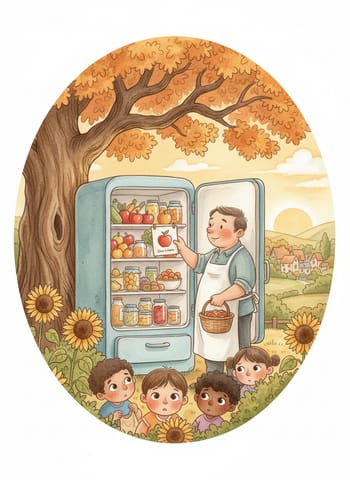
When Guido put a refrigerator outside his shop, he wanted to do something good for the street. He painted it green and wrote "Take what you need, leave what you can" on the door. Neighbors brought vegetables, bread and jars of soup. For the first week, he felt proud every time he walked past it.
Cuando Guido puso un refrigerador afuera de su tienda, quería hacer algo bueno por la calle. Lo pintó de verde y escribió en la puerta: «Toma lo que necesites, deja lo que puedas». Los vecinos trajeron verduras, pan y frascos de sopa. Durante la primera semana, se sentía orgulloso cada vez que pasaba junto a él.
Then the problem started. Every morning at about eight, the fridge was almost empty. Guido arrived at half past eight to find one lonely carton of milk and maybe a lemon. The food that people had left the night before was gone.
Entonces empezó el problema. Todas las mañanas, alrededor de las ocho, el refrigerador estaba casi vacío. Guido llegaba a las ocho y media y encontraba un solitario cartón de leche y, con suerte, un limón. La comida que la gente había dejado la noche anterior había desaparecido.
"Someone is taking everything," he told his wife on the phone. "That is not sharing. That is shopping."
«Alguien se lo está llevando todo», le dijo a su esposa por teléfono. «Eso no es compartir. Eso es ir de compras».
By Thursday, he was angry enough to make a plan. He bought a thick marker and a large piece of card, and he wrote: "ONE ITEM PER PERSON." He was about to tape it to the door when he stopped. He wanted to see the problem with his own eyes before he made a rule for everyone.
Para el jueves, estaba lo bastante enojado como para hacer un plan. Compró un marcador grueso y un trozo grande de cartulina, y escribió: «UN ARTÍCULO POR PERSONA». Estaba a punto de pegarlo con cinta en la puerta cuando se detuvo. Quería ver el problema con sus propios ojos antes de poner una regla para todos.
On Friday, he came to the shop at half past six. He waited behind the window with a coffee. At ten to eight, a woman arrived with a large cloth bag. A small boy walked beside her, carrying a loaf of bread from home. She looked tired. She opened the fridge, filled the bag carefully, and closed the door as softly as she could.
El viernes llegó a la tienda a las seis y media. Esperó detrás de la ventana con un café. A las ocho menos diez llegó una mujer con una gran bolsa de tela. A su lado caminaba un niño pequeño, que llevaba una barra de pan de su casa. Ella se veía cansada. Abrió el refrigerador, llenó la bolsa con cuidado y cerró la puerta lo más suavemente que pudo.
Guido went outside before she could leave. "Excuse me," he said, sounding sterner than he meant to. "Do you know that other people live on this street too?"
Guido salió antes de que ella pudiera irse. «Disculpe», dijo, con un tono más severo del que pretendía. «¿Sabe que en esta calle también vive otra gente?».
The woman looked at him calmly. "Yes," she said. "That is why I take so much."
La mujer lo miró con calma. «Sí», dijo. «Por eso me llevo tanto».
Her name was Salome, and she explained everything in a few quiet sentences. Every morning, she carried the food to three neighbors who could not walk to the fridge. One was an old man with a broken hip. The other two were sisters in their eighties. They lived on the fifth floor of a building with no elevator.
Se llamaba Salome, y lo explicó todo en unas pocas frases tranquilas. Todas las mañanas llevaba la comida a tres vecinos que no podían caminar hasta el refrigerador. Uno era un anciano con la cadera rota. Las otras dos eran hermanas de ochenta y tantos años. Vivían en el quinto piso de un edificio sin ascensor.
"I knock on their doors before I take my son to school," she said. "I thought somebody would tell me to stop."
«Toco a sus puertas antes de llevar a mi hijo a la escuela», dijo. «Pensé que alguien me diría que parara».
Guido looked at the card in his hand. It suddenly felt heavy and a little stupid. He folded it in half and put it in his pocket.
Guido miró la cartulina que tenía en la mano. De repente se sintió pesada y un poco tonta. La dobló por la mitad y se la guardó en el bolsillo.
"Nobody is going to stop you," he said. "I think I need a different sign."
«Nadie va a detenerla», dijo. «Creo que lo que necesito es otro letrero».
That afternoon, he wrote a new one. It said: "Take what you need. If you can carry some to a neighbor, thank you." He taped it to the door, and then he went inside to find a bigger bag.
Esa tarde escribió uno nuevo. Decía: «Toma lo que necesites. Si puedes llevarle algo a un vecino, gracias». Lo pegó con cinta en la puerta, y luego entró a buscar una bolsa más grande.