The Community Fridge
Uma história gratuita em inglês de nível B1 para estudantes, para ler online em 5 idiomas, com opção de ouvir no app gratuito Storyteller.
Guido wants to limit how much people take from his free fridge, until he learns who is emptying it and why.
Essa foi a prévia! Ouça a história completa no app gratuito Storyteller. Baixar o app
O áudio não está disponível no momento.
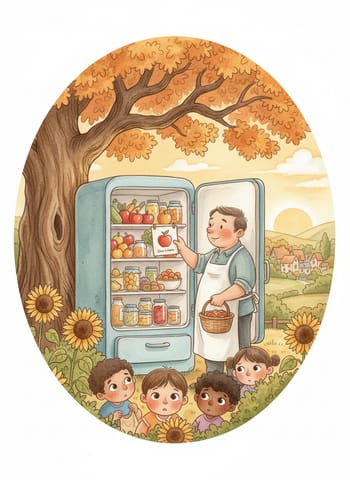
When Guido put a refrigerator outside his shop, he wanted to do something good for the street. He painted it green and wrote "Take what you need, leave what you can" on the door. Neighbors brought vegetables, bread and jars of soup. For the first week, he felt proud every time he walked past it.
Quando Guido colocou uma geladeira na frente da loja, queria fazer algo de bom pela rua. Pintou-a de verde e escreveu na porta: "Leve o que precisar, deixe o que puder". Os vizinhos traziam verduras, pão e potes de sopa. Na primeira semana, ele sentia orgulho toda vez que passava por ela.
Then the problem started. Every morning at about eight, the fridge was almost empty. Guido arrived at half past eight to find one lonely carton of milk and maybe a lemon. The food that people had left the night before was gone.
Então o problema começou. Toda manhã, por volta das oito, a geladeira estava quase vazia. Guido chegava às oito e meia e encontrava uma caixa solitária de leite e, talvez, um limão. A comida que as pessoas tinham deixado na noite anterior tinha sumido.
"Someone is taking everything," he told his wife on the phone. "That is not sharing. That is shopping."
"Alguém está levando tudo", disse ele à esposa pelo telefone. "Isso não é compartilhar. Isso é fazer compras."
By Thursday, he was angry enough to make a plan. He bought a thick marker and a large piece of card, and he wrote: "ONE ITEM PER PERSON." He was about to tape it to the door when he stopped. He wanted to see the problem with his own eyes before he made a rule for everyone.
Na quinta-feira, ele estava com raiva suficiente para fazer um plano. Comprou uma caneta grossa e um pedaço grande de cartolina e escreveu: "UM ITEM POR PESSOA." Ia colá-la na porta quando parou. Queria ver o problema com os próprios olhos antes de criar uma regra para todo mundo.
On Friday, he came to the shop at half past six. He waited behind the window with a coffee. At ten to eight, a woman arrived with a large cloth bag. A small boy walked beside her, carrying a loaf of bread from home. She looked tired. She opened the fridge, filled the bag carefully, and closed the door as softly as she could.
Na sexta, chegou à loja às seis e meia. Esperou atrás da vitrine com um café. Às oito menos dez, chegou uma mulher com uma grande sacola de pano. Um menino pequeno andava ao lado dela, carregando um pão que trouxera de casa. Ela parecia cansada. Abriu a geladeira, encheu a sacola com cuidado e fechou a porta o mais suavemente que pôde.
Guido went outside before she could leave. "Excuse me," he said, sounding sterner than he meant to. "Do you know that other people live on this street too?"
Guido saiu antes que ela fosse embora. "Com licença", disse, mais severo do que pretendia. "A senhora sabe que outras pessoas também moram nesta rua?"
The woman looked at him calmly. "Yes," she said. "That is why I take so much."
A mulher olhou para ele com calma. "Sei", disse. "É por isso que eu levo tanto."
Her name was Salome, and she explained everything in a few quiet sentences. Every morning, she carried the food to three neighbors who could not walk to the fridge. One was an old man with a broken hip. The other two were sisters in their eighties. They lived on the fifth floor of a building with no elevator.
O nome dela era Salomé, e ela explicou tudo em poucas frases tranquilas. Toda manhã, levava a comida para três vizinhos que não conseguiam ir até a geladeira. Um era um senhor com o quadril quebrado. As outras duas eram irmãs na casa dos oitenta anos. Moravam no quinto andar de um prédio sem elevador.
"I knock on their doors before I take my son to school," she said. "I thought somebody would tell me to stop."
"Bato na porta deles antes de levar meu filho para a escola", disse ela. "Achei que alguém ia mandar eu parar."
Guido looked at the card in his hand. It suddenly felt heavy and a little stupid. He folded it in half and put it in his pocket.
Guido olhou para a cartolina em sua mão. De repente, ela parecia pesada e um pouco boba. Ele a dobrou ao meio e a guardou no bolso.
"Nobody is going to stop you," he said. "I think I need a different sign."
"Ninguém vai mandar a senhora parar", disse. "Acho que eu é que preciso de outro cartaz."
That afternoon, he wrote a new one. It said: "Take what you need. If you can carry some to a neighbor, thank you." He taped it to the door, and then he went inside to find a bigger bag.
Naquela tarde, escreveu um novo. Dizia: "Leve o que precisar. Se puder levar um pouco para um vizinho, obrigado." Colou-o na porta e depois entrou na loja para procurar uma sacola maior.