The Back Booth
Una historia gratuita en inglés de nivel C1 para estudiantes, para leer en línea en 3 idiomas, con opción de escucharla en la app gratuita Storyteller.
Taking over her late mother's diner, Odessa finds an old note revealing her mother nearly sold it the year she was born.
¡Ese fue el avance! Escucha la historia completa en la app gratuita Storyteller. Descargar la app
El audio no está disponible en este momento.
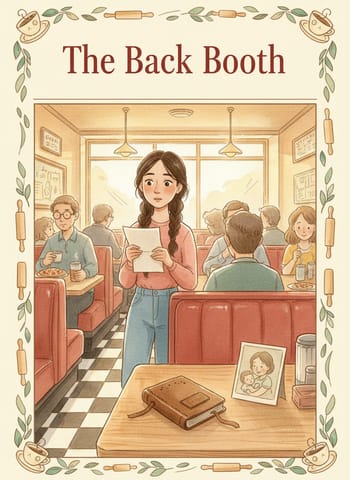
Odessa was thirty-four the week she finally agreed to take over the diner, a decision everyone in her family treated as inevitable, though nobody could say exactly when she had agreed to it.
Odessa tenía treinta y cuatro años la semana en que finalmente aceptó hacerse cargo del restaurante, una decisión que toda su familia consideraba inevitable, aunque nadie podía decir exactamente cuándo había aceptado.
She had grown up in the back booth doing homework while her mother, Imogen, ran the register, the till, and every crisis the kitchen produced, seemingly without effort. The plan, as far as Odessa understood it, had always been quiet and unspoken: the diner would pass to her the way it had passed to Imogen, and to Imogen's mother before that.
Ella había crecido en el reservado del fondo haciendo la tarea mientras su madre, Imogen, manejaba la caja registradora, el mostrador y cada crisis que surgía en la cocina, aparentemente sin esfuerzo. El plan, hasta donde Odessa entendía, siempre había sido silencioso y tácito: el restaurante pasaría a ella tal como había pasado a Imogen, y antes a la madre de Imogen.
It was while clearing out the office, three months after the funeral, that Odessa found the note, folded small inside an old bank ledger from the year she was born.
Fue mientras vaciaba la oficina, tres meses después del funeral, que Odessa encontró la nota, doblada en pequeño dentro de un viejo libro de contabilidad del banco del año en que ella nació.
Considering selling. Baby due in six weeks. Can't keep doing both, it read, in her mother's unmistakable handwriting, dated a full year before Odessa had any memory of the place existing at all.
«Pensando en vender. El bebé nace en seis semanas. No puedo seguir haciendo ambas cosas», decía la nota, con la inconfundible letra de su madre, fechada un año completo antes de que Odessa tuviera algún recuerdo de que el lugar existiera.
Standing in the office with the ledger open in her hands, Odessa realized something startling. Had that sale gone through, she would have grown up somewhere else entirely, doing something else entirely, with a mother who might have been less exhausted and, perhaps, considerably happier.
De pie en la oficina con el libro de contabilidad abierto en las manos, Odessa se dio cuenta de algo sorprendente. Si esa venta se hubiera concretado, ella habría crecido en un lugar completamente distinto, haciendo algo completamente distinto, con una madre que quizás habría estado menos agotada y, tal vez, considerablemente más feliz.
She had spent her whole life assuming the diner was simply what her mother wanted, a calling rather than a burden quietly carried for thirty-four years past the point where it might reasonably have ended. The note complicated that story in a way Odessa was not prepared for.
Había pasado toda su vida suponiendo que el restaurante era simplemente lo que su madre quería, una vocación y no una carga que había llevado en silencio durante treinta y cuatro años, mucho después del punto en que razonablemente podría haber terminado. La nota complicaba esa historia de una manera para la que Odessa no estaba preparada.
She called her aunt that evening, hoping for context, and got instead a long pause before an honest answer. "She almost did sell it," her aunt confirmed. "Your father talked her out of it. I never knew if that was the right call or not, and I don't think your mother ever fully decided either."
Llamó a su tía esa noche, esperando obtener contexto, y en cambio recibió una larga pausa antes de una respuesta honesta. «Casi la vendió», confirmó su tía. «Tu padre la convenció de no hacerlo. Nunca supe si esa fue la decisión correcta, y no creo que tu madre lo haya decidido del todo tampoco».
What Odessa had to sit with, in the weeks that followed, was a question with no comfortable answer. Was keeping the diner running, all these years, her mother's devotion, or simply the shape her life had taken once the harder choice went unmade?
Lo que Odessa tuvo que enfrentar, en las semanas siguientes, fue una pregunta sin respuesta cómoda. ¿Mantener el restaurante abierto todos esos años había sido la devoción de su madre, o simplemente la forma que había tomado su vida una vez que la decisión más difícil quedó sin tomar?
She thought about closing it herself, more seriously than she had let anyone know. She thought, too, about her own daughter, not yet born, and whether she wanted to hand down a business or finally hand down the choice her mother never quite got to make.
Pensó en cerrarlo ella misma, más en serio de lo que había dejado saber a nadie. Pensó también en su propia hija, todavía no nacida, y en si quería heredarle un negocio o, por fin, heredarle la decisión que su madre nunca llegó a tomar del todo.
In the end, Odessa kept the diner open, but not, she told herself carefully, out of the same quiet inevitability that had carried her mother through three decades of it. She kept it because she chose to, actively. The note from the ledger stayed taped inside a drawer only she ever opened, a small private reminder that devotion and habit can look, from the outside, exactly the same.
Al final, Odessa mantuvo el restaurante abierto, pero no, se dijo con cuidado a sí misma, por la misma silenciosa inevitabilidad que había llevado a su madre a lo largo de tres décadas. Lo mantuvo abierto porque eligió hacerlo, de manera activa. La nota del libro de contabilidad quedó pegada dentro de un cajón que solo ella abría, un pequeño recordatorio privado de que la devoción y la costumbre pueden parecer, desde fuera, exactamente lo mismo.