The Column Taken Literally
A free C1-level English story for language learners, readable online in 5 languages, with an option to listen via the free Storyteller app.
A small-town columnist's joke about painting the town hall in stripes is approved by the council, and he has to decide whether to confess.
That was the preview! Hear the full story in the free Storyteller app. Get the app
Audio isn't available right now.
In eleven years of writing the satirical column in the town's Thursday paper, Mehmet had never been quoted by anyone except his mother, who repeated him to her friends with the punctuation wrong. That was why he felt entirely safe on the Wednesday evening he wrote about the town hall.
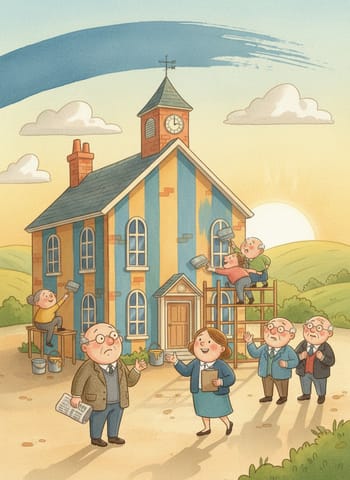
The council had spent the autumn commissioning a report on why nobody in town felt cheerful. The report cost more than the library's heating bill for a year, and it concluded that residents wanted "a visible symbol of renewal." With a deadline, a cold coffee and what he considered a modest sense of public duty, Mehmet proposed painting the town hall in wide orange and white stripes. A building that looked like a deckchair, he wrote, would lift anyone's mood, and it would be far cheaper than fixing the roof. He added a drawing of the mayor on a ladder, holding a ribbon and a very small brush.
He had been so sure of the tone that it never crossed his mind anyone could miss it. Not until the following Monday did his editor turn her screen toward him without a word.
The council had met on Sunday night. By five votes to two, it had approved "the Courier columnist's initiative" and set aside a modest sum from the renewal fund. A painter had been booked for the first week of May.
"They thanked you," she said. "Look. 'Mr. Mehmet's creative vision.'"
"It was a joke," he said. "It's called Small Print. It had a drawing of a deckchair."
"They don't read the drawings."
What troubled him in the days that followed was not the stripes but how happy people were. Strangers stopped him outside the bakery. The man who sold newspapers said it was the first idea in years that had made him look up at the building rather than past it. Had Mehmet written the same point about the roof in plain, serious language, he thought, it would have been filed and forgotten for another decade. Dressed as nonsense, it had been passed in a single evening.
On Friday the mayor caught him on the pavement and took both his hands in hers. "Do you know," she said, "that in thirty years nobody has suggested anything that made me smile during a budget meeting?"
"About the stripes," Mehmet began. "There's something I should—"
"Don't tell me the details. I want to be surprised."
That night he drafted a correction. It was a good one, dry and careful, admitting that the column had been satire and regretting any confusion. He read it to his editor over the phone, and she was quiet for so long he thought the line had dropped.
"Print that," she said finally, "and the stripes happen anyway, only now the whole town knows it was an accident. Or you stay silent, and they happen as a decision. Which would you rather have on the front of your building?"
"I'd rather not have anything on it."
"Too late for that."
He did not answer. Having spent a decade being safely unread, he found he had no practice at being believed, and the sensation was both flattering and faintly sick. If he had known the council read the paper at all, he would have written something duller. If he had written something duller, he thought, the roof would still be leaking and nobody would be smiling at the town hall at all.
He folded the correction in three and put it in the inside pocket of his jacket, next to his pen. It was still there in May, on the morning the ladder went up and the first stripe of orange rolled across the old grey stone. A small child at the edge of the crowd asked her father why the building was wearing a deckchair, and the whole square laughed, Mehmet loudest. He put a hand to his pocket. Then he took it away again.