The Man and His Image
A free B2-level English story for language learners, readable online in 7 languages, with an option to listen via the free Storyteller app.
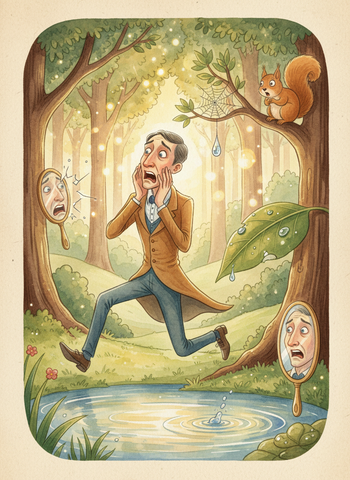
A man too vain to bear his own reflection flees every mirror he owns, only to discover that nature has just as many ways of showing him the truth.
Once there was a man who loved himself very much, and who permitted himself no rivals in that love. He thought his face and figure the handsomest in all the world. Anything in the shape of a mirror that could show him his own likeness he took care to avoid; for he did not want to be reminded that perhaps he was over-rating his beauty. For this reason he hated looking-glasses and accused them of being false. He made a very great mistake in this respect; but that he did not mind, being quite content to live in the happiness the mistake afforded him.
从前有一个非常爱自己的人,他绝不允许有谁在这份爱慕上与自己相提并论。他认为自己的容貌和身材是全世界最英俊的。任何能照出他容貌的镜子之类的东西,他都小心地加以避开;因为他不想被提醒,也许自己把自己的美貌估计得过高了。正因如此,他厌恶镜子,指责镜子说谎。在这方面他犯了一个很大的错误;但他并不在意,因为他心满意足地活在这个错误带给他的快乐之中。
To cure him of so grievous an error, officious Fate managed matters in such a way that wherever he turned his eyes they would fall on one of those mute little counsellors that ladies carry and appeal to when they are anxious about their appearance. He found mirrors in the houses; mirrors in the shops; mirrors in the pockets of gallants; mirrors even as ornaments on waist-belts of ladies.
为了治好他这个可悲的毛病,多管闲事的命运女神安排了这样的事情:无论他把目光转向哪里,总会落在那些贵妇人们随身携带、在为自己的容貌担忧时向其求教的沉默小顾问上。他在房屋里发现了镜子;在店铺里发现了镜子;在风流公子的口袋里发现了镜子;甚至在贵妇们的腰带饰物上也发现了镜子。
What was he to do—this poor Narcissus? He thought to avoid all such things by going far away from haunts of mankind, where he should never have to face a mirror again. But in the woods to which he retreated a clear rivulet ran. Into this he happened to look and—saw himself again. Angrily he told himself that his eyes had been deluded by an idle fancy. Henceforth he would keep away from the water! This he tried his utmost to do; but who can resist the beauty of a woodland stream? There he was and remained, always with that which he had determined to shun.
这个可怜的纳西索斯该怎么办呢?他想,只要远远地离开人烟之地,去到一个再也不必面对镜子的地方,便能躲开这一切。可是他退隐藏身的树林里,恰恰流淌着一条清澈的小溪。他碰巧朝溪中一看——又看见了自己。他愤怒地告诉自己,这是眼睛被一时的幻觉蒙蔽了。从此以后他要远离水边!他竭尽全力想做到这一点;可是谁又能抗拒得了林间溪流的美丽呢?于是他仍旧留在那里,始终摆脱不掉他本想避开的东西。
My meaning is easily seen. It applies to everybody; for everybody takes some joy in harbouring this very error. The man in love with himself stands for the soul of each one of us. All the mirrors wherein he saw himself reflected stand for the faults of other people, in which we really see our own faults though we hate to recognise them as such. As for the brook, that, as every one knows, stands for the book of maxims which the Duke de la Rochefoucauld wrote.
我的用意是显而易见的。它适用于每一个人;因为每个人都会从怀有这种错误中获得某种乐趣。那个爱上自己的人,代表着我们每个人的灵魂。他在其中看见自己映像的所有镜子,代表着别人的种种缺点,我们其实是从中看见了自己的缺点,只是我们不愿承认那就是自己的罢了。至于那条小溪,众所周知,代表的是拉罗什富科公爵所写的那部箴言集。
