The Man and His Image
A free B2-level English story for language learners, readable online in 7 languages, with an option to listen via the free Storyteller app.
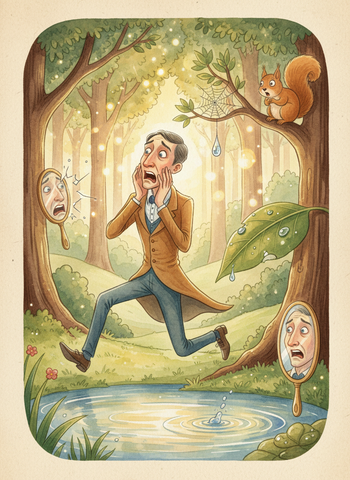
A man too vain to bear his own reflection flees every mirror he owns, only to discover that nature has just as many ways of showing him the truth.
Once there was a man who loved himself very much, and who permitted himself no rivals in that love. He thought his face and figure the handsomest in all the world. Anything in the shape of a mirror that could show him his own likeness he took care to avoid; for he did not want to be reminded that perhaps he was over-rating his beauty. For this reason he hated looking-glasses and accused them of being false. He made a very great mistake in this respect; but that he did not mind, being quite content to live in the happiness the mistake afforded him.
Dahulu kala ada seorang pria yang sangat mencintai dirinya sendiri, dan tidak mengizinkan adanya saingan dalam cinta itu. Ia menganggap wajah dan tubuhnya paling tampan di seluruh dunia. Ia selalu berusaha menghindari apa pun yang berbentuk cermin yang bisa menunjukkan wajahnya sendiri; sebab ia tidak ingin diingatkan bahwa mungkin ia terlalu membesar-besarkan ketampanannya. Karena itu ia membenci cermin dan menuduhnya berbohong. Ia sangat keliru dalam hal ini; tetapi ia tidak peduli, karena cukup puas hidup dalam kebahagiaan yang diberikan oleh kekeliruan itu.
To cure him of so grievous an error, officious Fate managed matters in such a way that wherever he turned his eyes they would fall on one of those mute little counsellors that ladies carry and appeal to when they are anxious about their appearance. He found mirrors in the houses; mirrors in the shops; mirrors in the pockets of gallants; mirrors even as ornaments on waist-belts of ladies.
Untuk menyembuhkannya dari kesalahan besar itu, Takdir yang usil mengatur segalanya sedemikian rupa sehingga ke mana pun ia memandang, matanya akan jatuh pada salah satu penasihat kecil yang bisu itu, yang biasa dibawa dan dipakai oleh para wanita ketika mereka cemas soal penampilan mereka. Ia menemukan cermin di rumah-rumah; cermin di toko-toko; cermin di saku para pria necis; bahkan cermin sebagai hiasan di ikat pinggang para wanita.
What was he to do—this poor Narcissus? He thought to avoid all such things by going far away from haunts of mankind, where he should never have to face a mirror again. But in the woods to which he retreated a clear rivulet ran. Into this he happened to look and—saw himself again. Angrily he told himself that his eyes had been deluded by an idle fancy. Henceforth he would keep away from the water! This he tried his utmost to do; but who can resist the beauty of a woodland stream? There he was and remained, always with that which he had determined to shun.
Apa yang harus ia lakukan—Narcissus yang malang ini? Ia berpikir untuk menghindari semua itu dengan pergi jauh dari keramaian manusia, ke tempat yang tak akan lagi membuatnya berhadapan dengan cermin. Tetapi di hutan tempat ia mengasingkan diri mengalir sebuah anak sungai yang jernih. Ke dalamnya ia kebetulan menatap dan—melihat dirinya sendiri lagi. Dengan marah ia meyakinkan diri bahwa matanya telah tertipu oleh khayalan belaka. Mulai sekarang ia akan menjauh dari air! Ia berusaha sekuat tenaga melakukannya; tetapi siapa yang bisa menahan diri dari keindahan aliran sungai di hutan? Di sanalah ia berada dan tetap berada, selalu bersama hal yang ingin ia hindari.
My meaning is easily seen. It applies to everybody; for everybody takes some joy in harbouring this very error. The man in love with himself stands for the soul of each one of us. All the mirrors wherein he saw himself reflected stand for the faults of other people, in which we really see our own faults though we hate to recognise them as such. As for the brook, that, as every one knows, stands for the book of maxims which the Duke de la Rochefoucauld wrote.
Maksudku mudah dipahami. Ini berlaku untuk semua orang; sebab setiap orang menyimpan kesenangan dalam kekeliruan ini. Pria yang jatuh cinta pada dirinya sendiri mewakili jiwa kita masing-masing. Semua cermin tempat ia melihat bayangannya mewakili kesalahan orang lain, yang di dalamnya sebenarnya kita melihat kesalahan kita sendiri meski kita enggan mengakuinya. Adapun anak sungai itu, seperti diketahui semua orang, mewakili buku kata-kata bijak yang ditulis oleh Adipati de la Rochefoucauld.
