The Man and His Image
A free B2-level English story for language learners, readable online in 7 languages, with an option to listen via the free Storyteller app.
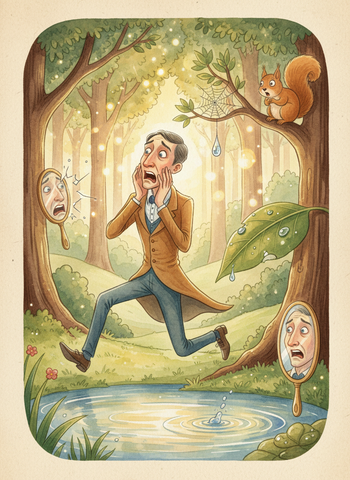
A man too vain to bear his own reflection flees every mirror he owns, only to discover that nature has just as many ways of showing him the truth.
Once there was a man who loved himself very much, and who permitted himself no rivals in that love. He thought his face and figure the handsomest in all the world. Anything in the shape of a mirror that could show him his own likeness he took care to avoid; for he did not want to be reminded that perhaps he was over-rating his beauty. For this reason he hated looking-glasses and accused them of being false. He made a very great mistake in this respect; but that he did not mind, being quite content to live in the happiness the mistake afforded him.
Érase una vez un hombre que se amaba a sí mismo con locura, y que no permitía rival alguno en ese amor. Consideraba que su rostro y su figura eran los más hermosos del mundo entero. Evitaba con cuidado cualquier objeto en forma de espejo que pudiera mostrarle su propio semblante, pues no quería que le recordaran que quizás sobrestimaba su belleza. Por esta razón odiaba los espejos y los acusaba de ser falsos. Se equivocaba profundamente en esto; pero no le importaba, pues se contentaba con vivir en la felicidad que aquel error le proporcionaba.
To cure him of so grievous an error, officious Fate managed matters in such a way that wherever he turned his eyes they would fall on one of those mute little counsellors that ladies carry and appeal to when they are anxious about their appearance. He found mirrors in the houses; mirrors in the shops; mirrors in the pockets of gallants; mirrors even as ornaments on waist-belts of ladies.
Para curarlo de tan grave error, el destino, entrometido, dispuso las cosas de tal manera que, mirara donde mirara, sus ojos se topaban con uno de esos mudos consejeros que las damas llevan consigo y consultan cuando están inquietas por su apariencia. Encontró espejos en las casas; espejos en las tiendas; espejos en los bolsillos de los galanes; espejos incluso como adornos en los cinturones de las damas.
What was he to do—this poor Narcissus? He thought to avoid all such things by going far away from haunts of mankind, where he should never have to face a mirror again. But in the woods to which he retreated a clear rivulet ran. Into this he happened to look and—saw himself again. Angrily he told himself that his eyes had been deluded by an idle fancy. Henceforth he would keep away from the water! This he tried his utmost to do; but who can resist the beauty of a woodland stream? There he was and remained, always with that which he had determined to shun.
¿Qué podía hacer este pobre Narciso? Pensó en evitar todo esto alejándose de los lugares frecuentados por los hombres, donde ya nunca tendría que enfrentarse a un espejo. Pero en los bosques a los que se retiró corría un arroyo cristalino. En él llegó a mirarse y… se vio de nuevo a sí mismo. Con enojo, se dijo que sus ojos habían sido engañados por una idea absurda. ¡De ahora en adelante se mantendría alejado del agua! Esto lo intentó con todas sus fuerzas; pero ¿quién puede resistirse a la belleza de un arroyo en el bosque? Allí estaba y allí permaneció, siempre junto a aquello que había decidido evitar.
My meaning is easily seen. It applies to everybody; for everybody takes some joy in harbouring this very error. The man in love with himself stands for the soul of each one of us. All the mirrors wherein he saw himself reflected stand for the faults of other people, in which we really see our own faults though we hate to recognise them as such. As for the brook, that, as every one knows, stands for the book of maxims which the Duke de la Rochefoucauld wrote.
Mi intención se comprende con facilidad. Se aplica a todo el mundo, pues todos hallamos cierto placer en albergar este mismo error. El hombre enamorado de sí mismo representa el alma de cada uno de nosotros. Todos los espejos en los que se vio reflejado representan los defectos de los demás, en los cuales en realidad vemos nuestros propios defectos, aunque odiemos reconocerlos como tales. En cuanto al arroyo, este, como todos saben, representa el libro de máximas que escribió el duque de La Rochefoucauld.
