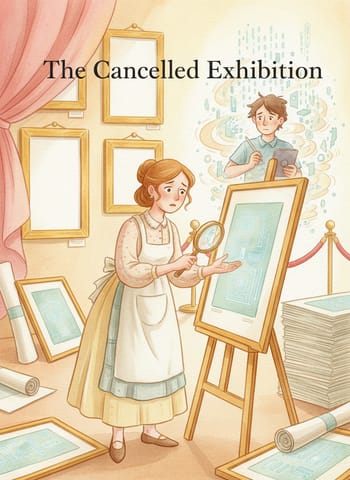
The Cancelled Exhibition
Một truyện tiếng Anh miễn phí trình độ C1 cho người học, đọc trực tuyến bằng 5 ngôn ngữ, có thể nghe qua ứng dụng Storyteller miễn phí.
A gallery curator who learns that an artist's "handmade" prints were largely generated by software must decide what honesty requires.
Hết phần nghe thử! Nghe trọn truyện trong ứng dụng Storyteller miễn phí. Tải app
Hiện chưa thể phát audio.
The first thing Olav noticed was a hair. It lay in the lower left corner of a print called Salt Field, No. 4, a tiny curved line in the ink that he took, on Tuesday morning, for the signature of a human hand. By Wednesday he had found the same curve in the same corner of seven other prints. A hand does not make the same mistake eight times. A file does.
Điều đầu tiên Olav để ý là một sợi tóc. Nó nằm ở góc dưới bên trái của một bản in tên Cánh đồng muối, số 4, một đường cong nhỏ trong lớp mực mà sáng thứ Ba anh tưởng là chữ ký của một bàn tay người. Đến thứ Tư, anh đã tìm thấy cùng đường cong ấy ở cùng góc trên bảy bản in khác. Một bàn tay không mắc cùng một lỗi tám lần. Một tệp dữ liệu thì có.
The gallery occupied two rooms above a bakery, and the exhibition was due to open in nine days. Olav had written the wall labels himself, from the artist's own catalogue notes: hand-cut linocut, hand-printed, edition of twenty. He had been proud of them. Having spent a decade persuading visitors that a slightly wobbly line was worth three times a perfect one, he had come to treat the word handmade as close to a promise.
Phòng tranh gồm hai phòng trên một tiệm bánh, và triển lãm sẽ khai mạc sau chín ngày. Olav đã tự viết các nhãn tường, dựa trên ghi chú trong cuốn danh mục của chính nghệ sĩ: khắc lino thủ công, in thủ công, ấn bản hai mươi bản. Anh đã tự hào về chúng. Sau một thập kỷ thuyết phục khách tham quan rằng một nét hơi run đáng giá gấp ba nét hoàn hảo, anh đã coi chữ thủ công gần như một lời hứa.
That evening he opened the folder Damaris had emailed in the spring and looked at the file names properly for the first time. Salt_Field_v47_final2. Next to each sat a small settings file from a piece of software, with the word generated in a line he had never scrolled down to. Rarely had he felt so politely deceived.
Tối đó anh mở thư mục Damaris đã gửi qua email hồi xuân và lần đầu tiên nhìn kỹ các tên tệp. Salt_Field_v47_final2. Cạnh mỗi tệp là một tệp thiết lập nhỏ của một phần mềm, với chữ generated ở một dòng anh chưa bao giờ cuộn xuống tới. Hiếm khi anh cảm thấy bị lừa một cách lịch sự đến vậy.
She came to the gallery the next morning, carrying her portfolio under one arm like a shield. She did not deny it. "The compositions are generated," she said. "I give the software a direction and a set of rules, and it makes thousands of variations. I choose. I change things. A machine cuts the blocks. And I print every sheet myself, with a roller and my own two hands."
Sáng hôm sau cô đến phòng tranh, kẹp tập tác phẩm dưới một cánh tay như chiếc khiên. Cô không chối. "Các bố cục được tạo ra bằng máy," cô nói. "Tôi cho phần mềm một hướng và một bộ quy tắc, và nó tạo ra hàng nghìn biến thể. Tôi chọn. Tôi sửa. Một chiếc máy cắt các khuôn. Và tôi tự in từng tờ, bằng một con lăn và đôi tay của mình."
"The labels say handmade."
"Nhãn ghi là thủ công."
"I never told you to write handmade."
"Tôi chưa bao giờ bảo anh viết thủ công."
"You never told me not to."
"Cô cũng chưa bao giờ bảo tôi đừng."
"My hands pulled every one of those prints."
"Tay tôi đã kéo từng bản in đó."
"Your hands pulled them," Olav said. "A program drew them."
"Tay cô kéo chúng," Olav nói. "Một chương trình đã vẽ chúng."
Damaris set the portfolio down. "Is a photographer's picture less hers because a lens does the drawing?"
Damaris đặt tập tác phẩm xuống. "Bức ảnh của một nhiếp ảnh gia có bớt là của cô ấy vì một ống kính làm việc vẽ không?"
"Nobody tells people a photograph is a painting." He heard his own voice, tighter than he wanted. "That's the whole difference. I have no objection to software. What I cannot do is let a stranger stand in front of these and believe they are looking at hours of cutting that never happened."
"Chẳng ai bảo người ta rằng một bức ảnh là một bức tranh." Anh nghe giọng mình, căng hơn anh muốn. "Đó là toàn bộ sự khác biệt. Tôi không phản đối phần mềm. Điều tôi không thể làm là để một người lạ đứng trước những thứ này và tin rằng họ đang nhìn hàng giờ khắc mà thực ra chưa từng xảy ra."
"Some of them will walk away."
"Một số người sẽ bỏ đi."
"Then those are the ones who most deserve to know."
"Thì đó chính là những người đáng được biết nhất."
She looked at him for a long moment. "And what would you have said," she asked, "if I had told you in the first meeting?"
Cô nhìn anh một lúc lâu. "Vậy nếu tôi đã nói với anh từ buổi gặp đầu tiên," cô hỏi, "anh sẽ nói gì?"
It was a fair question, and an uncomfortable one. Had she simply said so, he would have hung the show without a second thought, and probably with pleasure; the prints were beautiful, whatever else they were. It was the silence he could not forgive, not the software. Even so, he was not certain the silence had been entirely hers. He had never asked.
Đó là một câu hỏi công bằng, và khó chịu. Nếu cô chỉ nói thẳng, anh đã treo triển lãm mà không nghĩ lần thứ hai, và có lẽ còn vui lòng; các bản in rất đẹp, dù chúng còn là gì khác. Điều anh không thể tha thứ là sự im lặng, không phải phần mềm. Dù vậy, anh không chắc sự im lặng hoàn toàn là của cô. Anh chưa từng hỏi.
That night, in a voice he hoped sounded fair, he wrote the cancellation email to the printer, the press list and the two sponsors. He read it twice. He did not send it.
Đêm đó, bằng một giọng anh hy vọng nghe có vẻ công bằng, anh viết email hủy gửi cho xưởng in, danh sách báo chí và hai nhà tài trợ. Anh đọc hai lần. Anh không gửi.
At nine the next morning he asked her back. On the desk between them lay a single sheet of card, freshly printed.
Chín giờ sáng hôm sau anh mời cô trở lại. Trên bàn giữa hai người là một tấm bìa duy nhất, vừa mới in.
"Software-generated compositions," Damaris read aloud, slowly. "Selected, edited and hand-printed by the artist."
"Các bố cục do phần mềm tạo ra," Damaris đọc to, chậm rãi. "Được nghệ sĩ lựa chọn, chỉnh sửa và in thủ công."
"It will go beside every piece. Bigger than the title, if you want."
"Nó sẽ đặt cạnh mỗi tác phẩm. To hơn cả tựa đề, nếu cô muốn."
"It's less beautiful," she said.
"Nó kém đẹp hơn," cô nói.
"It's more accurate."
"Nó chính xác hơn."
"Those aren't the same thing."
"Hai thứ đó không giống nhau."
"I know," Olav said, and held out a pen.
"Tôi biết," Olav nói, và đưa ra một cây bút.