The Winter Shelter
Uma história gratuita em inglês de nível C1 para estudantes, para ler online em 5 idiomas, com opção de ouvir no app gratuito Storyteller.
A teenage volunteer serving soup at a night shelter recognises a guest as his old primary-school teacher and has to choose how to greet him.
Essa foi a prévia! Ouça a história completa no app gratuito Storyteller. Baixar o app
O áudio não está disponível no momento.
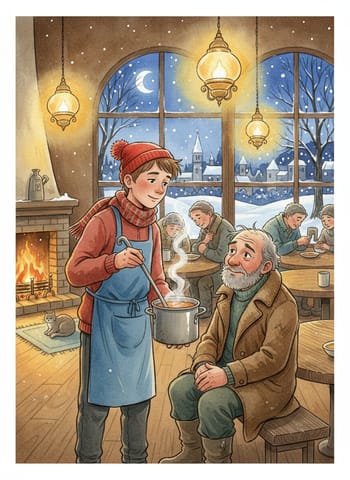
On his second Thursday at the winter shelter, Nathaniel is on soup duty. That means standing behind a steel counter in the community hall with a ladle and a single rule: look at people, not at their bags. He is seventeen and has signed up for forty volunteer hours for a school award. So far the hardest part has been staying out of the way of the coordinator, a retired nurse who calls everyone "my friend" and means it.
Na segunda quinta-feira no abrigo de inverno, Nathaniel está de plantão na sopa. Isso significa ficar atrás de um balcão de aço no salão comunitário, com uma concha e uma única regra: olhar para as pessoas, não para as bolsas delas. Tem dezessete anos e se inscreveu para quarenta horas de voluntariado para um prêmio da escola. Até agora, a parte mais difícil foi não atrapalhar a coordenadora, uma enfermeira aposentada que chama todo mundo de "meu amigo" e fala sério.
At half past seven a man in a grey wool coat reaches the counter and says, "Just the soup, thanks." Nathaniel knows the voice before he knows why. The man's face is thinner than it should be, his beard has not been trimmed for some time, and his glasses are mended at one hinge with a strip of tape. Then he pushes them up the bridge of his nose with one knuckle, exactly as he used to in front of a classroom. Nathaniel is nine years old again, reading aloud badly at the back of Room 4.
Às sete e meia, um homem de casaco de lã cinza chega ao balcão e diz: "Só a sopa, obrigado." Nathaniel reconhece a voz antes de saber por quê. O rosto do homem está mais magro do que deveria, a barba não é aparada há algum tempo e os óculos estão consertados numa das hastes com um pedaço de fita adesiva. Então ele os empurra na ponte do nariz com uma junta do dedo, exatamente como fazia diante de uma sala de aula. Nathaniel tem nove anos de novo, lendo em voz alta, mal, no fundo da Sala 4.
It is Mr. Anselm. Mr. Anselm, who pinned one new word to the board every Monday. Who let Nathaniel stay in at lunch to finish a book rather than go out and be bad at football. Who once taught thirty children to fold a paper boat that would float for a full minute, and who said, when Nathaniel's sank at once, that a sunk boat was only data.
É o Sr. Anselm. O Sr. Anselm, que fixava uma palavra nova no quadro toda segunda-feira. Que deixava Nathaniel ficar na sala durante o recreio para terminar um livro, em vez de sair e ser ruim no futebol. Que um dia ensinou trinta crianças a dobrar um barquinho de papel que flutuava por um minuto inteiro e que disse, quando o de Nathaniel afundou na hora, que barco afundado era só um dado.
The ladle stops halfway to the bowl. Two options arrive with the speed of a reflex. He can act as though he has never seen this man before, which is plainly what the man hopes, since his eyes are fixed on the counter. Or he can say the name aloud, and a hall full of strangers will turn to look. Had the coordinator put him on the door tonight instead of the kitchen, he would have been spared the choice altogether.
A concha para no meio do caminho até a tigela. Duas opções chegam com a rapidez de um reflexo. Ele pode agir como se nunca tivesse visto aquele homem, o que é claramente o que o homem espera, já que seus olhos estão fixos no balcão. Ou pode dizer o nome em voz alta, e um salão cheio de estranhos se virará para olhar. Se a coordenadora o tivesse colocado na porta esta noite em vez da cozinha, ele teria sido poupado da escolha.
What decides it is not exactly kindness. It is the memory of those lunch hours, and the way nobody had ever made a fuss.
O que decide não é exatamente a bondade. É a lembrança daquelas horas de recreio, e do jeito como ninguém nunca fez alarde.
He fills the bowl to the line, adds two rolls without asking, and sets them on the counter at the height he would offer them to anyone. "Good evening, Mr. Anselm," he says, in his ordinary voice. "It's lentil tonight. It's better than it sounds."
Enche a tigela até a marca, acrescenta dois pãezinhos sem perguntar e os coloca no balcão na altura em que os ofereceria a qualquer pessoa. "Boa noite, Sr. Anselm", diz, em sua voz normal. "Hoje é de lentilha. É melhor do que parece."
For a moment nothing moves in the man's face. Then his shoulders come down by about an inch. "Nathaniel," he says, quietly. It is not a question. "Room 4. You made the boat that sank."
Por um instante, nada se move no rosto do homem. Então os ombros dele descem cerca de dois centímetros. "Nathaniel", diz, baixinho. Não é uma pergunta. "Sala 4. Você fez o barco que afundou."
"Every time," Nathaniel says. "You said it was data."
"Todas as vezes", diz Nathaniel. "O senhor disse que era um dado."
"I did say that." Something almost like a smile appears and is put away again. "I'd rather it stayed between us, if it's all the same to you."
"Eu disse isso mesmo." Algo quase como um sorriso aparece e é guardado de novo. "Eu preferiria que ficasse entre nós, se for igual para você."
"There's nothing to stay. You're a guest, and I'm on soup."
"Não há nada para ficar. O senhor é um hóspede, e eu estou na sopa."
Mr. Anselm nods once, takes the bowl in both hands, and carries it to a table in the corner by the radiator. Nathaniel serves the next forty people without really seeing them. Twice the coordinator glances at him, but she says nothing, and he is grateful for that too.
O Sr. Anselm assente uma vez, pega a tigela com as duas mãos e a leva a uma mesa no canto, junto ao aquecedor. Nathaniel serve as próximas quarenta pessoas sem realmente vê-las. Duas vezes a coordenadora olha para ele, mas não diz nada, e ele agradece isso também.
Later, wiping down the counter, he looks across the hall. The man has finished the soup and eaten both rolls. He has taken a paper napkin from the dispenser and is folding it, slowly, with a precision Nathaniel recognises from across eight years. It takes nine moves. When it is done, Mr. Anselm sets the little boat on the water in his glass and watches it, his chin on his hand, with the grave attention of someone marking work. Nathaniel stops wiping and starts to count.
Mais tarde, limpando o balcão, ele olha para o outro lado do salão. O homem terminou a sopa e comeu os dois pãezinhos. Pegou um guardanapo de papel do dispensador e o dobra, devagar, com uma precisão que Nathaniel reconhece depois de oito anos. São nove movimentos. Quando termina, o Sr. Anselm coloca o barquinho na água do copo e o observa, o queixo na mão, com a atenção grave de quem corrige uma prova. Nathaniel para de limpar e começa a contar.