The Story of Icarus and Daedalus
A free C1-level English story for language learners, readable online in 7 languages, with an option to listen via the free Storyteller app.
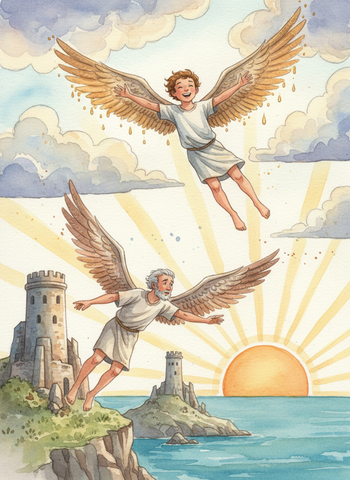
A brilliant inventor builds waxen wings to escape a tower prison with his son, warning the boy not to fly too high — but the thrill of soaring proves impossible to resist.
The labyrinth from which Theseus escaped by means of the clew of Ariadne was built by Daedalus, a most skilful artificer. It was an edifice with numberless winding passages and turnings opening into one another, and seeming to have neither beginning nor end, like the river Maeander, which returns on itself, and flows now onward, now backward, in its course to the sea. Daedalus built the labyrinth for King Minos, but afterwards lost the favor of the king, and was shut up in a tower.
O labirinto do qual Teseu escapou por meio do novelo de fio de Ariadne foi construído por Dédalo, um artífice de grande habilidade. Era um edifício com inúmeras passagens sinuosas e voltas que se abriam umas nas outras, e parecia não ter começo nem fim, como o rio Meandro, que retorna sobre si mesmo e flui ora para frente, ora para trás, em seu curso até o mar. Dédalo construiu o labirinto para o rei Minos, mas depois perdeu o favor do rei, e foi trancado em uma torre.
He contrived to make his escape from his prison, but could not leave the island by sea, as the king kept strict watch on all the vessels, and permitted none to sail without being carefully searched.
Ele conseguiu escapar de sua prisão, mas não podia deixar a ilha pelo mar, pois o rei mantinha vigilância estrita sobre todos os navios, e não permitia que nenhum zarpasse sem ser cuidadosamente revistado.
"Minos may control the land and sea," said Daedalus, "but not the regions of the air. I will try that way." So he set to work to fabricate wings for himself and his young son Icarus. He wrought feathers together, beginning with the smallest and adding larger, so as to form an increasing surface. The larger ones he secured with thread and the smaller with wax, and gave the whole a gentle curvature like the wings of a bird.
"Minos pode controlar a terra e o mar," disse Dédalo, "mas não as regiões do ar. Tentarei esse caminho." Então ele se pôs a fabricar asas para si mesmo e para seu jovem filho Ícaro. Ele entrelaçou penas, começando com as menores e acrescentando as maiores, de modo a formar uma superfície crescente. As maiores ele prendeu com fio e as menores com cera, e deu ao conjunto uma leve curvatura semelhante às asas de um pássaro.
Icarus, the boy, stood and looked on, sometimes running to gather up the feathers which the wind had blown away, and then handling the wax and working it over with his fingers, by his play impeding his father in his labors.
Ícaro, o menino, ficava olhando, às vezes correndo para recolher as penas que o vento havia levado, e então manuseando a cera e trabalhando-a com os dedos, atrapalhando com sua brincadeira o trabalho do pai.
When at last the work was done, the artist, waving his wings, found himself buoyed upward, and hung suspended, poising himself on the beaten air. He next equipped his son in the same manner, and taught him how to fly, as a bird tempts her young ones from the lofty nest into the air. When all was prepared for flight he said, "Icarus, my son, I charge you to keep at a moderate height, for if you fly too low the damp will clog your wings, and if too high the heat will melt them. Keep near me and you will be safe."
Quando finalmente o trabalho ficou pronto, o artesão, agitando as asas, sentiu-se erguido no ar, e ficou suspenso, equilibrando-se sobre o ar batido. Em seguida equipou o filho da mesma maneira, e ensinou-o a voar, como um pássaro atrai seus filhotes do ninho elevado para o ar. Quando tudo estava pronto para o voo, ele disse: "Ícaro, meu filho, eu te ordeno que voes a uma altura moderada, pois se voares muito baixo a umidade emperrará tuas asas, e se voares muito alto o calor derreterá as tuas asas. Fica perto de mim e estarás a salvo."
While he gave him these instructions and fitted the wings to his shoulders, the face of the father was wet with tears, and his hands trembled. He kissed the boy, not knowing that it was for the last time. Then rising on his wings, he flew off, encouraging him to follow, and looked back from his own flight to see how his son managed his wings. As they flew the ploughman stopped his work to gaze, and the shepherd leaned on his staff and watched them, astonished at the sight, and thinking they were gods who could thus cleave the air.
Enquanto lhe dava essas instruções e ajustava as asas em seus ombros, o rosto do pai estava molhado de lágrimas, e suas mãos tremiam. Ele beijou o menino, sem saber que era pela última vez. Então, erguendo-se em suas asas, ele partiu voando, encorajando o filho a segui-lo, e olhava para trás de seu próprio voo para ver como o filho manejava as asas. Enquanto voavam, o lavrador parou seu trabalho para observar, e o pastor apoiou-se no cajado e os observou, maravilhado com a visão, e pensando que eram deuses que assim fendiam o ar.
They passed Samos and Delos on the left and Lebynthos on the right, when the boy, exulting in his career, began to leave the guidance of his companion and soar upward as if to reach heaven. The nearness of the blazing sun softened the wax which held the feathers together, and they came off. He fluttered with his arms, but no feathers remained to hold the air.
Passaram Samos e Delos à esquerda e Lebinto à direita, quando o rapaz, exultante com sua proeza, começou a abandonar a orientação do companheiro e subir como se quisesse alcançar o céu. A proximidade do sol ardente amoleceu a cera que prendia as penas, e elas se soltaram. Ele agitou os braços, mas nenhuma pena restava para sustentar-se no ar.
While his mouth uttered cries to his father it was submerged in the blue waters of the sea, which thenceforth was called by his name. His father cried, "Icarus, Icarus, where are you?" At last he saw the feathers floating on the water, and bitterly lamenting his own arts, he buried the body and called the land Icaria in memory of his child. Daedalus arrived safe in Sicily, where he built a temple to Apollo, and hung up his wings, an offering to the god.
Enquanto sua boca proferia gritos por seu pai, ele foi submerso nas águas azuis do mar, que dali em diante passou a levar seu nome. Seu pai gritava, "Ícaro, Ícaro, onde estás?" Por fim viu as penas flutuando na água, e lamentando amargamente sua própria arte, ele sepultou o corpo e chamou a terra de Icária em memória de seu filho. Dédalo chegou a salvo na Sicília, onde construiu um templo a Apolo, e pendurou suas asas, uma oferenda ao deus.
Daedalus was so proud of his achievements that he could not bear the idea of a rival. His sister had placed her son Perdix under his charge to be taught the mechanical arts. He was an apt scholar and gave striking evidences of ingenuity. Walking on the seashore he picked up the spine of a fish. Imitating it, he took a piece of iron and notched it on the edge, and thus invented the SAW. He put two pieces of iron together, connecting them at one end with a rivet, and sharpening the other ends, and made a PAIR OF COMPASSES.
Dédalo tinha tanto orgulho de suas realizações que não suportava a ideia de um rival. Sua irmã havia posto seu filho Perdix sob seus cuidados para que fosse instruído nas artes mecânicas. Ele era um aluno aplicado e dava provas notáveis de engenhosidade. Caminhando pela praia, apanhou a espinha de um peixe. Imitando-a, pegou um pedaço de ferro e entalhou-o na borda, inventando assim a SERRA. Juntou duas peças de ferro, unindo-as em uma extremidade com um rebite, e afiando as outras extremidades, fez um PAR DE COMPASSOS.
Daedalus was so envious of his nephew's performances that he took an opportunity, when they were together one day on the top of a high tower, to push him off. But Minerva, who favors ingenuity, saw him falling, and arrested his fate by changing him into a bird called after his name, the Partridge. This bird does not build his nest in the trees, nor take lofty flights, but nestles in the hedges, and mindful of his fall, avoids high places.
Dédalo tinha tanta inveja das realizações do sobrinho que aproveitou uma ocasião, quando estavam juntos um dia no alto de uma torre, para empurrá-lo. Mas Minerva, que favorece a engenhosidade, viu-o caindo, e deteve seu destino transformando-o em um pássaro chamado com o seu nome, a Perdiz. Essa ave não constrói seu ninho nas árvores, nem faz voos elevados, mas aninha-se nas sebes, e, lembrando-se de sua queda, evita lugares altos.
The death of Icarus is told in the following lines by Darwin:
A morte de Ícaro é narrada nos seguintes versos de Darwin:
"… with melting wax and loosened strings Sunk hapless Icarus on unfaithful wings; Headlong he rushed through the affrighted air, With limbs distorted and dishevelled hair; His scattered plumage danced upon the wave, And sorrowing Nereids decked his watery grave; O'er his pale corse their pearly sea-flowers shed, And strewed with crimson moss his marble bed; Struck in their coral towers the passing bell, And wide in ocean tolled his echoing knell."
"… com cera derretida e cordões soltos Ícaro, infeliz, afundou sobre asas infiéis; Precipitou-se pelo ar assombrado, Com os membros distorcidos e os cabelos desalinhados; Sua plumagem dispersa dançou sobre a onda, E as Nereidas pesarosas ornaram sua sepultura aquática; Sobre seu corpo pálido derramaram suas flores marinhas de pérola, E cobriram de musgo carmesim seu leito de mármore; Nas torres de coral bateu o sino que passava, E longe, no oceano, ressoou seu dobrar fúnebre."
