The Count and the Wedding Guest
A free B2-level English story for language learners, readable online in 7 languages, with an option to listen via the free Storyteller app.
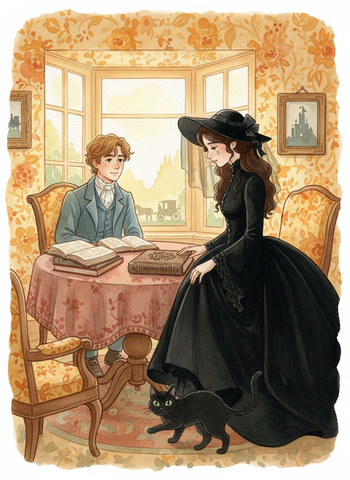
A lonely young man falls for a boarder mourning a dashing count she claims to have lost — but her all-black wardrobe is hiding a much closer secret.
One evening when Andy Donovan went to dinner at his Second Avenue boarding-house, Mrs. Scott introduced him to a new boarder, a young lady, Miss Conway. Miss Conway was small and unobtrusive. She wore a plain, snuffy-brown dress, and bestowed her interest, which seemed languid, upon her plate. She lifted her diffident eyelids and shot one perspicuous, judicial glance at Mr. Donovan, politely murmured his name, and returned to her mutton. Mr. Donovan bowed with the grace and beaming smile that were rapidly winning for him social, business and political advancement, and erased the snuffy-brown one from the tablets of his consideration.
Certa noite, quando Andy Donovan foi jantar na sua pensão da Second Avenue, a senhora Scott o apresentou a uma nova hóspede, uma jovem, a senhorita Conway. A senhorita Conway era pequena e discreta. Usava um vestido simples, de um marrom apagado, e dedicava seu interesse, que parecia lânguido, ao próprio prato. Ergueu as pálpebras tímidas e lançou um olhar rápido e avaliador ao senhor Donovan, murmurou educadamente seu nome, e voltou ao carneiro. O senhor Donovan cumprimentou com a graça e o sorriso radiante que rapidamente lhe conquistavam avanços sociais, comerciais e políticos, e apagou a moça de marrom apagado das tábuas de sua consideração.
Two weeks later Andy was sitting on the front steps enjoying his cigar. There was a soft rustle behind and above him, and Andy turned his head—and had his head turned.
Duas semanas depois, Andy estava sentado na escadaria da frente, saboreando seu charuto. Houve um farfalhar suave atrás e acima dele, e Andy virou a cabeça — e teve a cabeça virada de vez.
Just coming out the door was Miss Conway. She wore a night-black dress of crêpe de—crêpe de—oh, this thin black goods. Her hat was black, and from it drooped and fluttered an ebon veil, filmy as a spider’s web. She stood on the top step and drew on black silk gloves. Not a speck of white or a spot of color about her dress anywhere.
Justo saindo pela porta estava a senhorita Conway. Ela usava um vestido negro como a noite, de crepe de — crepe de — ah, esse tecido preto fino. Seu chapéu era preto, e dele pendia e esvoaçava um véu de ébano, tênue como teia de aranha. Ela parou no último degrau e calçou as luvas de seda preta. Nem um pingo de branco, nem uma pinta de cor em todo o seu vestido.
Her rich golden hair was drawn, with scarcely a ripple, into a shining, smooth knot low on her neck. Her face was plain rather than pretty, but it was now illuminated and made almost beautiful by her large gray eyes that gazed above the houses across the street into the sky with an expression of the most appealing sadness and melancholy.
Seus ricos cabelos dourados estavam presos, quase sem uma onda sequer, num coque brilhante e liso, baixo na nuca. Seu rosto era simples, mais que bonito, mas agora estava iluminado e quase embelezado pelos seus grandes olhos cinzentos, que fitavam por cima das casas do outro lado da rua, para o céu, com uma expressão da mais tocante tristeza e melancolia.
Gather the idea, girls—all black, you know, with the preference for crêpe de—oh, crêpe de Chine—that’s it. All black, and that sad, faraway look, and the hair shining under the black veil (you have to be a blonde, of course), and try to look as if, although your young life had been blighted just as it was about to give a hop-skip-and-a-jump over the threshold of life, a walk in the park might do you good, and be sure to happen out the door at the right moment, and—oh, it’ll fetch ’em every time. But it’s fierce, now, how cynical I am, ain’t it?—to talk about mourning costumes this way.
Peguem a ideia, moças — tudo de preto, sabem, com preferência pelo crepe de — ah, crepe da China — é isso mesmo. Tudo de preto, e aquele olhar triste e distante, e os cabelos brilhando sob o véu negro (é claro que é preciso ser loira), e tentem parecer como se, embora a sua jovem vida tivesse sido arruinada bem no momento em que estava prestes a dar um salto alegre sobre o limiar da existência, um passeio pelo parque pudesse lhes fazer bem, e cuidem de sair pela porta bem na hora certa, e — ah, isso pega todos, sem falhar nunca. Mas é terrível, não é, o quanto sou cínica? — falar assim de trajes de luto.
Mr. Donovan suddenly reinscribed Miss Conway upon the tablets of his consideration. He threw away the remaining inch-and-a-quarter of his cigar, that would have been good for eight minutes yet, and quickly shifted his center of gravity to his low cut patent leathers.
O senhor Donovan reinscreveu de repente a senhorita Conway nas tábuas de sua consideração. Jogou fora o resto de seu charuto, uma polegada e um quarto que ainda daria para oito minutos bons, e depressa transferiu seu centro de gravidade para os sapatos de verniz de bico baixo.
“It’s a fine, clear evening, Miss Conway,” he said; and if the Weather Bureau could have heard the confident emphasis of his tones it would have hoisted the square white signal, and nailed it to the mast.
— É uma noite bonita e clara, senhorita Conway — disse ele; e se o Serviço de Meteorologia tivesse ouvido a ênfase confiante em seu tom, teria hasteado a bandeira branca quadrada e a pregado bem no mastro.
“To them that has the heart to enjoy it, it is, Mr. Donovan,” said Miss Conway, with a sigh.
— Para quem tem coragem de aproveitá-la, é sim, senhor Donovan — disse a senhorita Conway, com um suspiro.
Mr. Donovan, in his heart, cursed fair weather. Heartless weather! It should hail and blow and snow to be consonant with the mood of Miss Conway.
O senhor Donovan, no fundo do coração, amaldiçoou o bom tempo. Tempo sem coração! Devia haver granizo, vento e neve, para condizer com o humor da senhorita Conway.
“I hope none of your relatives—I hope you haven’t sustained a loss?” ventured Mr. Donovan.
— Espero que nenhum parente seu… espero que a senhorita não tenha sofrido uma perda? — arriscou o senhor Donovan.
“Death has claimed,” said Miss Conway, hesitating—“not a relative, but one who—but I will not intrude my grief upon you, Mr. Donovan.”
— A Morte reclamou — disse a senhorita Conway, hesitando — não um parente, mas alguém que… mas não vou impor meu pesar ao senhor, senhor Donovan.
“Intrude?” protested Mr. Donovan. “Why, say, Miss Conway, I’d be delighted, that is, I’d be sorry—I mean I’m sure nobody could sympathize with you truer than I would.”
— Impor? — protestou o senhor Donovan. — Ora, veja bem, senhorita Conway, eu ficaria encantado, quer dizer, ficaria triste… quero dizer, tenho certeza de que ninguém saberia compadecer-se da senhorita com mais sinceridade do que eu.
Miss Conway smiled a little smile. And oh, it was sadder than her expression in repose.
A senhorita Conway sorriu um pequeno sorriso. E ah, era mais triste ainda do que sua expressão em repouso.
“‘Laugh, and the world laughs with you; weep, and they give you the laugh,’” she quoted. “I have learned that, Mr. Donovan. I have no friends or acquaintances in this city. But you have been kind to me. I appreciate it highly.”
— "Ria, e o mundo ri com você; chore, e riem de você" — ela citou. — Aprendi isso, senhor Donovan. Não tenho amigos nem conhecidos nesta cidade. Mas o senhor tem sido gentil comigo. Eu agradeço muito.
He had passed her the pepper twice at the table.
Ele havia passado a pimenta para ela duas vezes, à mesa.
“It’s tough to be alone in New York—that’s a cinch,” said Mr. Donovan. “But, say—whenever this little old town does loosen up and get friendly it goes the limit. Say you took a little stroll in the park, Miss Conway—don’t you think it might chase away some of your mullygrubs? And if you’d allow me—”
— É duro ficar sozinho em Nova York, isso é certo — disse o senhor Donovan. — Mas, veja bem, quando esta velha cidadezinha resolve se soltar e ficar amigável, ela não economiza esforços. Diga, a senhorita não gostaria de dar um passeio pelo parque, senhorita Conway? Não acha que isso ajudaria a espantar um pouco desse seu abatimento? E se a senhorita me permitisse…
“Thanks, Mr. Donovan. I’d be pleased to accept of your escort if you think the company of one whose heart is filled with gloom could be anyways agreeable to you.”
— Obrigada, senhor Donovan. Ficaria feliz em aceitar sua companhia, se o senhor acha que a companhia de alguém cujo coração está tomado de tristeza poderia lhe ser de alguma forma agradável.
Through the open gates of the iron-railed, old, downtown park, where the elect once took the air, they strolled, and found a quiet bench.
Pelos portões de ferro do velho parque do centro, onde outrora a elite tomava ar, os dois passearam, e encontraram um banco tranquilo.
There is this difference between the grief of youth and that of old age: youth’s burden is lightened by as much of it as another shares; old age may give and give, but the sorrow remains the same.
Há esta diferença entre a dor da juventude e a da velhice: o fardo da juventude se alivia na exata medida em que outra pessoa o compartilha; a velhice pode dar e dar, mas a mágoa permanece a mesma.
“He was my fiance,” confided Miss Conway, at the end of an hour. “We were going to be married next spring. I don’t want you to think that I am stringing you, Mr. Donovan, but he was a real Count. He had an estate and a castle in Italy. Count Fernando Mazzini was his name. I never saw the beat of him for elegance. Papa objected, of course, and once we eloped, but papa overtook us, and took us back. I thought sure papa and Fernando would fight a duel. Papa has a livery business—in P’kipsee, you know.”
— Ele era meu noivo — confidenciou a senhorita Conway, ao fim de uma hora. — Íamos nos casar na primavera que vem. Não quero que o senhor pense que estou lhe pregando uma peça, senhor Donovan, mas ele era um verdadeiro conde. Tinha uma propriedade e um castelo na Itália. Conde Fernando Mazzini era seu nome. Nunca vi ninguém igual em elegância. Papai se opôs, claro, e uma vez até fugimos juntos, mas papai nos alcançou e nos trouxe de volta. Cheguei a pensar que papai e Fernando iam brigar num duelo. Papai tem um negócio de aluguel de carruagens… em Poughkeepsie, sabe.
“Finally, papa came ’round, all right, and said we might be married next spring. Fernando showed him proofs of his title and wealth, and then went over to Italy to get the castle fixed up for us. Papa’s very proud, and when Fernando wanted to give me several thousand dollars for my trousseau he called him down something awful. He wouldn’t even let me take a ring or any presents from him. And when Fernando sailed I came to the city and got a position as cashier in a candy store.”
— Por fim, papai cedeu, tudo bem, e disse que podíamos nos casar na primavera. Fernando lhe mostrou provas de seu título e de sua riqueza, e depois foi para a Itália arrumar o castelo para nós. Papai é muito orgulhoso, e quando Fernando quis me dar vários milhares de dólares para o meu enxoval, ele o repreendeu de um jeito terrível. Nem sequer me deixou aceitar um anel ou qualquer presente dele. E quando Fernando partiu de navio, eu vim para a cidade e consegui um emprego como caixa numa loja de doces.
“Three days ago I got a letter from Italy, forwarded from P’kipsee, saying that Fernando had been killed in a gondola accident.”
— Há três dias recebi uma carta da Itália, encaminhada de Poughkeepsie, dizendo que Fernando havia morrido num acidente de gôndola.
“That is why I am in mourning. My heart, Mr. Donovan, will remain forever in his grave. I guess I am poor company, Mr. Donovan, but I cannot take any interest in no one. I should not care to keep you from gayety and your friends who can smile and entertain you. Perhaps you would prefer to walk back to the house?”
— É por isso que estou de luto. Meu coração, senhor Donovan, ficará para sempre no túmulo dele. Acho que sou má companhia, senhor Donovan, mas não consigo me interessar por mais ninguém. Não gostaria de tirar o senhor da alegria e de seus amigos, que sabem sorrir e lhe fazer companhia. Talvez o senhor prefira que voltemos para casa a pé?
Now, girls, if you want to observe a young man hustle out after a pick and shovel, just tell him that your heart is in some other fellow’s grave. Young men are grave-robbers by nature. Ask any widow. Something must be done to restore that missing organ to weeping angels in _crêpe de Chine_. Dead men certainly get the worst of it from all sides.
Ora, moças, se querem observar um rapaz correndo atrás de picareta e pá, é só dizer a ele que seu coração está no túmulo de outro sujeito. Rapazes são profanadores de túmulos por natureza. Perguntem a qualquer viúva. Algo precisa ser feito para devolver esse órgão perdido aos anjos chorosos em crepe da China. Os homens mortos certamente levam a pior de todos os lados.
“I’m awfully sorry,” said Mr. Donovan, gently. “No, we won’t walk back to the house just yet. And don’t say you haven’t no friends in this city, Miss Conway. I’m awful sorry, and I want you to believe I’m your friend, and that I’m awful sorry.”
— Sinto muito mesmo — disse o senhor Donovan, gentilmente. — Não, não vamos voltar para casa ainda. E não diga que não tem amigos nesta cidade, senhorita Conway. Sinto muito mesmo, e quero que a senhorita acredite que sou seu amigo, e que sinto muito mesmo.
“I’ve got his picture here in my locket,” said Miss Conway, after wiping her eyes with her handkerchief. “I never showed it to anybody; but I will to you, Mr. Donovan, because I believe you to be a true friend.”
— Tenho o retrato dele aqui no meu medalhão — disse a senhorita Conway, depois de enxugar os olhos com o lenço. — Nunca mostrei a ninguém; mas vou mostrar ao senhor, senhor Donovan, porque acredito que o senhor é um verdadeiro amigo.
Mr. Donovan gazed long and with much interest at the photograph in the locket that Miss Conway opened for him. The face of Count Mazzini was one to command interest. It was a smooth, intelligent, bright, almost a handsome face—the face of a strong, cheerful man who might well be a leader among his fellows.
O senhor Donovan contemplou por um bom tempo, e com grande interesse, a fotografia no medalhão que a senhorita Conway abriu para ele. O rosto do Conde Mazzini era daqueles que prendem a atenção. Era um rosto liso, inteligente, vivo, quase bonito — o rosto de um homem forte e alegre, que bem poderia ser um líder entre seus semelhantes.
“I have a larger one, framed, in my room,” said Miss Conway. “When we return I will show you that. They are all I have to remind me of Fernando. But he ever will be present in my heart, that’s a sure thing.”
— Tenho uma foto maior, emoldurada, no meu quarto — disse a senhorita Conway. — Quando voltarmos, vou mostrar essa também. São tudo o que tenho para me lembrar de Fernando. Mas ele estará sempre presente no meu coração, disso eu tenho certeza.
A subtle task confronted Mr. Donovan,—that of supplanting the unfortunate Count in the heart of Miss Conway. This his admiration for her determined him to do. But the magnitude of the undertaking did not seem to weigh upon his spirits. The sympathetic but cheerful friend was the rôle he essayed; and he played it so successfully that the next half-hour found them conversing pensively across two plates of ice-cream, though yet there was no diminution of the sadness in Miss Conway’s large gray eyes.
Uma tarefa sutil se apresentava ao senhor Donovan — a de substituir o infeliz conde no coração da senhorita Conway. Sua admiração por ela o levou a decidir fazê-lo. Mas a grandeza da empreitada não parecia pesar em seu ânimo. O papel do amigo compassivo, mas alegre, foi o que ele decidiu interpretar; e o fez com tanto sucesso que, meia hora depois, os dois já conversavam pensativamente diante de dois pratos de sorvete, embora a tristeza nos grandes olhos cinzentos da senhorita Conway não tivesse diminuído em nada.
Before they parted in the hall that evening she ran upstairs and brought down the framed photograph wrapped lovingly in a white silk scarf. Mr. Donovan surveyed it with inscrutable eyes.
Antes de se despedirem no corredor naquela noite, ela correu escada acima e trouxe a fotografia emoldurada, envolta com carinho num lenço de seda branco. O senhor Donovan a examinou com olhos insondáveis.
“He gave me this the night he left for Italy,” said Miss Conway. “I had the one for the locket made from this.”
— Ele me deu isto na noite em que partiu para a Itália — disse a senhorita Conway. — Foi a partir desta que fiz a do medalhão.
“A fine-looking man,” said Mr. Donovan, heartily. “How would it suit you, Miss Conway, to give me the pleasure of your company to Coney next Sunday afternoon?”
— Um homem de boa aparência — disse o senhor Donovan, com sinceridade. — Que tal, senhorita Conway, me dar o prazer de sua companhia até Coney no próximo domingo à tarde?
A month later they announced their engagement to Mrs. Scott and the other boarders. Miss Conway continued to wear black.
Um mês depois, anunciaram seu noivado à senhora Scott e aos demais hóspedes. A senhorita Conway continuou a usar preto.
A week after the announcement the two sat on the same bench in the downtown park, while the fluttering leaves of the trees made a dim kinetoscopic picture of them in the moonlight. But Donovan had worn a look of abstracted gloom all day. He was so silent to-night that love’s lips could not keep back any longer the questions that love’s heart propounded.
Uma semana depois do anúncio, os dois estavam sentados no mesmo banco do parque do centro, enquanto as folhas trêmulas das árvores formavam sobre eles um quadro cinético e vago sob o luar. Mas Donovan andava com um ar de tristeza distraída o dia inteiro. Estava tão calado aquela noite que os lábios do amor não conseguiram mais reter as perguntas que o coração do amor formulava.
“What’s the matter, Andy, you are so solemn and grouchy to-night?”
— O que foi, Andy, por que você está tão sério e mal-humorado esta noite?
“Nothing, Maggie.”
— Nada, Maggie.
“I know better. Can’t I tell? You never acted this way before. What is it?”
— Sei que não é nada disso. Você acha que eu não percebo? Você nunca agiu assim antes. O que é?
“It’s nothing much, Maggie.”
— Não é nada de mais, Maggie.
“Yes it is; and I want to know. I’ll bet it’s some other girl you are thinking about. All right. Why don’t you go get her if you want her? Take your arm away, if you please.”
— É sim; e eu quero saber. Aposto que é alguma outra garota em quem você está pensando. Tudo bem. Por que você não vai atrás dela, se é o que quer? Tire o braço, por favor.
“I’ll tell you then,” said Andy, wisely, “but I guess you won’t understand it exactly. You’ve heard of Mike Sullivan, haven’t you? ‘Big Mike’ Sullivan, everybody calls him.”
— Então eu vou te contar — disse Andy, prudente —, mas acho que você não vai entender direito. Você já ouviu falar de Mike Sullivan, não já? "Big Mike" Sullivan, todo mundo o chama assim.
“No, I haven’t,” said Maggie. “And I don’t want to, if he makes you act like this. Who is he?”
— Não, nunca ouvi — disse Maggie. — E nem quero ouvir, se é isso que te deixa assim. Quem é ele?
“He’s the biggest man in New York,” said Andy, almost reverently. “He can about do anything he wants to with Tammany or any other old thing in the political line. He’s a mile high and as broad as East River. You say anything against Big Mike, and you’ll have a million men on your collarbone in about two seconds. Why, he made a visit over to the old country awhile back, and the kings took to their holes like rabbits.
— Ele é o homem mais importante de Nova York — disse Andy, quase com reverência. — Ele consegue fazer praticamente qualquer coisa com a Tammany ou qualquer outra coisa na área política. Ele é alto como uma montanha e largo como o East River. Você fala mal de Big Mike, e em dois segundos tem um milhão de homens em cima de você. Ora, ele fez uma visita ao velho continente há um tempo, e os reis se enfiaram em seus buracos como coelhos.
“Well, Big Mike’s a friend of mine. I ain’t more than deuce-high in the district as far as influence goes, but Mike’s as good a friend to a little man, or a poor man as he is to a big one. I met him to-day on the Bowery, and what do you think he does? Comes up and shakes hands.
— Pois bem, Big Mike é meu amigo. Eu não sou grande coisa no bairro, em matéria de influência, mas Mike é tão bom amigo de um homem pequeno, ou pobre, quanto é de um grande. Encontrei com ele hoje na Bowery, e adivinha o que ele fez? Veio e apertou minha mão.
“‘Andy,’ says he, ‘I’ve been keeping cases on you. You’ve been putting in some good licks over on your side of the street, and I’m proud of you. What’ll you take to drink?” He takes a cigar, and I take a highball. I told him I was going to get married in two weeks. ‘Andy,’ says he, ‘send me an invitation, so I’ll keep in mind of it, and I’ll come to the wedding.’ That’s what Big Mike says to me; and he always does what he says.
— "Andy", disse ele, "tenho acompanhado seus passos. Você tem feito boas jogadas do seu lado da rua, e tenho orgulho de você. O que você vai tomar?" Ele pegou um charuto, e eu peguei um uísque com soda. Contei a ele que ia me casar dentro de duas semanas. "Andy", disse ele, "me manda um convite, para eu não esquecer, e eu vou no casamento." Foi isso que Big Mike me disse; e ele sempre faz o que diz.
“You don’t understand it, Maggie, but I’d have one of my hands cut off to have Big Mike Sullivan at our wedding. It would be the proudest day of my life. When he goes to a man’s wedding, there’s a guy being married that’s made for life. Now, that’s why I’m maybe looking sore to-night.”
— Você não entende, Maggie, mas eu cortaria uma das minhas mãos para ter o Big Mike Sullivan no nosso casamento. Seria o dia mais orgulhoso da minha vida. Quando ele vai ao casamento de um homem, esse homem está com a vida feita. Agora, é por isso que talvez eu esteja com essa cara amarrada esta noite.
“Why don’t you invite him, then, if he’s so much to the mustard?” said Maggie, lightly.
— Então por que você não o convida, se ele é tão importante assim? — disse Maggie, com leveza.
“There’s a reason why I can’t,” said Andy, sadly. “There’s a reason why he mustn’t be there. Don’t ask me what it is, for I can’t tell you.”
— Tem uma razão pela qual eu não posso — disse Andy, com tristeza. — Tem uma razão pela qual ele não pode estar lá. Não me pergunte qual é, porque eu não posso te contar.
“Oh, I don’t care,” said Maggie. “It’s something about politics, of course. But it’s no reason why you can’t smile at me.”
— Ah, tanto faz — disse Maggie. — Deve ser alguma coisa de política, é claro. Mas isso não é motivo para você não sorrir para mim.
“Maggie,” said Andy, presently, “do you think as much of me as you did of your—as you did of the Count Mazzini?”
— Maggie — disse Andy, depois de um instante —, você gosta tanto de mim quanto gostava do seu… quanto gostava do Conde Mazzini?
He waited a long time, but Maggie did not reply. And then, suddenly she leaned against his shoulder and began to cry—to cry and shake with sobs, holding his arm tightly, and wetting the crêpe de Chine with tears.
Ele esperou um bom tempo, mas Maggie não respondeu. E então, de repente, ela se apoiou no ombro dele e começou a chorar — a chorar e a tremer em soluços, agarrando o braço dele com força, e molhando o crepe da China com lágrimas.
“There, there, there!” soothed Andy, putting aside his own trouble. “And what is it, now?”
— Calma, calma, calma! — consolou Andy, deixando de lado sua própria preocupação. — E o que foi, afinal?
“Andy,” sobbed Maggie. “I’ve lied to you, and you’ll never marry me, or love me any more. But I feel that I’ve got to tell. Andy, there never was so much as the little finger of a count. I never had a beau in my life. But all the other girls had; and they talked about ’em; and that seemed to make the fellows like ’em more.
— Andy — soluçou Maggie —, eu menti para você, e você nunca mais vai querer se casar comigo, nem me amar. Mas sinto que preciso contar. Andy, nunca existiu conde nenhum, nem o dedo mindinho de um conde. Eu nunca tive namorado na vida. Mas todas as outras garotas tinham; e falavam deles; e isso parecia fazer os rapazes gostarem ainda mais delas.
“And, Andy, I look swell in black—you know I do. So I went out to a photograph store and bought that picture, and had a little one made for my locket, and made up all that story about the Count, and about his being killed, so I could wear black. And nobody can love a liar, and you’ll shake me, Andy, and I’ll die for shame. Oh, there never was anybody I liked but you—and that’s all.”
— E, Andy, eu fico linda de preto… você sabe que fico. Então fui até uma loja de fotografias e comprei aquele retrato, mandei fazer um pequeno para o meu medalhão, e inventei toda aquela história do conde, e da morte dele, só para poder usar preto. E ninguém pode amar uma mentirosa, e você vai me deixar, Andy, e eu vou morrer de vergonha. Ah, nunca existiu ninguém de quem eu gostasse além de você… e é só isso.
But instead of being pushed away, she found Andy’s arm folding her closer. She looked up and saw his face cleared and smiling.
Mas em vez de ser afastada, ela sentiu o braço de Andy envolvê-la com mais força ainda. Ela ergueu os olhos e viu o rosto dele iluminado, sorrindo.
“Could you—could you forgive me, Andy?”
— Você podia… você podia me perdoar, Andy?
“Sure,” said Andy. “It’s all right about that. Back to the cemetery for the Count. You’ve straightened everything out, Maggie. I was in hopes you would before the wedding-day. Bully girl!”
— Claro — disse Andy. — Está tudo bem quanto a isso. De volta ao cemitério com o conde. Você acertou tudo, Maggie. Eu tinha esperança de que fosse fazer isso antes do dia do casamento. Que garota valente!
“Andy,” said Maggie, with a somewhat shy smile, after she had been thoroughly assured of forgiveness, “did you believe all that story about the Count?”
— Andy — disse Maggie, com um sorriso um tanto tímido, depois de ter certeza absoluta do perdão —, você acreditou em toda aquela história do conde?
“Well, not to any large extent,” said Andy, reaching for his cigar case, “because it’s Big Mike Sullivan’s picture you’ve got in that locket of yours.”
— Bem, não muito — disse Andy, estendendo a mão para sua carteira de charutos —, porque é a foto do Big Mike Sullivan que está aí no seu medalhão.
