Jack and the Beanstalk
A free B1-level English story for language learners, readable online in 7 languages, with an option to listen via the free Storyteller app.
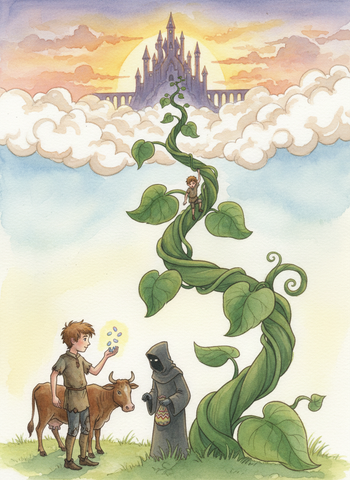
A boy trades the family cow for magic beans and climbs the giant beanstalk that grows overnight, straight into a giant's castle in the clouds.
There was once upon a time a poor widow who had an only son named Jack, and a cow named Milky-white. And all they had to live on was the milk the cow gave every morning which they carried to the market and sold. But one morning Milky-white gave no milk and they didn't know what to do.
Era uma vez uma pobre viúva que tinha um único filho chamado João, e uma vaca chamada Branca-de-Leite. E tudo o que tinham para viver era o leite que a vaca dava toda manhã, que levavam ao mercado e vendiam. Mas certa manhã Branca-de-Leite não deu leite nenhum, e eles não sabiam o que fazer.
“What shall we do, what shall we do?” said the widow, wringing her hands.
— O que vamos fazer, o que vamos fazer? — dizia a viúva, torcendo as mãos.
“Cheer up, mother, I'll go and get work somewhere,” said Jack.
— Anime-se, mãe, vou sair e arranjar trabalho em algum lugar — disse João.
“We've tried that before, and nobody would take you,” said his mother; “we must sell Milky-white and with the money do something, start shop, or something.”
— Já tentamos isso antes, e ninguém quis te aceitar — disse sua mãe. — Precisamos vender a Branca-de-Leite e fazer alguma coisa com o dinheiro, abrir uma lojinha, ou algo assim.
“All right, mother,” says Jack; “it's market-day today, and I'll soon sell Milky-white, and then we'll see what we can do.”
— Está bem, mãe — diz João. — Hoje é dia de feira, e logo vendo a Branca-de-Leite, e depois veremos o que podemos fazer.
So he took the cow's halter in his hand, and off he starts. He hadn't gone far when he met a funny-looking old man who said to him: “Good morning, Jack.”
Então ele pegou o cabresto da vaca na mão, e lá se foi. Não tinha andado muito quando encontrou um velho de aspecto engraçado, que lhe disse: — Bom dia, João.
“Good morning to you,” said Jack, and wondered how he knew his name.
— Bom dia para o senhor também — disse João, imaginando como ele sabia seu nome.
“Well, Jack, and where are you off to?” said the man.
— Então, João, e para onde você vai? — disse o homem.
“I'm going to market to sell our cow here.”
— Vou ao mercado vender nossa vaca aqui.
“Oh, you look the proper sort of chap to sell cows,” said the man; “I wonder if you know how many beans make five.”
— Ah, você parece bem o tipo de sujeito que sabe vender vacas — disse o homem. — Será que você sabe quantos feijões dão cinco?
“Two in each hand and one in your mouth,” says Jack, as sharp as a needle.
— Dois em cada mão e um na boca — diz João, esperto que só ele.
“Right you are,” said the man, “and here they are the very beans themselves,” he went on pulling out of his pocket a number of strange-looking beans. “As you are so sharp,” says he, “I don't mind doing a swop with you—your cow for these beans.”
— Você acertou — disse o homem —, e aqui estão eles, os próprios feijões — continuou, tirando do bolso uma porção de feijões de aparência estranha. — Já que você é tão esperto — diz ele —, não me importo de fazer uma troca com você… sua vaca por estes feijões.
“Walker!” says Jack; “wouldn't you like it?”
— Conta outra! — diz João. — Não gostaria mesmo?
“Ah! you don't know what these beans are,” said the man; “if you plant them over-night, by morning they grow right up to the sky.”
— Ah! Você não sabe o que são estes feijões — disse o homem. — Se você os plantar de um dia para o outro, até de manhã eles crescem direto até o céu.
“Really?” says Jack; “you don't say so.”
— Sério? — diz João. — Não me diga.
“Yes, that is so, and if it doesn't turn out to be true you can have your cow back.”
— Sim, é isso mesmo, e se não se provar verdade, você pode ficar com sua vaca de volta.
“Right,” says Jack, and hands him over Milky-white's halter and pockets the beans.
— Combinado — diz João, e entrega o cabresto da Branca-de-Leite e embolsa os feijões.
Back goes Jack home, and as he hadn't gone very far it wasn't dusk by the time he got to his door.
João volta para casa, e como não tinha andado muito longe, ainda não escurecia quando chegou à sua porta.
“What back, Jack?” said his mother; “I see you haven't got Milky-white, so you've sold her. How much did you get for her?”
— Já de volta, João? — disse sua mãe. — Vejo que você não trouxe a Branca-de-Leite, então você a vendeu. Quanto conseguiu por ela?
“You'll never guess, mother,” says Jack.
— A senhora nunca vai adivinhar, mãe — diz João.
“No, you don't say so. Good boy! Five pounds, ten, fifteen, no, it can't be twenty.”
— Não, não me diga isso. Bom garoto! Cinco libras, dez, quinze, não, não pode ser vinte.
“I told you you couldn't guess, what do you say to these beans; they're magical, plant them over-night and——”
— Já disse que a senhora não ia adivinhar, o que acha destes feijões; eles são mágicos, plante-os de um dia para o outro e…
“What!” says Jack's mother, “have you been such a fool, such a dolt, such an idiot, as to give away my Milky-white, the best milker in the parish, and prime beef to boot, for a set of paltry beans. Take that! Take that! Take that! And as for your precious beans here they go out of the window. And now off with you to bed. Not a sup shall you drink, and not a bit shall you swallow this very night.”
— O quê! — diz a mãe de João. — Você foi tão tolo, tão bobo, tão idiota, a ponto de dar embora minha Branca-de-Leite, a melhor leiteira da paróquia, e boa carne de primeira ainda por cima, por um punhado de feijões sem valor. Toma essa! Toma essa! Toma essa! E quanto aos seus preciosos feijões, lá vão eles pela janela. E agora vá logo para a cama. Nem um gole você vai beber, nem um pedaço você vai engolir esta noite.
So Jack went upstairs to his little room in the attic, and sad and sorry he was, to be sure, as much for his mother's sake, as for the loss of his supper.
Então João subiu para seu quartinho no sótão, triste e arrependido, é certo, tanto por causa de sua mãe, quanto pela perda de sua ceia.
At last he dropped off to sleep.
Por fim, acabou pegando no sono.
When he woke up, the room looked so funny. The sun was shining into part of it, and yet all the rest was quite dark and shady. So Jack jumped up and dressed himself and went to the window. And what do you think he saw? why, the beans his mother had thrown out of the window into the garden, had sprung up into a big beanstalk which went up and up and up till it reached the sky. So the man spoke truth after all.
Quando acordou, o quarto parecia tão engraçado. O sol brilhava numa parte dele, e ainda assim todo o resto estava bem escuro e sombreado. Então João pulou da cama, se vestiu e foi até a janela. E adivinha o que ele viu? Ora, os feijões que sua mãe tinha jogado pela janela no jardim tinham brotado num pé de feijão enorme, que subia e subia e subia até alcançar o céu. Então o homem tinha falado a verdade, afinal.
The beanstalk grew up quite close past Jack's window, so all he had to do was to open it and give a jump on to the beanstalk which was made like a big plaited ladder. So Jack climbed and he climbed and he climbed and he climbed and he climbed and he climbed and he climbed till at last he reached the sky. And when he got there he found a long broad road going as straight as a dart. So he walked along and he walked along and he walked along till he came to a great big tall house, and on the doorstep there was a great big tall woman.
O pé de feijão crescia bem perto da janela de João, então tudo o que ele tinha que fazer era abri-la e dar um pulo até o pé de feijão, que era feito como uma grande escada trançada. Então João subiu e subiu e subiu e subiu e subiu e subiu e subiu até finalmente alcançar o céu. E quando chegou lá, encontrou uma estrada longa e larga, reta como uma flecha. Então caminhou e caminhou e caminhou até chegar a uma casa grande e alta, e na soleira da porta havia uma mulher grande e alta.
“Good morning, mum,” says Jack, quite polite-like. “Could you be so kind as to give me some breakfast.” For he hadn't had anything to eat, you know, the night before and was as hungry as a hunter.
— Bom dia, senhora — diz João, bem educadinho. — A senhora poderia ser tão gentil a ponto de me dar um pouco de café da manhã? — Pois ele não tinha comido nada, veja bem, desde a noite anterior, e estava faminto como um caçador.
“It's breakfast you want, is it?” says the great big tall woman, “it's breakfast you'll be if you don't move off from here. My man is an ogre and there's nothing he likes better than boys broiled on toast. You'd better be moving on or he'll soon be coming.”
— Café da manhã é o que você quer, é? — diz a mulher grande e alta. — Café da manhã é o que você vai ser se não sair daqui. Meu marido é um ogro e não há nada que ele goste mais do que meninos assados na torrada. É melhor você ir andando ou ele logo vai chegar.
“Oh! please mum, do give me something to eat, mum. I've had nothing to eat since yesterday morning, really and truly, mum,” says Jack. “I may as well be broiled, as die of hunger.”
— Ah! Por favor, senhora, me dê alguma coisa para comer, senhora. Não como nada desde ontem de manhã, de verdade e sinceramente, senhora — diz João. — Prefiro ser assado a morrer de fome.
Well, the ogre's wife wasn't such a bad sort, after all. So she took Jack into the kitchen, and gave him a junk of bread and cheese and a jug of milk. But Jack hadn't half finished these when thump! thump! thump! the whole house began to tremble with the noise of someone coming.
Bem, a esposa do ogro não era de todo má, afinal. Então levou João para a cozinha, e lhe deu um pedaço de pão com queijo e uma jarra de leite. Mas João mal tinha terminado a metade disso quando pum! pum! pum! a casa inteira começou a tremer com o barulho de alguém chegando.
“Goodness gracious me! It's my old man,” said the ogre's wife, “what on earth shall I do? Here, come quick and jump in here.” And she bundled Jack into the oven just as the ogre came in.
— Minha nossa! É meu marido — disse a esposa do ogro. — O que é que eu vou fazer? Aqui, vem rápido e pula aqui dentro. — E enfiou João dentro do forno bem quando o ogro entrava.
He was a big one, to be sure. At his belt he had three calves strung up by the heels, and he unhooked them and threw them down on the table and said: “Here, wife, broil me a couple of these for breakfast. Ah what's this I smell?
Era um grandalhão, com certeza. No cinto tinha três bezerros pendurados pelos calcanhares, e os desatou e jogou sobre a mesa, dizendo: — Aqui, mulher, asse um par destes para o meu café da manhã. Ah, o que é isso que estou cheirando?
Fee-fi-fo-fum, I smell the blood of an Englishman, Be he alive, or be he dead I'll have his bones to grind my bread.”
Fim-fá-fó-fum, Sinto o sangue de um inglês, Esteja vivo, ou esteja morto, Vou moer seus ossos no meu pão desta vez.
“Nonsense, dear,” said his wife, “you're dreaming. Or perhaps you smell the scraps of that little boy you liked so much for yesterday's dinner. Here, go you and have a wash and tidy up, and by the time you come back your breakfast'll be ready for you.”
— Bobagem, querido — disse a esposa —, você está sonhando. Ou talvez esteja sentindo o cheiro das sobras daquele garotinho de quem você gostou tanto no jantar de ontem. Vá, vá se lavar e se arrumar, e quando você voltar, seu café da manhã estará pronto para você.
So the ogre went off, and Jack was just going to jump out of the oven and run off when the woman told him not. “Wait till he's asleep,” says she; “he always has a snooze after breakfast.”
Então o ogro se afastou, e João já ia pular para fora do forno e sair correndo quando a mulher lhe disse que não. — Espera até ele adormecer — diz ela —; ele sempre tira uma soneca depois do café da manhã.
Well, the ogre had his breakfast, and after that he goes to a big chest and takes out of it a couple of bags of gold and sits down counting them till at last his head began to nod and he began to snore till the whole house shook again.
Bem, o ogro tomou seu café da manhã, e depois disso foi até um grande baú e tirou dele um par de sacos de ouro e se sentou a contá-los, até que por fim sua cabeça começou a pender e ele começou a roncar de um jeito que a casa inteira tremia de novo.
Then Jack crept out on tiptoe from his oven, and as he was passing the ogre he took one of the bags of gold under his arm, and off he pelters till he came to the beanstalk, and then he threw down the bag of gold which of course fell in to his mother's garden, and then he climbed down and climbed down till at last he got home and told his mother and showed her the gold and said: “Well, mother, wasn't I right about the beans. They are really magical, you see.”
Então João saiu de fininho na ponta dos pés de dentro do forno, e ao passar pelo ogro pegou um dos sacos de ouro debaixo do braço, e saiu correndo até chegar ao pé de feijão, e então jogou o saco de ouro lá para baixo, que é claro caiu no jardim de sua mãe, e depois desceu e desceu até finalmente chegar em casa e contar para a mãe e mostrar o ouro a ela e dizer: — Então, mãe, eu não estava certo sobre os feijões? Eles são mesmo mágicos, a senhora vê.
So they lived on the bag of gold for some time, but at last they came to the end of that so Jack made up his mind to try his luck once more up at the top of the beanstalk. So one fine morning he got up early, and got on to the beanstalk, and he climbed and he climbed and he climbed and he climbed and he climbed and he climbed till at last he got on the road again and came to the great big tall house he had been to before. There, sure enough, was the great big tall woman a-standing on the door-step.
Então viveram do saco de ouro por algum tempo, mas por fim chegaram ao fim dele, então João decidiu tentar a sorte mais uma vez lá no topo do pé de feijão. Então, numa bela manhã, ele se levantou cedo, e subiu no pé de feijão, e subiu e subiu e subiu e subiu e subiu e subiu até finalmente chegar de novo à estrada e chegar àquela casa grande e alta onde tinha estado antes. Lá, com certeza, estava a mulher grande e alta parada na soleira da porta.
“Good morning, mum,” says Jack, as bold as brass, “could you be so good as to give me something to eat?”
— Bom dia, senhora — diz João, atrevido como só ele. — A senhora poderia ser tão gentil a ponto de me dar alguma coisa para comer?
“Go away, my boy,” said the big, tall woman, “or else my man will eat you up for breakfast. But aren't you the youngster who came here once before? Do you know, that very day, my man missed one of his bags of gold.”
— Vá embora, meu rapaz — disse a mulher grande e alta —, ou meu marido vai te comer no café da manhã. Mas você não é aquele rapazinho que veio aqui uma vez antes? Sabe que, naquele mesmo dia, meu marido sentiu falta de um de seus sacos de ouro?
“That's strange, mum,” says Jack, “I dare say I could tell you something about that but I'm so hungry I can't speak till I've had something to eat.”
— Que estranho, senhora — diz João —, ouso dizer que eu poderia lhe contar alguma coisa sobre isso, mas estou tão faminto que não consigo falar antes de comer alguma coisa.
Well the big tall woman was that curious that she took him in and gave him something to eat. But he had scarcely begun munching it as slowly as he could when thump! thump! thump! they heard the giant's footstep, and his wife hid Jack away in the oven.
Bem, a mulher grande e alta ficou tão curiosa que o levou para dentro e lhe deu algo para comer. Mas ele mal tinha começado a mastigar bem devagarinho quando pum! pum! pum! ouviram os passos do gigante, e sua esposa escondeu João dentro do forno.
All happened as it did before. In came the ogre as he did before, said: “Fee-fi-fo-fum,” and had his breakfast off three broiled oxen. Then he said: “Wife, bring me the hen that lays the golden eggs.” So she brought it, and the ogre said: “Lay,” and it laid an egg all of gold. And then the ogre began to nod his head, and to snore till the house shook.
Tudo aconteceu como da vez anterior. O ogro entrou como antes, disse: “Fim-fá-fó-fum”, e tomou seu café da manhã com três bois assados. Então disse: — Mulher, traga-me a galinha que põe ovos de ouro. — Então ela a trouxe, e o ogro disse: — Põe — e ela pôs um ovo todo de ouro. E então o ogro começou a pender a cabeça, e a roncar de um jeito que a casa tremia.
Then Jack crept out of the oven on tiptoe and caught hold of the golden hen, and was off before you could say “Jack Robinson.” But this time the hen gave a cackle which woke the ogre, and just as Jack got out of the house he heard him calling: “Wife, wife, what have you done with my golden hen?”
Então João saiu de fininho do forno na ponta dos pés e agarrou a galinha de ouro, e sumiu antes que se pudesse dizer “Zé Ninguém”. Mas desta vez a galinha soltou um cacarejo que acordou o ogro, e justo quando João estava saindo da casa ele ouviu o ogro gritando: — Mulher, mulher, o que você fez com minha galinha de ouro?
And the wife said: “Why, my dear?”
E a esposa disse: — Por quê, meu querido?
But that was all Jack heard, for he rushed off to the beanstalk and climbed down like a house on fire. And when he got home he showed his mother the wonderful hen and said “Lay,” to it; and it laid a golden egg every time he said “Lay.”
Mas isso foi tudo o que João ouviu, pois correu para o pé de feijão e desceu como um raio. E quando chegou em casa, mostrou à mãe a galinha maravilhosa e disse “Põe” para ela; e ela pôs um ovo de ouro toda vez que ele dizia “Põe”.
Well, Jack was not content, and it wasn't very long before he determined to have another try at his luck up there at the top of the beanstalk. So one fine morning, he got up early, and went on to the beanstalk, and he climbed and he climbed and he climbed and he climbed till he got to the top.
Bem, João não estava satisfeito, e não demorou muito para que decidisse tentar a sorte mais uma vez lá em cima, no topo do pé de feijão. Então, numa bela manhã, ele se levantou cedo, e subiu no pé de feijão, e subiu e subiu e subiu e subiu até chegar ao topo.
But this time he knew better than to go straight to the ogre's house. And when he got near it he waited behind a bush till he saw the ogre's wife come out with a pail to get some water, and then he crept into the house and got into the copper. He hadn't been there long when he heard thump! thump! thump! as before, and in come the ogre and his wife.
Mas desta vez ele sabia melhor do que ir direto para a casa do ogro. E quando chegou perto dela, esperou atrás de um arbusto até ver a esposa do ogro sair com um balde para buscar água, e então entrou de fininho na casa e se meteu dentro do caldeirão de cobre. Não fazia muito tempo que estava ali quando ouviu pum! pum! pum! como antes, e entraram o ogro e sua esposa.
“Fee-fi-fo-fum, I smell the blood of an Englishman,” cried out the ogre; “I smell him, wife, I smell him.”
— Fim-fá-fó-fum, sinto o sangue de um inglês — gritou o ogro. — Sinto o cheiro dele, mulher, sinto o cheiro dele.
“Do you, my dearie?” says the ogre's wife. “Then if it's that little rogue that stole your gold and the hen that laid the golden eggs he's sure to have got into the oven.” And they both rushed to the oven. But Jack wasn't there, luckily, and the ogre's wife said: “There you are again with your fee-fi-fo-fum. Why of course it's the laddie you caught last night that I've broiled for your breakfast. How forgetful I am, and how careless you are not to tell the difference between a live un and a dead un.”
— Sente, meu querido? — diz a esposa do ogro. — Então, se for aquele patifezinho que roubou seu ouro e a galinha que põe ovos de ouro, com certeza ele deve ter se metido no forno. — E os dois correram para o forno. Mas João não estava lá, por sorte, e a esposa do ogro disse: — Lá vai você de novo com seu fim-fá-fó-fum. Ora, é claro que é o rapazinho que você pegou ontem à noite, que eu assei para o seu café da manhã. Como sou esquecida, e como você é descuidado por não saber diferenciar um vivo de um morto.
So the ogre sat down to the breakfast and ate it, but every now and then he would mutter: “Well, I could have sworn——” and he'd get up and search the larder and the cupboards, and everything, only luckily he didn't think of the copper.
Então o ogro se sentou para o café da manhã e o comeu, mas de vez em quando resmungava: — Bem, eu poderia jurar… — e se levantava e revistava a despensa e os armários, e tudo, só que por sorte não pensou no caldeirão de cobre.
After breakfast was over, the ogre called out: “Wife, wife, bring me my golden harp.” So she brought it and put it on the table before him. Then he said: “Sing!” and the golden harp sang most beautifully. And it went on singing till the ogre fell asleep, and commenced to snore like thunder.
Depois que o café da manhã terminou, o ogro gritou: — Mulher, mulher, traga-me minha harpa de ouro. — Então ela a trouxe e a colocou na mesa diante dele. Então ele disse: — Canta! — e a harpa de ouro cantou lindamente. E continuou cantando até o ogro adormecer, e começar a roncar como um trovão.
Then Jack lifted up the copper-lid very quietly and got down like a mouse and crept on hands and knees till he got to the table when he got up and caught hold of the golden harp and dashed with it towards the door. But the harp called out quite loud: “Master! Master!” and the ogre woke up just in time to see Jack running off with his harp.
Então João ergueu bem devagarinho a tampa do caldeirão e desceu como um camundongo e rastejou de mãos e joelhos até chegar à mesa, quando se levantou e agarrou a harpa de ouro e disparou com ela em direção à porta. Mas a harpa gritou bem alto: — Mestre! Mestre! — e o ogro acordou bem a tempo de ver João fugindo com sua harpa.
Jack ran as fast as he could, and the ogre came rushing after, and would soon have caught him only Jack had a start and dodged him a bit and knew where he was going. When he got to the beanstalk the ogre was not more than twenty yards away when suddenly he saw Jack disappear like, and when he got up to the end of the road he saw Jack underneath climbing down for dear life. Well, the ogre didn't like trusting himself to such a ladder, and he stood and waited, so Jack got another start.
João correu o mais rápido que pôde, e o ogro veio correndo atrás, e logo o teria alcançado, só que João tinha uma vantagem e o esquivou um pouco e sabia para onde estava indo. Quando chegou ao pé de feijão, o ogro não estava a mais de vinte metros de distância, quando de repente o viu desaparecer, e quando chegou ao fim da estrada, viu João logo abaixo, descendo desesperadamente. Bem, o ogro não gostava de confiar seu peso a uma escada daquelas, e ficou ali parado esperando, então João ganhou mais uma vantagem.
But just then the harp cried out: “Master! master!” and the ogre swung himself down on to the beanstalk which shook with his weight. Down climbs Jack, and after him climbed the ogre. By this time Jack had climbed down and climbed down and climbed down till he was very nearly home. So he called out: “Mother! mother! bring me an axe, bring me an axe.” And his mother came rushing out with the axe in her hand, but when she came to the beanstalk she stood stock still with fright for there she saw the ogre just coming down below the clouds.
Mas então a harpa gritou: — Mestre! Mestre! — e o ogro se lançou pelo pé de feijão abaixo, que tremia com seu peso. João desce, e atrás dele desce o ogro. A essa altura, João já tinha descido e descido e descido até estar bem perto de casa. Então gritou: — Mãe! Mãe! Traga-me um machado, traga-me um machado! — E sua mãe saiu correndo com o machado na mão, mas quando chegou ao pé de feijão, ficou parada, imóvel de susto, pois viu o ogro descendo por baixo das nuvens.
But Jack jumped down and got hold of the axe and gave a chop at the beanstalk which cut it half in two. The ogre felt the beanstalk shake and quiver so he stopped to see what was the matter. Then Jack gave another chop with the axe, and the beanstalk was cut in two and began to topple over. Then the ogre fell down and broke his crown, and the beanstalk came toppling after.
Mas João pulou para baixo e agarrou o machado e deu uma machadada no pé de feijão, cortando-o quase pela metade. O ogro sentiu o pé de feijão tremer e balançar, então parou para ver o que estava acontecendo. Então João deu outra machadada, e o pé de feijão foi cortado em dois e começou a desabar. Então o ogro caiu e quebrou a cabeça, e o pé de feijão veio desabando atrás dele.
Then Jack showed his mother his golden harp, and what with showing that and selling the golden eggs, Jack and his mother became very rich, and he married a great princess, and they lived happy ever after.
Então João mostrou à sua mãe sua harpa de ouro, e, com isso e com a venda dos ovos de ouro, João e sua mãe ficaram muito ricos, e ele se casou com uma grande princesa, e viveram felizes para sempre.
