The Ogre of Rashomon
A free B1-level English story for language learners, readable online in 7 languages, with an option to listen via the free Storyteller app.
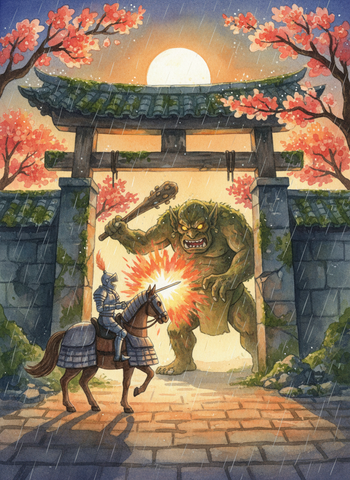
A knight rides out alone at night to prove that the ogre said to haunt Kyoto's Rashomon Gate is just a rumor — and discovers, in a fierce clash, that it is anything but.
Long, long ago in Kyoto, the people of the city were terrified by accounts of a dreadful ogre, who, it was said, haunted the Gate of Rashomon at twilight and seized whoever passed by. The missing victims were never seen again, so it was whispered that the ogre was a horrible cannibal, who not only killed the unhappy victims but ate them also. Now everybody in the town and neighborhood was in great fear, and no one durst venture out after sunset near the Gate of Rashomon.
Dahulu kala di Kyoto, penduduk kota diliputi ketakutan oleh kabar tentang seekor ogre mengerikan yang, konon, menghantui Gerbang Rashomon saat senja dan menerkam siapa saja yang lewat. Para korban yang hilang tak pernah terlihat lagi, sehingga tersiar bisik-bisik bahwa ogre itu adalah kanibal yang mengerikan, yang bukan hanya membunuh korban-korban malang itu tetapi juga memakan mereka. Kini seluruh penduduk kota dan sekitarnya diliputi ketakutan besar, dan tak seorang pun berani keluar setelah matahari terbenam di dekat Gerbang Rashomon.
Now at this time there lived in Kyoto a general named Raiko, who had made himself famous for his brave deeds. Some time before this he made the country ring with his name, for he had attacked Oeyama, where a band of ogres lived with their chief, who instead of wine drank the blood of human beings. He had routed them all and cut off the head of the chief monster.
Pada masa itu, di Kyoto tinggallah seorang jenderal bernama Raiko, yang terkenal karena keberaniannya. Beberapa waktu sebelumnya ia membuat seluruh negeri menggemakan namanya, sebab ia telah menyerang Oeyama, tempat sekelompok ogre tinggal bersama pemimpin mereka, yang alih-alih minum anggur, meminum darah manusia. Ia telah mengalahkan mereka semua dan memenggal kepala sang monster pemimpin.
This brave warrior was always followed by a band of faithful knights. In this band there were five knights of great valor. One evening as the five knights sat at a feast quaffing SAKE in their rice bowls and eating all kinds of fish, raw, and stewed, and broiled, and toasting each other’s healths and exploits, the first knight, Hojo, said to the others:
Pendekar pemberani ini selalu diiringi oleh sepasukan ksatria setia. Dalam pasukan itu ada lima ksatria yang sangat gagah berani. Suatu malam, ketika kelima ksatria itu duduk berpesta, menenggak sake dari mangkuk nasi mereka dan menyantap berbagai jenis ikan, mentah, direbus, dan dibakar, sambil bersulang untuk kesehatan dan keberanian satu sama lain, ksatria pertama, Hojo, berkata kepada yang lain:
“Have you all heard the rumor that every evening after sunset there comes an ogre to the Gate of Rashomon, and that he seizes all who pass by?”
"Sudahkah kalian semua mendengar desas-desus bahwa setiap malam setelah matahari terbenam, seekor ogre datang ke Gerbang Rashomon, dan bahwa ia menerkam semua yang lewat?"
The second knight, Watanabe, answered him, saying:
Ksatria kedua, Watanabe, menjawabnya, katanya:
“Do not talk such nonsense! All the ogres were killed by our chief Raiko at Oeyama! It cannot be true, because even if any ogres did escape from that great killing they would not dare to show themselves in this city, for they know that our brave master would at once attack them if he knew that any of them were still alive!”
"Jangan bicara omong kosong seperti itu! Semua ogre telah dibunuh oleh pemimpin kita Raiko di Oeyama! Itu tidak mungkin benar, sebab bahkan jika ada ogre yang lolos dari pembantaian besar itu, mereka tak akan berani menampakkan diri di kota ini, sebab mereka tahu bahwa tuan kita yang berani akan segera menyerang mereka jika ia tahu ada yang masih hidup!"
“Then do you disbelieve what I say, and think that I am telling you a falsehood?”
"Jadi kau tidak percaya apa yang kukatakan, dan mengira aku berbohong kepadamu?"
“No, I do not think that you are telling a lie,” said Watanabe; “but you have heard some old woman’s story which is not worth believing.”
"Tidak, aku tidak berpikir kau berbohong," kata Watanabe; "tetapi kau pasti sudah mendengar cerita nenek-nenek tua yang tak layak dipercaya."
“Then the best plan is to prove what I say, by going there yourself and finding out yourself whether it is true or not,” said Hojo.
"Kalau begitu, cara terbaik untuk membuktikan apa yang kukatakan adalah dengan kau pergi ke sana sendiri dan mencari tahu sendiri apakah itu benar atau tidak," kata Hojo.
Watanabe, the second knight, could not bear the thought that his companion should believe he was afraid, so he answered quickly:
Watanabe, ksatria kedua itu, tak tahan dengan pikiran bahwa temannya mengira ia takut, maka ia menjawab cepat:
“Of course, I will go at once and find out for myself!”
"Tentu saja, aku akan pergi sekarang juga dan mencari tahu sendiri!"
So Watanabe at once got ready to go—he buckled on his long sword and put on a coat of armor, and tied on his large helmet. When he was ready to start he said to the others:
Maka Watanabe segera bersiap untuk berangkat—ia mengenakan pedang panjangnya dan memakai baju zirah, serta mengikatkan helm besarnya. Ketika siap berangkat ia berkata kepada yang lain:
“Give me something so that I can prove I have been there!”
"Berikan aku sesuatu supaya aku bisa membuktikan aku sudah ke sana!"
Then one of the men got a roll of writing paper and his box of Indian ink and brushes, and the four comrades wrote their names on a piece of paper.
Maka salah seorang dari mereka mengambil gulungan kertas tulis dan kotak tinta India serta kuasnya, dan keempat kawannya menuliskan nama mereka di secarik kertas.
“I will take this,” said Watanabe, “and put it on the Gate of Rashomon, so to-morrow morning will you all go and look at it? I may be able to catch an ogre or two by then!” and he mounted his horse and rode off gallantly.
"Akan kubawa ini," kata Watanabe, "dan kutempelkan di Gerbang Rashomon, jadi besok pagi apakah kalian semua akan pergi melihatnya? Mungkin aku bisa menangkap satu atau dua ogre pada saat itu!" dan ia menaiki kudanya lalu melaju dengan gagah.
It was a very dark night, and there was neither moon nor star to light Watanabe on his way. To make the darkness worse a storm came on, the rain fell heavily and the wind howled like wolves in the mountains.
Malam itu sangat gelap, tak ada bulan maupun bintang yang menerangi jalan Watanabe. Untuk memperburuk kegelapan itu, badai datang, hujan turun deras dan angin melolong seperti serigala di pegunungan.
Any ordinary man would have trembled at the thought of going out of doors, but Watanabe was a brave warrior and dauntless, and his honor and word were at stake, so he sped on into the night, while his companions listened to the sound of his horse’s hoofs dying away in the distance, then shut the sliding shutters close and gathered round the charcoal fire and wondered what would happen—and whether their comrade would encounter one of those horrible Oni.
Orang biasa mana pun tentu akan gemetar memikirkan keluar rumah, tetapi Watanabe adalah pendekar pemberani dan pantang mundur, dan kehormatan serta janjinya dipertaruhkan, maka ia melaju ke dalam malam, sementara kawan-kawannya mendengarkan derap kuda yang kian menghilang di kejauhan, lalu menutup rapat pintu geser dan berkumpul di sekitar api arang, bertanya-tanya apa yang akan terjadi—dan apakah kawan mereka akan berjumpa salah satu dari Oni yang mengerikan itu.
At last Watanabe reached the Gate of Rashomon, but peer as he might through the darkness he could see no sign of an ogre.
Akhirnya Watanabe tiba di Gerbang Rashomon, tetapi sekeras apa pun ia menatap ke dalam kegelapan, ia tak melihat tanda-tanda seekor ogre.
“It is just as I thought,” said Watanabe to himself; “there are certainly no ogres here; it is only an old woman’s story. I will stick this paper on the gate so that the others can see I have been here when they come to-morrow, and then I will take my way home and laugh at them all.”
"Persis seperti dugaanku," kata Watanabe pada dirinya sendiri; "memang tak ada ogre di sini; itu hanya cerita nenek-nenek tua. Akan kutempelkan kertas ini di gerbang supaya yang lain bisa melihat aku sudah ke sini ketika mereka datang besok, lalu aku akan pulang dan menertawakan mereka semua."
He fastened the piece of paper, signed by all his four companions, on the gate, and then turned his horse’s head towards home.
Ia menempelkan secarik kertas yang ditandatangani keempat kawannya itu pada gerbang, lalu memutar kepala kudanya ke arah pulang.
As he did so he became aware that some one was behind him, and at the same time a voice called out to him to wait. Then his helmet was seized from the back. “Who are you?” said Watanabe fearlessly. He then put out his hand and groped around to find out who or what it was that held him by the helmet. As he did so he touched something that felt like an arm—it was covered with hair and as big round as the trunk of a tree!
Saat ia melakukan itu, ia menyadari ada seseorang di belakangnya, dan pada saat yang sama sebuah suara memanggilnya untuk menunggu. Lalu helmnya dicengkeram dari belakang. "Siapa kau?" kata Watanabe tanpa gentar. Ia lalu mengulurkan tangannya dan meraba-raba untuk mengetahui siapa atau apa yang mencengkeram helmnya. Saat ia melakukan itu, ia menyentuh sesuatu yang terasa seperti lengan—berbulu dan besar bundarnya seperti batang pohon!
Watanabe knew at once that this was the arm of an ogre, so he drew his sword and cut at it fiercely.
Watanabe segera tahu bahwa itu adalah lengan seekor ogre, maka ia menghunus pedangnya dan menebasnya dengan garang.
There was a loud yell of pain, and then the ogre dashed in front of the warrior.
Terdengar jeritan kesakitan yang keras, lalu ogre itu melompat ke hadapan pendekar itu.
Watanabe’s eyes grew large with wonder, for he saw that the ogre was taller than the great gate, his eyes were flashing like mirrors in the sunlight, and his huge mouth was wide open, and as the monster breathed, flames of fire shot out of his mouth.
Mata Watanabe membelalak lebar penuh keheranan, sebab ia melihat ogre itu lebih tinggi dari gerbang besar itu, matanya berkilau seperti cermin di bawah sinar matahari, dan mulutnya yang besar terbuka lebar, dan ketika monster itu bernapas, kobaran api menyembur dari mulutnya.
The ogre thought to terrify his foe, but Watanabe never flinched. He attacked the ogre with all his strength, and thus they fought face to face for a long time. At last the ogre, finding that he could neither frighten nor beat Watanabe and that he might himself be beaten, took to flight. But Watanabe, determined not to let the monster escape, put spurs to his horse and gave chase.
Ogre itu bermaksud menakut-nakuti lawannya, tetapi Watanabe tak sedikit pun gentar. Ia menyerang ogre itu dengan sekuat tenaga, dan mereka pun bertarung berhadap-hadapan untuk waktu yang lama. Akhirnya ogre itu, mendapati bahwa ia tak bisa menakuti maupun mengalahkan Watanabe dan bahwa ia sendiri mungkin akan kalah, melarikan diri. Namun Watanabe, bertekad tak membiarkan monster itu lolos, memacu kudanya dan mengejar.
But though the knight rode very fast the ogre ran faster, and to his disappointment he found himself unable to overtake the monster, who was gradually lost to sight.
Namun meski sang ksatria memacu kudanya sangat cepat, ogre itu berlari lebih cepat, dan dengan kecewa ia mendapati dirinya tak mampu menyusul monster itu, yang perlahan hilang dari pandangan.
Watanabe returned to the gate where the fierce fight had taken place, and got down from his horse. As he did so he stumbled upon something lying on the ground.
Watanabe kembali ke gerbang tempat pertarungan sengit itu terjadi, dan turun dari kudanya. Saat itu ia tersandung sesuatu yang tergeletak di tanah.
Stooping to pick it up he found that it was one of the ogre’s huge arms which he must have slashed off in the fight. His joy was great at having secured such a prize, for this was the best of all proofs of his adventure with the ogre. So he took it up carefully and carried it home as a trophy of his victory.
Membungkuk untuk memungutnya, ia mendapati itu adalah salah satu lengan besar ogre itu yang pastilah tertebas dalam pertarungan tadi. Kegembiraannya sangat besar karena telah memperoleh harta seperti itu, sebab inilah bukti terbaik dari petualangannya dengan ogre itu. Maka ia mengambilnya dengan hati-hati dan membawanya pulang sebagai trofi kemenangannya.
When he got back, he showed the arm to his comrades, who one and all called him the hero of their band and gave him a great feast. His wonderful deed was soon noised abroad in Kyoto, and people from far and near came to see the ogre’s arm.
Setibanya di rumah, ia menunjukkan lengan itu kepada kawan-kawannya, yang semuanya menyebutnya pahlawan pasukan mereka dan mengadakan pesta besar untuknya. Perbuatannya yang luar biasa itu segera tersiar di Kyoto, dan orang-orang dari jauh dan dekat datang untuk melihat lengan ogre itu.
Watanabe now began to grow uneasy as to how he should keep the arm in safety, for he knew that the ogre to whom it belonged was still alive. He felt sure that one day or other, as soon as the ogre got over his scare, he would come to try to get his arm back again. Watanabe therefore had a box made of the strongest wood and banded with iron. In this he placed the arm, and then he sealed down the heavy lid, refusing to open it for anyone. He kept the box in his own room and took charge of it himself, never allowing it out of his sight.
Watanabe kini mulai merasa gelisah tentang bagaimana ia harus menyimpan lengan itu dengan aman, sebab ia tahu bahwa ogre pemilik lengan itu masih hidup. Ia yakin benar bahwa suatu hari nanti, begitu ogre itu pulih dari ketakutannya, ia akan datang berusaha mengambil kembali lengannya. Karena itu Watanabe membuat sebuah peti dari kayu terkuat dan dililit besi. Di dalamnya ia menyimpan lengan itu, lalu ia menyegel tutupnya yang berat, menolak membukanya untuk siapa pun. Ia menyimpan peti itu di kamarnya sendiri dan menjaganya sendiri, tak pernah membiarkannya lepas dari pandangannya.
Now one night he heard some one knocking at the porch, asking for admittance.
Suatu malam ia mendengar seseorang mengetuk beranda, meminta izin masuk.
When the servant went to the door to see who it was, there was only an old woman, very respectable in appearance. On being asked who she was and what was her business, the old woman replied with a smile that she had been nurse to the master of the house when he was a little baby. If the lord of the house were at home she begged to be allowed to see him.
Ketika pelayan pergi ke pintu untuk melihat siapa itu, ternyata hanya seorang nenek tua, yang tampak sangat terhormat. Ketika ditanya siapa dia dan apa urusannya, nenek tua itu menjawab dengan senyum bahwa ia dahulu adalah pengasuh tuan rumah ini ketika ia masih bayi kecil. Jika tuan rumah ada di rumah, ia memohon diizinkan untuk menemuinya.
The servant left the old woman at the door and went to tell his master that his old nurse had come to see him. Watanabe thought it strange that she should come at that time of night, but at the thought of his old nurse, who had been like a foster-mother to him and whom he had not seen for a long time, a very tender feeling sprang up for her in his heart. He ordered the servant to show her in.
Pelayan itu meninggalkan nenek tua itu di pintu dan pergi memberi tahu tuannya bahwa pengasuh lamanya datang menemuinya. Watanabe merasa aneh bahwa ia datang pada jam malam seperti itu, tetapi mengingat pengasuh lamanya, yang telah menjadi seperti ibu asuh baginya dan yang sudah lama tak ia jumpai, muncullah perasaan lembut baginya di dalam hatinya. Ia memerintahkan pelayan untuk mempersilakannya masuk.
The old woman was ushered into the room, and after the customary bows and greetings were over, she said:
Nenek tua itu dipersilakan masuk ke kamar itu, dan setelah upacara membungkuk dan salam yang biasa selesai, ia berkata:
“Master, the report of your brave fight with the ogre at the Gate of Rashomon is so widely known that even your poor old nurse has heard of it. Is it really true, what every one says, that you cut off one of the ogre’s arms? If you did, your deed is highly to be praised!”
"Tuan, kabar tentang pertarungan beranimu melawan ogre di Gerbang Rashomon begitu luas tersiar sehingga bahkan pengasuh tuamu yang malang ini pun sudah mendengarnya. Benarkah, seperti yang dikatakan semua orang, bahwa engkau telah memenggal salah satu lengan ogre itu? Jika benar, perbuatanmu sungguh patut dipuji!"
“I was very disappointed,” said Watanabe, “that I was not able take the monster captive, which was what I wished to do, instead of only cutting off an arm!”
"Aku sangat kecewa," kata Watanabe, "sebab aku tak berhasil menangkap monster itu hidup-hidup, yang sesungguhnya kuinginkan, bukan hanya memotong lengannya!"
“I am very proud to think,” answered the old woman, “that my master was so brave as to dare to cut off an ogre’s arm. There is nothing that can be compared to your courage. Before I die it is the great wish of my life to see this arm,” she added pleadingly.
"Aku sangat bangga membayangkan," jawab nenek tua itu, "bahwa tuanku begitu berani hingga berani memotong lengan seekor ogre. Tak ada yang bisa dibandingkan dengan keberanianmu. Sebelum aku mati, keinginan besar dalam hidupku adalah melihat lengan ini," tambahnya memohon.
“No,” said Watanabe, “I am sorry, but I cannot grant your request.”
"Tidak," kata Watanabe, "maaf, tetapi aku tak bisa mengabulkan permintaanmu."
“But why?” asked the old woman.
"Tetapi mengapa?" tanya nenek tua itu.
“Because,” replied Watanabe, “ogres are very revengeful creatures, and if I open the box there is no telling but that the ogre may suddenly appear and carry off his arm. I have had a box made on purpose with a very strong lid, and in this box I keep the ogre’s arm secure; and I never show it to any one, whatever happens.”
"Sebab," jawab Watanabe, "ogre adalah makhluk yang sangat pendendam, dan jika aku membuka peti itu, tak ada yang tahu apakah ogre itu bisa tiba-tiba muncul dan membawa lari lengannya. Aku sengaja membuat sebuah peti dengan tutup yang sangat kuat, dan di dalam peti ini kusimpan lengan ogre itu dengan aman; dan aku tak pernah menunjukkannya kepada siapa pun, apa pun yang terjadi."
“Your precaution is very reasonable,” said the old woman. “But I am your old nurse, so surely you will not refuse to show ME the arm. I have only just heard of your brave act, and not being able to wait till the morning I came at once to ask you to show it to me.”
"Kehati-hatianmu sangat masuk akal," kata nenek tua itu. "Tetapi aku pengasuh lamamu, jadi tentu kau tak akan menolak menunjukkan lengan itu kepadaKU. Aku baru saja mendengar tentang perbuatan beranimu, dan karena tak sanggup menunggu sampai pagi, aku datang saat ini juga untuk memintamu menunjukkannya kepadaku."
Watanabe was very troubled at the old woman’s pleading, but he still persisted in refusing. Then the old woman said:
Watanabe sangat terganggu oleh permohonan nenek tua itu, tetapi ia masih bersikeras menolak. Lalu nenek tua itu berkata:
“Do you suspect me of being a spy sent by the ogre?”
"Apakah kau mencurigaiku sebagai mata-mata yang dikirim oleh ogre itu?"
“No, of course I do not suspect you of being the ogre’s spy, for you are my old nurse,” answered Watanabe.
"Tidak, tentu saja aku tidak mencurigaimu sebagai mata-mata ogre itu, sebab engkau pengasuh lamaku," jawab Watanabe.
“Then you cannot surely refuse to show me the arm any longer.” entreated the old woman; “for it is the great wish of my heart to see for once in my life the arm of an ogre!”
"Kalau begitu, kau pasti tak bisa lagi menolak menunjukkan lengan itu kepadaku," pinta nenek tua itu dengan sangat; "sebab keinginan besar hatiku adalah melihat, sekali saja dalam hidupku, lengan seekor ogre!"
Watanabe could not hold out in his refusal any longer, so he gave in at last, saying:
Watanabe tak bisa lagi bertahan pada penolakannya, maka akhirnya ia menyerah, katanya:
“Then I will show you the ogre’s arm, since you so earnestly wish to see it. Come, follow me!” and he led the way to his own room, the old woman following.
"Kalau begitu, akan kutunjukkan lengan ogre itu kepadamu, karena kau begitu ingin melihatnya. Mari, ikuti aku!" dan ia berjalan menuju kamarnya sendiri, dengan nenek tua itu mengikuti.
When they were both in the room Watanabe shut the door carefully, and then going towards a big box which stood in a corner of the room, he took off the heavy lid. He then called to the old woman to come near and look in, for he never took the arm out of the box.
Ketika mereka berdua sudah berada di dalam kamar, Watanabe menutup pintu dengan hati-hati, lalu berjalan ke arah sebuah peti besar yang berdiri di sudut kamar, ia membuka tutupnya yang berat. Ia lalu memanggil nenek tua itu untuk mendekat dan melihat ke dalam, sebab ia tak pernah mengeluarkan lengan itu dari petinya.
“What is it like? Let me have a good look at it,” said the old nurse, with a joyful face.
"Seperti apa bentuknya? Biar aku melihatnya baik-baik," kata nenek pengasuh itu, dengan wajah gembira.
She came nearer and nearer, as if she were afraid, till she stood right against the box. Suddenly she plunged her hand into the box and seized the arm, crying with a fearful voice which made the room shake:
Ia mendekat, semakin dekat, seolah ketakutan, hingga berdiri tepat di depan peti itu. Tiba-tiba ia mencelupkan tangannya ke dalam peti dan mencengkeram lengan itu, sambil berteriak dengan suara mengerikan yang mengguncang seisi kamar:
“Oh, joy! I have got my arm back again!”
"Oh, girang! Lenganku kembali padaku!"
And from an old woman she was suddenly transformed into the towering figure of the frightful ogre!
Dan dari seorang nenek tua, ia tiba-tiba berubah menjadi sosok ogre menjulang yang menakutkan!
Watanabe sprang back and was unable to move for a moment, so great was his astonishment; but recognizing the ogre who had attacked him at the Gate of Rashomon, he determined with his usual courage to put an end to him this time. He seized his sword, drew it out of its sheath in a flash, and tried to cut the ogre down.
Watanabe melompat mundur dan tak bisa bergerak sesaat, begitu besar keterkejutannya; tetapi mengenali ogre yang telah menyerangnya di Gerbang Rashomon, ia bertekad dengan keberanian biasanya untuk mengakhirinya kali ini. Ia menghunus pedangnya, mencabutnya dari sarungnya secepat kilat, dan berusaha menebas ogre itu.
So quick was Watanabe that the creature had a narrow escape. But the ogre sprang up to the ceiling, and bursting through the roof, disappeared in the mist and clouds.
Watanabe begitu cepat sehingga makhluk itu nyaris tak lolos. Tetapi ogre itu melompat ke langit-langit, dan menjebol atap, lalu menghilang di kabut dan awan.
In this way the ogre escaped with his arm. The knight gnashed his teeth with disappointment, but that was all he could do. He waited in patience for another opportunity to dispatch the ogre. But the latter was afraid of Watanabe’s great strength and daring, and never troubled Kyoto again. So once more the people of the city were able to go out without fear even at night time, and the brave deeds of Watanabe have never been forgotten!
Dengan cara itu ogre itu lolos bersama lengannya. Sang ksatria menggeretakkan giginya karena kecewa, tetapi hanya itu yang bisa ia lakukan. Ia menunggu dengan sabar kesempatan lain untuk menghabisi ogre itu. Tetapi ogre itu takut akan kekuatan dan keberanian besar Watanabe, dan tak pernah lagi mengganggu Kyoto. Maka sekali lagi penduduk kota bisa keluar tanpa rasa takut bahkan pada malam hari, dan perbuatan berani Watanabe tak pernah dilupakan!
