The Town Musicians (Bremen Town Musicians)
A free A2-level English story for language learners, readable online in 7 languages, with an option to listen via the free Storyteller app.
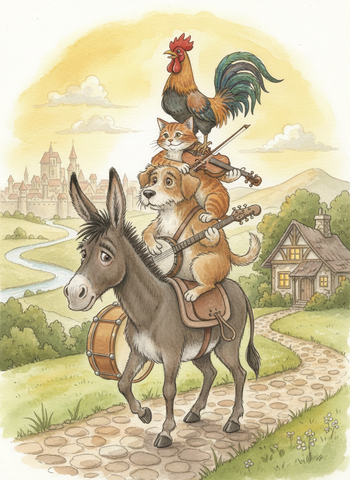
Four aging animals, cast off by their owners, set out together to become musicians in the big city — but a house full of robbers changes their plans.
A donkey had grown so old and feeble that he was of no more use to his master.
Un burro se había vuelto tan viejo y débil que ya no le servía de nada a su amo.
One night he heard his master and mistress talking together. “I wonder you still keep that donkey,” said the woman; “he is of no use to you, and you only waste your money buying food for him.”
Una noche oyó a su amo y a su ama conversando juntos. «Me pregunto por qué sigues teniendo a ese burro», dijo la mujer; «ya no te sirve de nada, y solo gastas tu dinero comprándole comida.»
“That is true,” answered the man. “I would do well to get rid of him. I might sell his hide to the tanner.”
«Es cierto», respondió el hombre. «Haría bien en deshacerme de él. Podría vender su piel al curtidor.»
When the donkey heard this he knew it was time for him to be going, if he wished to keep his skin for his own use. He pushed the stable-door open with his nose, and made off down the road without saying good-by to anyone. “I may be too weak to work,” said he, “but my voice is still strong. I will go to the big city and become a musician.”
Cuando el burro oyó esto, supo que era hora de marcharse, si quería conservar su piel para su propio uso. Empujó la puerta del establo con el hocico, y se alejó por el camino sin despedirse de nadie. «Puede que sea demasiado débil para trabajar», se dijo, «pero mi voz sigue siendo fuerte. Iré a la gran ciudad y me haré músico.»
He had not gone far when he saw an old hound lying beside the road and whining. “Well, old Bellmouth,” said the donkey, “what ails you? You seem to be in trouble.”
No había ido muy lejos cuando vio a un viejo sabueso tendido junto al camino, gimiendo. «Vaya, viejo Boquiplata», dijo el burro, «¿qué te pasa? Pareces tener algún problema.»
“Trouble indeed,” answered the hound. “I have grown so old and stiff that I am no longer able to run with the pack, so my master had no more use for me. He drove me away and threw stones after me. What is to become of me now I do not know. If my master would not keep me I am sure no one else will.”
«Problema, sin duda», respondió el sabueso. «Me he vuelto tan viejo y entumecido que ya no puedo correr con la jauría, así que mi amo ya no me necesitaba. Me echó y me arrojó piedras. Qué será de mí ahora, no lo sé. Si mi propio amo no quiso quedarse conmigo, estoy seguro de que nadie más lo hará.»
“Do not trouble yourself over that,” said the donkey. “I am going to the city to be a musician, and if you like you shall come along and sing with me. I know you have a fine voice, and we two together may make our fortunes.”
«No te preocupes por eso», dijo el burro. «Voy a la ciudad para ser músico, y si quieres puedes venir conmigo y cantar a mi lado. Sé que tienes una hermosa voz, y entre los dos podríamos hacer fortuna.»
The hound was pleased with this idea. He got to his feet, and he and the donkey went on together in company.
Al sabueso le agradó la idea. Se puso en pie, y él y el burro siguieron juntos el camino en compañía.
A little while after they came to where a cat sat in the grass by the roadside, looking as sad and doleful as a rainy day in fall.
Poco después llegaron a donde una gata estaba sentada en la hierba junto al camino, con un aspecto tan triste y lúgubre como un día lluvioso de otoño.
“What is the matter with you, Whiskers?” asked the donkey. “You look as though all the cream were sour and all the rats were dead.”
«¿Qué te pasa, Bigotes?», preguntó el burro. «Pareces como si toda la nata se hubiera agriado y todas las ratas hubieran muerto.»
“There is no cream for me nowadays,” said the cat, “and though there are plenty of rats I am too old to catch them. I am no longer quick and active, and I would rather sit by the fire and purr. For this reason my mistress has driven me out of the house with a broom, and I have no place to go. What would you advise me to do in such a case?”
«Ya no hay nata para mí estos días», dijo la gata, «y aunque hay muchas ratas, soy demasiado vieja para atraparlas. Ya no soy rápida ni ágil, y preferiría sentarme junto al fuego y ronronear. Por esta razón mi ama me ha echado de la casa a escobazos, y no tengo adónde ir. ¿Qué me aconsejarías hacer en tal caso?»
“Come with us,” said the donkey. “Brother Bellmouth and I are going to the city to be musicians, and if you choose to come along and join your voice with ours we shall be glad to have you.”
«Ven con nosotros», dijo el burro. «El hermano Boquiplata y yo vamos a la ciudad para ser músicos, y si decides venir y unir tu voz a las nuestras, nos alegrará tenerte con nosotros.»
The cat was delighted, and leaping out into the road it trotted along beside the others.
La gata se puso encantada, y saltando al camino, trotó junto a los demás.
Presently they came to a farmyard, and a cock had flown up on the gate post. It stretched its neck and crowed, and crowed again.
Enseguida llegaron a un corral de granja, y un gallo había volado hasta posarse en el poste de la puerta. Estiró el cuello y cantó, y volvió a cantar.
“Enough! Enough!” cried the donkey. “Do you want to split our ears with your crowing?”
«¡Basta! ¡Basta!», gritó el burro. «¿Quieres reventarnos los oídos con tu canto?»
“I must crow while I can,” said the cock, “for that is my business. Every morning I crow to wake the men, and I also crow to tell what weather we will have. But I heard the mistress say that company was coming to-morrow and that she must make me into soup, so my crowing days are almost over.”
«Debo cantar mientras pueda», dijo el gallo, «pues ese es mi oficio. Cada mañana canto para despertar a los hombres, y también canto para anunciar qué tiempo tendremos. Pero oí decir a mi ama que mañana vendrían visitas y que debía hacer de mí una sopa, así que mis días de cantar están casi contados.»
“That is a bad business,” said the donkey. “You had better come with us. We are going to the city to become musicians, and such a voice as yours would be a great help.”
«Eso es un mal asunto», dijo el burro. «Mejor ven con nosotros. Vamos a la ciudad a hacernos músicos, y una voz como la tuya sería de gran ayuda.»
The cock did not wait to be asked twice. He flew down from the gatepost and flapped along beside them, but this was tiresome, so the donkey bade the cock fly up on to his back, and after that Master Red-head rode along in comfort.
El gallo no esperó a que se lo pidieran dos veces. Voló abajo desde el poste de la puerta y anduvo aleteando junto a ellos, pero esto era agotador, así que el burro invitó al gallo a subirse a volar sobre su lomo, y a partir de entonces el maestro Cabezarroja cabalgó cómodamente.
Presently it began to grow dark, and still the musicians had not come within sight of the big city. Instead they came to a deep wood, and after wandering about in it for some time they grew so weary that they decided to go no farther that night. The donkey and the hound lay down under a large tree, the cat climbed up to a crotch of the branches, while the cock was not content to roost anywhere but at the top of the tree.
Poco después empezó a oscurecer, y los músicos todavía no habían llegado a la vista de la gran ciudad. En cambio llegaron a un bosque profundo, y después de vagar por él durante un rato, se cansaron tanto que decidieron no seguir adelante esa noche. El burro y el sabueso se tendieron bajo un gran árbol, la gata trepó hasta una horquilla de las ramas, mientras que el gallo no se conformaba con posarse en ningún otro lugar que no fuera la copa del árbol.
He had not been sitting there long when he said, “Brothers, I see a light not far off. There must be a house there.”
No llevaba mucho tiempo allí sentado cuando dijo: «Hermanos, veo una luz no muy lejos. Debe de haber una casa allí.»
“That is good news,” said the donkey. “I for one have no liking for sleeping on the bare ground. Perhaps if we go there and sing they may give us a night’s lodging.”
«Esa es buena noticia», dijo el burro. «Yo, por mi parte, no tengo ningún gusto por dormir en el suelo desnudo. Quizá si vamos allí y cantamos, nos den alojamiento para pasar la noche.»
This plan suited the others. The cat and the cock came down from the tree, and the four musicians set out together in the direction of the light.
Este plan les pareció bien a los demás. La gata y el gallo bajaron del árbol, y los cuatro músicos partieron juntos en dirección a la luz.
It was not long before they came to a house and the light the cock had seen shone through a lower window. The donkey, being the largest, was chosen to look in through the window and tell the others what he saw.
No tardaron mucho en llegar a una casa, y la luz que había visto el gallo brillaba a través de una ventana baja. El burro, siendo el más grande, fue elegido para mirar por la ventana y contarles a los demás lo que veía.
The donkey looked so long and so silently that the others grew impatient. “Well, Brother Greycoat, what do you see?” asked the hound.
El burro miró tan largo y silenciosamente que los demás se impacientaron. «Bueno, hermano Pardogris, ¿qué ves?», preguntó el sabueso.
“Brothers,” said the donkey in a low voice, “I can easily see that this house belongs to a band of robbers. They have a quantity of treasure piled up in one corner of the room, and they are sitting around the table eating and drinking.”
«Hermanos», dijo el burro en voz baja, «puedo ver fácilmente que esta casa pertenece a una banda de ladrones. Tienen una cantidad de tesoro amontonado en un rincón de la sala, y están sentados alrededor de la mesa comiendo y bebiendo.»
“Oh, if we could only scare them away and take the treasure for ourselves! Robbers are always cowards,” said the dog.
«¡Ay, si pudiéramos espantarlos y quedarnos con el tesoro para nosotros! Los ladrones siempre son cobardes», dijo el perro.
The four companions consulted together and laid out a plan for frightening the robbers away. The donkey put his front feet up on the windowsill, the dog mounted on his back, the cat mounted on the dog’s back, and the cock flew up on to the cat. Then at a certain signal they all began to sing together. The donkey brayed, the dog howled, the cat miaued, and the cock crowed. The noise they made was terrible. The robbers jumped up in a fright, and as soon as the animals saw they were frightened they smashed the glass and sprang into the room.
Los cuatro compañeros deliberaron entre sí y trazaron un plan para espantar a los ladrones. El burro puso sus patas delanteras sobre el alféizar de la ventana, el perro se montó sobre su lomo, la gata se montó sobre el lomo del perro, y el gallo voló hasta posarse sobre la gata. Entonces, a una señal convenida, todos se pusieron a cantar juntos. El burro rebuznó, el perro aulló, la gata maulló, y el gallo cantó. El ruido que hicieron fue terrible. Los ladrones se levantaron de un salto, asustados, y en cuanto los animales vieron que estaban asustados, rompieron el cristal y saltaron dentro de la sala.
The robbers fled out of the door pell-mell and into the woods without stopping to look behind them.
Los ladrones huyeron por la puerta en tropel y se internaron en el bosque sin detenerse a mirar atrás.
“That was easily done,” said the donkey. The animals then sat down at the table and ate and drank to their hearts’ content. After that they put out the lights, and then they settled down for the night, each one in the most comfortable place it could find. The donkey lay down on a heap of straw outside, the dog curled up behind the door, the cat settled down on the warm ashes, and the cock flew up and perched on the rafters. Then they all went to sleep.
«Eso fue fácil», dijo el burro. Los animales se sentaron entonces a la mesa y comieron y bebieron hasta hartarse. Después apagaron las luces, y se instalaron para pasar la noche, cada uno en el lugar más cómodo que pudo encontrar. El burro se tendió sobre un montón de paja afuera, el perro se acurrucó detrás de la puerta, la gata se acomodó sobre las cenizas calientes, y el gallo voló y se posó en las vigas. Entonces todos se quedaron dormidos.
Out in the forest the robbers wandered about for awhile, and then they all got together and talked things over.
Afuera, en el bosque, los ladrones vagaron un rato, y luego se reunieron todos y hablaron del asunto.
“We were very foolish to be so easily frightened,” said the captain. “I have been listening and watching, and everything is quiet around the house and the lights are out. Let us go back there and see if anyone is there.”
«Fuimos muy tontos al asustarnos tan fácilmente», dijo el capitán. «He estado escuchando y observando, y todo está tranquilo alrededor de la casa y las luces están apagadas. Volvamos allí y veamos si hay alguien.»
To this the others agreed. They crept back to the house, and the captain sent one of the men inside to see what was doing.
Los demás estuvieron de acuerdo. Se arrastraron de vuelta hacia la casa, y el capitán envió a uno de los hombres adentro para ver qué ocurría.
The man went in and looked about, and saw the cat’s eyes shining in the dark. He thought they were live coals, and as he needed a light he went up and stuck a stick toward them, meaning to light it.
El hombre entró y miró alrededor, y vio los ojos de la gata brillando en la oscuridad. Pensó que eran brasas encendidas, y como necesitaba una luz, se acercó y acercó un palo hacia ellos, con intención de encenderlo.
At once the cat sprang up with a yowl and scratched his face. The man was terrified. He ran to the door and the dog sprang out and bit him. He tumbled out into the courtyard and the donkey kicked him. The noise wakened the cock and it stretched its neck and crowed “Cock-a-doodle-doo!”
De inmediato la gata saltó con un maullido y le arañó la cara. El hombre se aterrorizó. Corrió hacia la puerta y el perro saltó y lo mordió. Cayó rodando hasta el patio y el burro le dio una coz. El ruido despertó al gallo, que estiró el cuello y cantó: «¡Quiquiriquí!»
The robber ran back to his captain trembling. “Let us get away!” he cried. “A horrible witch sits by the hearth, and she flew at me screaming, and bit and scratched me. A man back of the door stuck a knife in my leg. Outside a hideous black thing hit me with a club, and on the roof sits a judge who cried, ‘Bring the rascal here!’”
El ladrón corrió de vuelta hacia su capitán, temblando. «¡Vámonos de aquí!», gritó. «Una horrible bruja está sentada junto al hogar, y se lanzó hacia mí chillando, y me mordió y me arañó. Un hombre detrás de la puerta me clavó un cuchillo en la pierna. Afuera una cosa negra y horrible me golpeó con un garrote, y en el techo hay sentado un juez que gritó: “¡Traedme al pícaro aquí!”»
The robbers waited to hear no more; they took to their heels and ran away, and if they have not stopped they must be running still.
Los ladrones no esperaron a oír más; echaron a correr y huyeron, y si no se han detenido, deben de seguir corriendo todavía.
But the four comrades found it so comfortable in the robbers’ house that they stayed there and enjoyed the robbers’ treasure, and never went to the big city to become musicians after all.
Pero los cuatro compañeros encontraron tan cómoda la casa de los ladrones que se quedaron allí y disfrutaron del tesoro de los ladrones, y nunca llegaron a la gran ciudad a hacerse músicos después de todo.
Transcriber’s Notes:
Transcriber's Notes:
Obvious punctuation errors repaired.
Obvious punctuation errors repaired.
Page vi, “Alladin” changed to “Aladdin” to reflect usage in text (Aladdin, or the Magic)
Page vi, “Alladin” changed to “Aladdin” to reflect usage in text (Aladdin, or the Magic)
