The Miraculous Hen
A free B2-level English story for language learners, readable online in 7 languages, with an option to listen via the free Storyteller app.
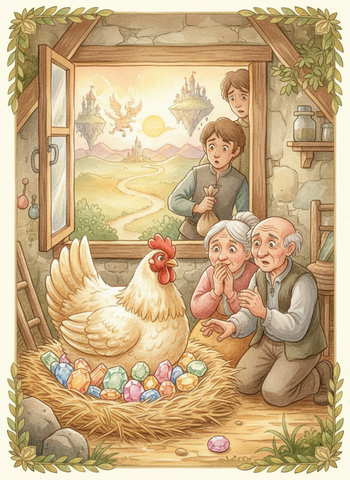
A poor old couple's hen begins laying jewels instead of eggs — a secret so precious it draws betrayal at home and sends two brothers on a perilous quest for kingdoms, magic, and revenge.
Beyond thrice-nine lands, in the thrice-tenth realm—it was not in our kingdom—once an old man and an old woman lived in great need and poverty. They had two sons, who were very young and as yet of no use for field work. So the old man got up himself, and himself did all the work; he went out and looked after the labourers, and for all that he could only earn a few pence.
Más allá de las tierras tres veces nueve, en el reino tres veces décimo —no era en nuestro reino— vivían antaño un viejo y una vieja en gran necesidad y pobreza. Tenían dos hijos, que eran muy pequeños y aún no servían para el trabajo del campo. Así que el viejo se levantaba él mismo y hacía él mismo todo el trabajo; salía y vigilaba a los jornaleros, y aun así apenas podía ganar unos pocos céntimos.
As he was going home one day he met a sorry drunkard, who had a hen in his hands. “Will you, old man, buy my hen?”
Un día, mientras volvía a casa, se encontró con un pobre borracho que llevaba una gallina en las manos. «¿Quiere usted, buen hombre, comprarme la gallina?»
“What do you want for it?”
«¿Cuánto quiere por ella?»
“Give me fifty kopeks for it.”
«Deme cincuenta kopeks por ella.»
“No, brother; take these few pence—that will be enough for you; you will get a pint and can drink it out on your way home and go to sleep.”
«No, hermano; toma estos pocos céntimos, con eso te bastará; te comprarás una jarra y podrás bebértela de camino a casa y a dormir.»
So the drunkard took the pence and gave the old man the hen.
Así que el borracho tomó los céntimos y le dio al viejo la gallina.
Then the old man returned home. But they were very hungry there; there was not a crust of bread. “Here,” he said, as he came in, to his wife, “here is a hen I have bought you.”
Entonces el viejo volvió a casa. Pero allí pasaban mucha hambre; no había ni una corteza de pan. «Mira», dijo al entrar, a su mujer, «te he comprado una gallina.»
But his wife turned on him fiercely and scolded him. “What an old fool you are! You must have gone utterly mad: our children are sitting down at home without any bread, and you buy a hen which you must feed!”
Pero su mujer se volvió hacia él con furia y lo regañó. «¡Qué viejo tonto eres! Debes de haberte vuelto loco: nuestros hijos están en casa sin una migaja de pan, ¡y tú compras una gallina que hay que alimentar!»
“Hold your tongue, foolish woman; does a hen eat so much? Why, she will lay us an egg and will bring us chicks; we can sell the chicks and then buy bread.”
«Calla, mujer necia; ¿acaso una gallina come tanto? Ya verás cómo nos pone un huevo y nos traerá pollitos; venderemos los pollitos y con eso compraremos pan.»
So the old man made a little nest and he put the hen under the stove. In the morning he looked, and the hen had laid a jewel of absolutely natural colours. So the old man said to his wife, “Now, old lady; amongst other folks the hens lay eggs, but our hen lays jewels: what shall we do?”
Así que el viejo hizo un nidito y puso a la gallina bajo la estufa. Por la mañana miró, y la gallina había puesto una joya de colores absolutamente naturales. Entonces el viejo le dijo a su mujer: «Mira, vieja mía; entre la otra gente las gallinas ponen huevos, pero la nuestra pone joyas: ¿qué haremos?»
“Take it into the city; possibly somebody may buy it.”
«Llévala a la ciudad; quizá alguien quiera comprarla.»
So the old man went into the city, went into all the inns by turns and showed his precious stone. All the merchants gathered round him and began valuing the stone. They valued it and valued it, and it was at last bought for five hundred roubles.
Así que el viejo fue a la ciudad, entró en todas las posadas por turno y mostró su piedra preciosa. Todos los mercaderes se reunieron a su alrededor y comenzaron a tasar la piedra. La tasaron y la tasaron, y al final se vendió por quinientos rublos.
From that day the old man went on trading in precious stones which his hen laid him, and he very soon became enriched, had himself inscribed into the merchants’ guild, put up a shop, hired apprentices, and set up seafaring ships to carry his wares into foreign lands. One day he was going into foreign parts, and he bade his wife have a great heed to the hen: “Treasure her more than your eyes; should she be lost, you shall forfeit your own head.”
Desde aquel día el viejo se dedicó a comerciar con las piedras preciosas que le ponía su gallina, y muy pronto se enriqueció, se hizo inscribir en el gremio de mercaderes, abrió una tienda, contrató aprendices y armó barcos para llevar sus mercancías a tierras extranjeras. Un día, cuando se disponía a partir hacia países lejanos, encargó a su mujer que cuidara mucho de la gallina: «Guárdala más que a tus propios ojos; si se pierde, pagarás con tu cabeza.»
As soon as he had gone the old woman began to think evil thoughts. For she was great friends with one of the young apprentices.
En cuanto él se hubo marchado, la vieja comenzó a pensar malos pensamientos. Pues era muy amiga de uno de los jóvenes aprendices.
“Where do you get these precious stones from?” the apprentice asked her.
«¿De dónde sacas estas piedras preciosas?», le preguntó el aprendiz.
“Oh, it is our hen that lays them.”
«Ah, es nuestra gallina la que las pone.»
So the apprentice took the hen, looked, and under the right wing he saw written in gold: “Whoever eats this hen’s head shall become a king, and whoever eats her liver shall spit out gold.”
Así que el aprendiz tomó la gallina, la miró, y bajo el ala derecha vio escrito en letras de oro: «Quien coma la cabeza de esta gallina se convertirá en rey, y quien coma su hígado escupirá oro.»
So he told the wife, “Bake me the hen for supper.”
Entonces le dijo a la mujer: «Cocíname la gallina para la cena.»
“Oh, my dear friend, how can I? My husband will be coming back and will punish me.”
«Ay, querido amigo, ¿cómo puedo hacerlo? Mi marido volverá pronto y me castigará.»
But the apprentice would not listen to any argument. “Bake it,” he said—that was all.
Pero el aprendiz no quiso escuchar ningún argumento. «Cocínala», dijo, y eso fue todo.
The next day the old woman got supper ready, made ready to twist the hen’s neck and to roast it for supper with the head and the liver. The cook twisted the hen’s neck and put her into the oven, and himself went out. But in that time the two little children of the house, who were at school, ran in, looked into the oven, and wanted to nibble. The elder brother ate the head and the youngest ate the liver.
Al día siguiente la vieja preparó la cena, se dispuso a retorcerle el cuello a la gallina y a asarla para la cena con la cabeza y el hígado. El cocinero le retorció el cuello a la gallina y la metió en el horno, y luego salió. Pero en ese momento los dos niños pequeños de la casa, que estaban en la escuela, entraron corriendo, miraron dentro del horno y quisieron picotear algo. El hermano mayor comió la cabeza y el menor comió el hígado.
When supper-time came, the hen was put on the table, but when the apprentice saw that both the head and the liver were missing he was very angry, quarrelled with the old woman and went home. The old woman followed him and wheedled, but he still insisted: “You bring your children, take their liver out and brains, and give them me for supper; otherwise I will have nothing to do with you.”
Cuando llegó la hora de la cena, pusieron la gallina en la mesa, pero cuando el aprendiz vio que faltaban la cabeza y el hígado se enfureció, riñó con la vieja y se fue a su casa. La vieja lo siguió y trató de engatusarlo, pero él insistió: «Trae a tus hijos, sácales el hígado y los sesos, y dámelos para la cena; de lo contrario no quiero saber nada más de ti.»
So the old woman put her children to bed, called the cook and bade him take them whilst they were asleep into the wood, there kill them and extract their liver and their brains and get them ready for supper. The cook took the children into the slumbrous forest, stopped, and made ready to whet the knife.
Así que la vieja acostó a sus hijos, llamó al cocinero y le ordenó que los llevara mientras dormían al bosque, que allí los matara y les sacara el hígado y los sesos y los preparara para la cena. El cocinero llevó a los niños al bosque somnoliento, se detuvo y se dispuso a afilar el cuchillo.
The boys woke up and asked, “Why are you sharpening the knife?”
Los niños se despertaron y preguntaron: «¿Por qué afilas el cuchillo?»
“Because your mother has bidden me take out your liver and brains and cook them.”
«Porque tu madre me ha ordenado sacaros el hígado y los sesos y cocinarlos.»
“Oh, grandfather, little dove, do not slay us; we will give you all the gold you desire, only pity us and let us free.” So the younger brother filled his skirt with gold, and the cook was contented with this and he set them free.
«Ay, abuelito, palomita, no nos mates; te daremos todo el oro que desees, ten piedad de nosotros y déjanos libres.» Así que el hermano menor le llenó el faldón de oro, y el cocinero, satisfecho con esto, los dejó en libertad.
So the boys went forth into the forest and he turned back. Fortunately for him a bitch came his way, so he took her two puppies, took their livers and brains, roasted them and gave them for supper. The apprentice was very pleased with the dish, swallowed it all, and became neither a king nor a king’s son, but simply a fool.
Así que los niños se adentraron en el bosque y él volvió atrás. Por fortuna para él, se cruzó con una perra, así que tomó a sus dos cachorros, les sacó el hígado y los sesos, los asó y los sirvió para la cena. El aprendiz quedó muy contento con el plato, se lo comió todo, y no se convirtió ni en rey ni en hijo de rey, sino simplemente en un tonto.
The boys went out of the wood on the broad road, and went whither their eyes gazed—maybe far, maybe short, they went. Soon the road divided into two, and a column stood there, and on the column it was written:
Los niños salieron del bosque al camino ancho, y fueron adonde sus ojos los guiaban, ya fuera lejos o cerca. Pronto el camino se dividió en dos, y allí se alzaba una columna, y en la columna estaba escrito:
“WHO GOES TO THE RIGHT SHALL RECEIVE A KINGDOM, WHO GOES TO THE LEFT SHALL RECEIVE MUCH OF EVIL AND OF GRIEF, BUT HE SHALL MARRY A FAIR PRINCESS.”
«QUIEN VAYA A LA DERECHA RECIBIRÁ UN REINO, QUIEN VAYA A LA IZQUIERDA RECIBIRÁ MUCHO MAL Y MUCHA PENA, PERO SE CASARÁ CON UNA HERMOSA PRINCESA.»
So the brothers considered this inscription, and decided to go in different directions; the elder went to the right and the younger to the left.
Así que los hermanos consideraron esta inscripción y decidieron ir en direcciones distintas; el mayor fue hacia la derecha y el menor hacia la izquierda.
The elder went on and on, and soon came to an unknown capital city. He also saw a mass of people, only they were all mourning and sad. So he begged shelter of a poor old widow. “Will you protect,” he said, “a foreigner from the dark night?”
El mayor caminó y caminó, y pronto llegó a una capital desconocida. Vio también una multitud de gente, pero todos estaban de luto y tristes. Así que pidió refugio a una pobre viuda anciana. «¿Me protegerá usted», dijo, «a un forastero de la oscuridad de la noche?»
“I should be very glad to have you,” she said, “but I cannot put you anywhere, I am so closely packed.”
«Me alegraría mucho tenerlo», dijo ella, «pero no puedo alojarlo en ningún sitio, estoy muy apretada de espacio.»
“Do let me in, bábushka; I am such a simple youth, just as you are; you can find me some small space, some kind of nook for the night.”
«Déjeme entrar, bábushka; soy un joven sencillo, igual que usted; podrá encontrarme algún pequeño rincón para pasar la noche.»
So the old woman admitted him, and they began to speak.
Así que la anciana lo dejó entrar, y empezaron a hablar.
“Why, bábushka,” the stranger asked, “is there such a throng in the city, why are rooms so dear, and why are the people all mourning and melancholy?”
«Dígame, bábushka», preguntó el forastero, «¿por qué hay tanta multitud en la ciudad, por qué las habitaciones están tan caras, y por qué la gente está toda de luto y melancólica?»
“Well, our king has just died, and the boyárs have sent the town-crier out to announce that old and young are to assemble, and each of them is to have a candle, and with the candles they are to go into the cathedral, and whosesoever’s candle lights of itself is to be king.”
«Bueno, nuestro rey acaba de morir, y los boyardos han enviado al pregonero a anunciar que jóvenes y viejos deben reunirse, y cada uno ha de llevar una vela, y con las velas han de entrar en la catedral, y aquel cuya vela se encienda por sí sola será el rey.»
So in the morning the boy got up, washed, prayed to God, said the grace for the bread and salt and the soft bed which his hostess had given him, and went into the cathedral. When he got there, if you had been there three years you could not have counted all those people. And he took a candle in his hand, and it lit up at once. So they all burst upon him and began to blow out his candle, to damp it, but the flame lit all the brighter. There was no help for it: they acknowledged him as their king, and dressed him in golden apparel and led him to the palace.
Así que a la mañana siguiente el muchacho se levantó, se lavó, rezó a Dios, dio gracias por el pan y la sal y la cama blanda que su anfitriona le había dado, y fue a la catedral. Cuando llegó allí, aunque hubiera estado tres años no habría podido contar a toda aquella gente. Tomó una vela en la mano, y esta se encendió al instante. Entonces todos se abalanzaron sobre él y empezaron a soplar para apagar su vela, para humedecerla, pero la llama ardía cada vez más brillante. No hubo remedio: lo reconocieron como su rey, lo vistieron con ropajes dorados y lo llevaron al palacio.
But the younger brother, who had turned to the left, heard that there was a fair princess in a certain kingdom who was indescribably lovely. But she was very grudging, and she announced in all countries that she would only marry the man who could feed her army for three whole years; yet every one had to try his luck. So the boy went there, and he went on his way, went on the broad road. And he spat into his little bag, and spat it full of pure gold.
Pero el hermano menor, que había tomado hacia la izquierda, oyó que había una hermosa princesa en cierto reino, de una belleza indescriptible. Pero era muy tacaña, y anunció en todos los países que solo se casaría con el hombre que pudiera alimentar a su ejército durante tres años enteros; y aun así todos querían probar suerte. Así que el muchacho fue allí, y siguió su camino, siguió por el camino ancho. Y escupió en su pequeña bolsa, y la llenó de escupitajos de oro puro.
Well, it may be long, it may be short, it may be near, it may be far, but he at last reached the fair princess, and he said he would accomplish her task. He had no need to ask for gold, he simply had to spit and there it was. For three years he maintained the princess’s army, gave it food and drink and dress.
Bueno, puede que fuera largo, puede que fuera corto, puede que estuviera cerca, puede que estuviera lejos, pero al fin llegó ante la hermosa princesa, y le dijo que cumpliría su tarea. No tenía necesidad de pedir oro, solo tenía que escupir y allí estaba. Durante tres años mantuvo al ejército de la princesa, le dio comida, bebida y vestimenta.
So the time came for a jolly feast and for the wedding. But the princess was still full of wiles. She asked herself and she sought to know whence God had sent him such enormous wealth. So she invited him to be her guest, received him, honoured him. And the doughty youth fell sick, and he vomited up the liver of the hen, and the Tsarévna swallowed it. From that day gold fell from her lips, and she would not have her bridegroom with her. “What shall I do with this ignoramus?” she asked her boyárs, and she asked her generals. “He has had the idiotic idea of wanting to marry me.”
Así que llegó el momento de una alegre fiesta y de la boda. Pero la princesa seguía llena de artimañas. Se preguntó a sí misma y quiso saber de dónde le había enviado Dios semejante riqueza. Así que lo invitó a ser su huésped, lo recibió, lo honró. Y el valiente joven cayó enfermo, y vomitó el hígado de la gallina, y la Tsarevna lo tragó. Desde aquel día el oro caía de sus labios, y ya no quiso a su prometido a su lado. «¿Qué haré yo con este ignorante?», preguntó a sus boyardos, y preguntó a sus generales. «Ha tenido la idea idiota de querer casarse conmigo.»
So the boyárs said he must be hung, and the generals said he must be shot. But the Tsarévna had a better idea—that he ought to be sent to hell.
Así que los boyardos dijeron que debía ser ahorcado, y los generales dijeron que debía ser fusilado. Pero la Tsarevna tuvo una idea mejor: que debía ser enviado al infierno.
So the doughty youth escaped and once more set forth on his road. And he had only one thought in his mind, how he should make himself wise and revenge himself on the Tsarévna for her unkind jest. So he went on and went on, and he came into the dreamy wood, and he looked and he saw three men fighting with their fists.
Así que el valiente joven escapó y de nuevo emprendió su camino. Y tenía un solo pensamiento en la mente: cómo hacerse sabio y vengarse de la Tsarevna por su cruel burla. Así que siguió y siguió, y llegó a un bosque de ensueño, y miró y vio a tres hombres peleándose a puñetazos.
“What are you fighting about?”
«¿Por qué os peleáis?»
“We have three finds in the road, and we cannot divide them; every one wants them for himself.”
«Hemos encontrado tres cosas en el camino, y no podemos repartirlas; cada uno las quiere para sí.»
“What are the finds? what are you contending for?”
«¿Cuáles son los hallazgos? ¿Por qué os disputáis?»
“Look, this is a barrel: you only have to knock it, and a soldier leaps out of its mouth. This is a flying carpet: wherever you think it will take you. And this is a whip: strike a maiden and say ‘You have been a maiden, now become a mare,’ and she will become a mare at once.”
«Mira, esto es un barril: solo tienes que golpearlo, y un soldado sale de su boca. Esto es una alfombra voladora: te lleva a donde pienses. Y esto es un látigo: golpea a una doncella y di ‘Has sido doncella, ahora conviértete en yegua’, y se convertirá en yegua al instante.»
“These are valuable gifts, and they are hard to divide. But this is the way out: I will send an arrow in this direction, and you all run after it; he who reaches it first shall have the barrel, and the second shall have the flying carpet, and the third shall have the whip.”
«Estos son dones valiosos, y son difíciles de repartir. Pero hay una solución: lanzaré una flecha en esta dirección, y todos corréis tras ella; el que la alcance primero tendrá el barril, el segundo tendrá la alfombra voladora, y el tercero tendrá el látigo.»
“Very well; shoot the dart.”
«Muy bien; lanza el dardo.»
So the youth sent out the arrow very far. The three darted after it and ran, and they never looked up. But the doughty youth took the barrel and the whip, sat upon the flying carpet, waved it one end, and he rose higher than the forest that stood there, lower than the clouds above, and he flew whither he would.
Así que el joven lanzó la flecha muy lejos. Los tres corrieron tras ella y jamás miraron atrás. Pero el valiente joven tomó el barril y el látigo, se sentó sobre la alfombra voladora, agitó una punta, y se elevó más alto que el bosque que se alzaba allí, más bajo que las nubes de arriba, y voló a donde quiso.
So he went back to the forbidden lands of the fair princess, began beating the barrel, and an enormous army came out; infantry, cavalry and artillery, with cannon and with powder waggons. And the mighty host rolled on and rolled on. The doughty youth asked for a horse, mounted it, and went up to his army and commanded it. The drums beat out and the trumpets sounded, and the army went at a pace.
Así que volvió a las tierras prohibidas de la hermosa princesa, comenzó a golpear el barril, y de él salió un ejército enorme: infantería, caballería y artillería, con cañones y carros de pólvora. Y la poderosa hueste avanzaba y avanzaba. El valiente joven pidió un caballo, lo montó, se acercó a su ejército y lo comandó. Los tambores retumbaron y las trompetas sonaron, y el ejército avanzó a buen paso.
Then the Tsarévna saw from her rooms and was very much frightened, and sent her boyárs and generals to ask for peace. The good youth bade these ambassadors be seized, had them cruelly and savagely punished and sent them back to the Tsarévna, who was to come herself and ask for a reconciliation.
Entonces la Tsarevna vio todo esto desde sus aposentos y se asustó mucho, y envió a sus boyardos y generales a pedir la paz. El buen joven ordenó que apresaran a estos embajadores, los castigó con crueldad y saña y los envió de vuelta a la Tsarevna, quien debía venir ella misma a pedir la reconciliación.
Well, there was no help for it: so the Tsarévna herself got out of her carriage, recognised him and swooned. But he took the whip, struck her on the back: “You are a maiden, now become a mare!” And the Tsarévna turned into a mare. He bridled and rode her, and went to the kingdom of his elder brother. He galloped at a full pace, put both spurs into her back and used a scourge of three iron rods, and the army followed him, an unbelievable host.
Bueno, no hubo remedio: así que la Tsarevna misma bajó de su carruaje, lo reconoció y se desmayó. Pero él tomó el látigo, la golpeó en la espalda: «¡Eras doncella, ahora conviértete en yegua!» Y la Tsarevna se convirtió en yegua. La embridó y la montó, y se dirigió al reino de su hermano mayor. Cabalgó a toda velocidad, le clavó ambas espuelas en el lomo y usó un látigo de tres varas de hierro, y el ejército lo siguió, una hueste increíble.
It may be long, it may be short, at last they came to the boundary, and the doughty youth stopped, collected his army into the barrel, and went to the capital. He went straight to the royal palace, and the king himself saw him and looked at the mare and began to wonder: “What is this great hero approaching? I have never seen such a fine mare in all my life.” So he sent his generals to trade for that horse.
Puede que fuera largo, puede que fuera corto, al fin llegaron a la frontera, y el valiente joven se detuvo, reunió a su ejército dentro del barril y se dirigió a la capital. Fue directo al palacio real, y el rey mismo lo vio y miró a la yegua y comenzó a maravillarse: «¿Qué gran héroe es este que se acerca? Jamás he visto una yegua tan fina en toda mi vida.» Así que envió a sus generales a negociar por aquel caballo.
“No, what an envious king you have!” said the youth. “It would evidently be out of the question in your city to come here with a young wife; if you are so greedy for a mare, you would certainly take away my wife.”
«No, ¡qué rey tan envidioso tenéis!», dijo el joven. «Sería evidentemente impensable en vuestra ciudad venir aquí con una joven esposa; si sois tan codiciosos de una yegua, sin duda os llevaríais a mi mujer.»
Then he went to the palace and said, “Hail, brother!”
Entonces fue al palacio y dijo: «¡Salve, hermano!»
“Oh, I never knew you!”
«¡Ay, no te reconocí!»
So they set to kissing each other.
Y se pusieron a besarse el uno al otro.
“What sort of barrel have you?”
«¿Qué clase de barril tienes?»
“That is for drinking. How should I journey forth on the road otherwise?”
«Ese es para beber. ¿Cómo, si no, iba a viajar por el camino?»
“And the carpet?”
«¿Y la alfombra?»
“Sit down and you will find out.”
«Siéntate y lo descubrirás.»
So they sat on the flying carpet, and the younger brother shook it at the corner and they flew higher than the forest, lower than the wandering cloud, straight back to their own country. So they flew back, took a room with their father, and as to who they were they never told their father and mother. So they then thought they would give a feast to all the christened world. They assembled all the people in countless hosts, and for three whole days they gave food and drink to all without requital, without any charge.
Así que se sentaron sobre la alfombra voladora, y el hermano menor la sacudió por la esquina y volaron más alto que el bosque, más bajo que la nube errante, directos de vuelta a su propio país. Así volaron de regreso, tomaron una habitación con su padre, y jamás dijeron a su padre y a su madre quiénes eran en realidad. Así que entonces pensaron en dar un banquete a todo el mundo cristiano. Reunieron a toda la gente en incontables huestes, y durante tres días enteros dieron comida y bebida a todos sin cobrar, sin ningún pago.
And afterwards every one began saying had any one a tale of wonder to tell; let him start. But no one would say: “We, it is said, are strange folk, but——”
Y después todos empezaron a decir que quien tuviera un cuento maravilloso que contar, que lo contara. Pero nadie quería hablar: «Nosotros, según dicen, somos gente extraña, pero…»
“Well, I will tell you a story,” said the younger brother; “only do not talk until the end. Whoever interrupts three times is to be ruthlessly punished.” So they all agreed.
«Bueno, yo os contaré una historia», dijo el hermano menor; «pero no habléis hasta el final. Quien interrumpa tres veces será castigado sin piedad.» Así que todos estuvieron de acuerdo.
And he began to tell how the two old folks had lived together, how they had had a hen which laid jewels, and how the mother had made friends with the apprentice. “What a lie!” interrupted the mistress. But the son went on with his tale. And he narrated how they had twisted the hen’s neck, and the mother again interrupted. At last the story went up to the point when the old woman wished to take away the children, and again she would not stand it: “It is untrue!” she said. “Could ever such a thing happen? Could ever a mother wish to be torn from her children?”
Y comenzó a contar cómo los dos ancianos habían vivido juntos, cómo habían tenido una gallina que ponía joyas, y cómo la madre se había hecho amiga del aprendiz. «¡Qué mentira!», interrumpió la señora de la casa. Pero el hijo continuó su relato. Y narró cómo le habían retorcido el cuello a la gallina, y la madre volvió a interrumpir. Al fin el relato llegó al punto en que la vieja quiso llevarse a los niños, y de nuevo ella no pudo soportarlo: «¡Es mentira!», dijo. «¿Cómo podría suceder tal cosa? ¿Cómo podría una madre desear ser separada de sus hijos?»
“Obviously, it is possible. Look at us, mother; we are your children.”
«Es posible, evidentemente. Míranos, madre; somos tus hijos.»
Then the whole story came out, and the father bade his wife be chopped up into bits. He tied the apprentice to the tail of horses, and the horses broke in every direction and scattered his bones over the fields. “Let the dog die a dog’s death!” said the old man. And he gave all his property to the poor and went to live in his elder son’s kingdom.
Entonces salió a la luz toda la historia, y el padre ordenó que su esposa fuera despedazada. Ató al aprendiz a la cola de unos caballos, y los caballos se dispersaron en todas direcciones y esparcieron sus huesos por los campos. «¡Que el perro muera como perro!», dijo el viejo. Y dio todos sus bienes a los pobres y se fue a vivir al reino de su hijo mayor.
But the younger son smote his mare with the back of his hand and said, “You are a mare; now become a maiden!” So the mare turned into the fair Tsarévna. They made peace, became friends and wedded. It was a magnificent wedding.
Pero el hijo menor golpeó a su yegua con el dorso de la mano y dijo: «¡Eres una yegua; ahora conviértete en doncella!» Y la yegua se convirtió en la hermosa Tsarevna. Hicieron las paces, se hicieron amigos y se casaron. Fue una boda magnífica.
I was there, I drank mead and it flowed up to my beard, but none came into my mouth.
Yo estuve allí, bebí hidromiel y me corrió hasta la barba, pero nada me entró en la boca.
