The Language She Lost
Una historia gratuita en inglés de nivel B2 para estudiantes, para leer en línea en 5 idiomas, con opción de escucharla en la app gratuita Storyteller.
When her grandmother comes to stay, Cecilia discovers that she cannot talk to her in the language she spent her childhood refusing to speak.
¡Ese fue el avance! Escucha la historia completa en la app gratuita Storyteller. Descargar la app
El audio no está disponible en este momento.
As a child, Cecilia had made herself a rule. At school she spoke only the language of her classmates, and at home she answered her parents in the same one, whatever they said. Her mother and father spoke their own language in the kitchen, softly, as if it were a secret they were embarrassed to keep. Cecilia, who was nine, had decided she wanted no part of it.
De niña, Cecilia se había impuesto una regla. En la escuela hablaba solo el idioma de sus compañeros, y en casa respondía a sus padres en ese mismo, dijeran lo que dijeran. Su madre y su padre hablaban su propio idioma en la cocina, en voz baja, como si fuera un secreto que les avergonzaba guardar. Cecilia, que tenía nueve años, había decidido que no quería tener nada que ver con él.
Twenty years later, she could still understand most of it. That had been her private compromise: she listened, but she never replied. The words had settled in her like furniture in a dark room, and she moved around them without touching anything.
Veinte años después, todavía entendía casi todo. Ese había sido su compromiso privado: escuchaba, pero nunca respondía. Las palabras se habían asentado en ella como muebles en una habitación oscura, y se movía entre ellas sin tocar nada.
Then her grandmother came to stay for the summer. The old woman knew only a handful of words of the local language. Nobody had arranged for an interpreter, because everyone had assumed that Cecilia would manage.
Entonces su abuela vino a pasar el verano. La anciana solo conocía un puñado de palabras del idioma local. Nadie había dispuesto un intérprete, porque todos habían dado por hecho que Cecilia se las arreglaría.
On the second evening, Cecilia tried to ask her grandmother how the journey had been. The sentence collapsed after three words. She knew how to say "eat", "come here" and "put your shoes on". That was the vocabulary of being a child, and she had almost nothing for being a grown woman.
La segunda noche, Cecilia intentó preguntarle a su abuela cómo había sido el viaje. La frase se derrumbó después de tres palabras. Sabía decir «come», «ven aquí» y «ponte los zapatos». Ese era el vocabulario de ser una niña, y casi no tenía nada para ser una mujer adulta.
Her grandmother waited, hands folded in her lap, and then said something slow and simple. Cecilia caught every word: Say it like a little girl, then. I don't mind.
Su abuela esperó, con las manos juntas en el regazo, y luego dijo algo lento y sencillo. Cecilia captó cada palabra: Dilo como una niña pequeña, entonces. No me importa.
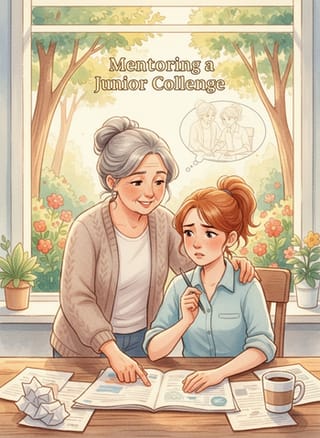
So they began. Cecilia wrote the words she wanted on sticky notes and pressed them to the doorframe, the kettle and the bathroom mirror. Her grandmother crossed out the wrong ones with a pencil and wrote the right ones beneath, in handwriting that leaned to the right. By the end of June, the kitchen looked as if it had been wallpapered with yellow squares.
Así que empezaron. Cecilia escribía las palabras que quería en notas adhesivas y las pegaba en el marco de la puerta, en la tetera y en el espejo del baño. Su abuela tachaba las equivocadas con un lápiz y escribía las correctas debajo, con una letra inclinada hacia la derecha. A fines de junio, la cocina parecía empapelada con cuadritos amarillos.
It was humbling. If she could go back to that nine-year-old, she thought, she would not argue with her. She would only ask her to wait. Her grandmother corrected her mistakes only when they changed the meaning. Otherwise she let the sentence stand, lopsided but alive.
Fue una lección de humildad. Si pudiera volver a esa niña de nueve años, pensó, no discutiría con ella. Solo le pediría que esperara. Su abuela corregía sus errores únicamente cuando cambiaban el significado. Por lo demás, dejaba la frase en pie, torcida pero viva.
In July, Cecilia asked the question she had been carrying for years. Why had her parents never forced her? Her grandmother answered slowly that they had pushed for a year. Then they had stopped, because they were tired and afraid of losing her entirely. "Better a silent daughter than a daughter who is gone," she said.
En julio, Cecilia hizo la pregunta que había llevado consigo durante años. ¿Por qué sus padres nunca la habían obligado? Su abuela respondió despacio que habían insistido durante un año. Luego habían parado, porque estaban cansados y temían perderla por completo. «Mejor una hija callada que una hija que se ha ido», dijo.
Cecilia hadn't known that. She should have asked years earlier, although until this summer she would not have had the words to do it.
Cecilia no lo había sabido. Debió haberlo preguntado años antes, aunque hasta este verano no habría tenido las palabras para hacerlo.
At the end of August, they stood together at the airport. Her grandmother said goodbye in the old language, in a long speech with a gap in the middle for Cecilia to fill. Cecilia filled it. The grammar was crooked and the pronunciation was worse, but the sentence reached its end.
A fines de agosto, estaban juntas en el aeropuerto. Su abuela se despidió en el idioma antiguo, en un largo discurso con un hueco en el medio para que Cecilia lo llenara. Cecilia lo llenó. La gramática era torcida y la pronunciación peor, pero la frase llegó a su fin.
Her grandmother touched the side of her face. She did not correct a single word.
Su abuela le tocó un lado de la cara. No corrigió ni una sola palabra.
On the first Sunday of September, Cecilia sat in the kitchen beneath the last of the yellow notes and dialed the long number. When her grandmother answered, she said hello in her parents' language. Then she kept talking.
El primer domingo de septiembre, Cecilia se sentó en la cocina bajo las últimas notas amarillas y marcó el largo número. Cuando su abuela contestó, dijo hola en el idioma de sus padres. Y luego siguió hablando.