The Engine and the Old Man
Una historia gratuita en inglés de nivel C1 para estudiantes, para leer en línea en 5 idiomas, con opción de escucharla en la app gratuita Storyteller.
A teenage chess player trained by an engine loses to an old man in a park and wonders what the machine never taught her.
¡Ese fue el avance! Escucha la historia completa en la app gratuita Storyteller. Descargar la app
El audio no está disponible en este momento.
Paulina had not lost a game to a human being in over a year. She was sixteen, and her teacher was a program on her phone. For a small subscription and a great many evenings, it had taught her to see the board as a machine sees it: a column of numbers that rose and fell with every move. When a move was good, a green bar grew. When it was a mistake, the bar turned red, and she took the move back and tried again until the bar approved.
Paulina llevaba más de un año sin perder una partida contra un ser humano. Tenía dieciséis años, y su maestro era un programa en su teléfono. Por una pequeña suscripción y muchísimas tardes, le había enseñado a ver el tablero como lo ve una máquina: una columna de números que subía y bajaba con cada jugada. Cuando una jugada era buena, crecía una barra verde. Cuando era un error, la barra se ponía roja, y ella deshacía la jugada y volvía a intentarlo hasta que la barra la aprobaba.
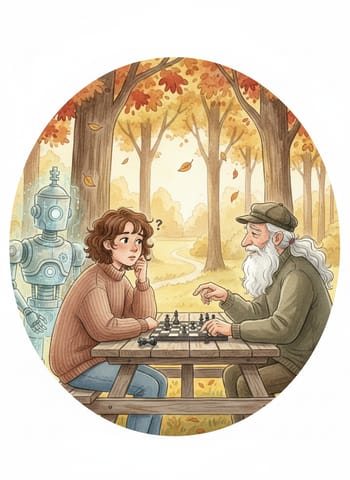
On Saturday she carried her folding board down to the stone tables by the fountain, where the retirees played. She sat opposite an old man in a woollen cap who seemed to be asleep until she set up her pieces. He opened with a pawn on the very edge of the board, a move she would have called pointless. Then he spent his next four turns shuffling a knight backwards. Her phone, in her bag, would have painted every one of them red.
El sábado llevó su tablero plegable hasta las mesas de piedra junto a la fuente, donde jugaban los jubilados. Se sentó frente a un anciano con gorro de lana que parecía dormido hasta que ella colocó sus piezas. Abrió con un peón en el borde mismo del tablero, una jugada que ella habría llamado inútil. Luego dedicó sus cuatro turnos siguientes a mover un caballo hacia atrás. Su teléfono, en la mochila, habría pintado de rojo cada una de ellas.
She played the way she had been taught, quickly and accurately, counting each exchange to the end. By the twentieth move she was sure she was winning; by the thirtieth she had stopped being sure of anything. It was no single blow that undid her. The old man's pieces had simply been gathering, one slow step at a time, on the side of the board she had judged too dull to look at. When her king finally turned around, there was nowhere left for it to go.
Jugó como le habían enseñado, con rapidez y exactitud, contando cada intercambio hasta el final. En la jugada veinte estaba segura de que ganaba; en la treinta había dejado de estar segura de nada. No fue un solo golpe lo que la deshizo. Las piezas del anciano simplemente se habían ido reuniendo, un paso lento a la vez, en el lado del tablero que ella había juzgado demasiado aburrido para mirar. Cuando su rey por fin se volvió, ya no le quedaba adónde ir.
"Good game," he said, and held out a hand as dry as paper. She shook it without thinking. "You played that very well, you know. Every move was right."
«Buena partida», dijo él, y le tendió una mano seca como papel. Ella se la estrechó sin pensar. «Jugaste muy bien, ¿sabes? Cada jugada fue correcta».
"Then why did I lose?" The words came out harder than she meant.
«Entonces, ¿por qué perdí?». Las palabras salieron más duras de lo que quería.
He considered this, scratching his ear. "Every move was right for a board. I don't think you were looking at one. You were looking for the move somebody cleverer than both of us would pick, whereas I was only looking at you."
Él lo consideró, rascándose la oreja. «Cada jugada fue correcta para un tablero. No creo que estuvieras mirando uno. Buscabas la jugada que elegiría alguien más listo que los dos, mientras que yo solo te miraba a ti».
He nodded at her hand. "You touch your bishop before you commit to anything. Twice you took your hand away. Rarely does anyone give me so much for free."
Señaló su mano con un gesto. «Tocas el alfil antes de comprometerte con algo. Dos veces retiraste la mano. Pocas veces alguien me da tanto gratis».
Walking home, she kept replaying the game in her head, and it refused to turn red anywhere. That was what she could not forgive. His moves, which the engine would have rated as errors, had not been errors at all, only questions. They had asked her something, and she had answered every one the same way, politely, with the best line a machine would find. The engine had never been afraid of her. It had never wondered whether she was bluffing, or tired, or about to touch her bishop. If she had been taught by a person, she thought, she might have learned what a person's hand does when it hesitates.
De camino a casa, siguió repitiendo la partida en su cabeza, y no había manera de que se pusiera roja en ningún punto. Eso era lo que no podía perdonar. Sus jugadas, que el motor habría calificado de errores, no habían sido errores en absoluto, solo preguntas. Le habían preguntado algo, y ella había respondido a todas de la misma manera, con cortesía, con la mejor línea que encontraría una máquina. El motor nunca había tenido miedo de ella. Nunca se había preguntado si ella farolea, o está cansada, o a punto de tocar su alfil. Si la hubiera enseñado una persona, pensó, quizá habría aprendido lo que hace la mano de una persona cuando duda.
She stopped at the corner and took out her phone. The app opened on the last game she had analysed, a long scroll of green bars. For a minute she looked at it the way you look at a photograph of a house you no longer live in. Then she put the phone back in her bag, turned around, and walked back to the fountain, where the old man was still sitting, folding and unfolding his cap.
Se detuvo en la esquina y sacó el teléfono. La aplicación se abrió en la última partida que había analizado, un largo desfile de barras verdes. Durante un minuto la miró como se mira la fotografía de una casa en la que ya no se vive. Luego guardó el teléfono en la mochila, dio media vuelta y volvió a la fuente, donde el anciano seguía sentado, doblando y desdoblando su gorro.
"Again," she said, and began to set up the pieces.
«Otra vez», dijo, y empezó a colocar las piezas.