The Engine and the Old Man
A free C1-level English story for language learners, readable online in 5 languages, with an option to listen via the free Storyteller app.
A teenage chess player trained by an engine loses to an old man in a park and wonders what the machine never taught her.
That was the preview! Hear the full story in the free Storyteller app. Get the app
Audio isn't available right now.
Paulina had not lost a game to a human being in over a year. She was sixteen, and her teacher was a program on her phone. For a small subscription and a great many evenings, it had taught her to see the board as a machine sees it: a column of numbers that rose and fell with every move. When a move was good, a green bar grew. When it was a mistake, the bar turned red, and she took the move back and tried again until the bar approved.
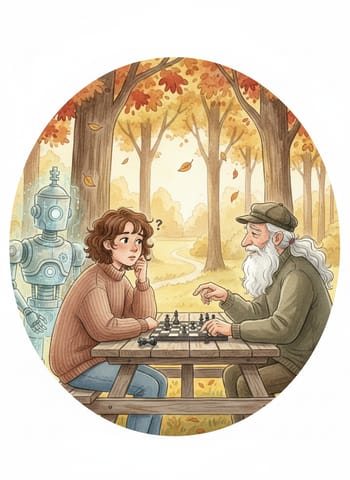
On Saturday she carried her folding board down to the stone tables by the fountain, where the retirees played. She sat opposite an old man in a woollen cap who seemed to be asleep until she set up her pieces. He opened with a pawn on the very edge of the board, a move she would have called pointless. Then he spent his next four turns shuffling a knight backwards. Her phone, in her bag, would have painted every one of them red.
She played the way she had been taught, quickly and accurately, counting each exchange to the end. By the twentieth move she was sure she was winning; by the thirtieth she had stopped being sure of anything. It was no single blow that undid her. The old man's pieces had simply been gathering, one slow step at a time, on the side of the board she had judged too dull to look at. When her king finally turned around, there was nowhere left for it to go.
"Good game," he said, and held out a hand as dry as paper. She shook it without thinking. "You played that very well, you know. Every move was right."
"Then why did I lose?" The words came out harder than she meant.
He considered this, scratching his ear. "Every move was right for a board. I don't think you were looking at one. You were looking for the move somebody cleverer than both of us would pick, whereas I was only looking at you."
He nodded at her hand. "You touch your bishop before you commit to anything. Twice you took your hand away. Rarely does anyone give me so much for free."
Walking home, she kept replaying the game in her head, and it refused to turn red anywhere. That was what she could not forgive. His moves, which the engine would have rated as errors, had not been errors at all, only questions. They had asked her something, and she had answered every one the same way, politely, with the best line a machine would find. The engine had never been afraid of her. It had never wondered whether she was bluffing, or tired, or about to touch her bishop. If she had been taught by a person, she thought, she might have learned what a person's hand does when it hesitates.
She stopped at the corner and took out her phone. The app opened on the last game she had analysed, a long scroll of green bars. For a minute she looked at it the way you look at a photograph of a house you no longer live in. Then she put the phone back in her bag, turned around, and walked back to the fountain, where the old man was still sitting, folding and unfolding his cap.
"Again," she said, and began to set up the pieces.