The Train Stopped at the Border
A free B2-level English story for language learners, readable online in 5 languages, with an option to listen via the free Storyteller app.
A night train breaks down near a border, and two strangers in the same compartment spend the long wait sharing snacks and stories.
That was the preview! Hear the full story in the free Storyteller app. Get the app
Audio isn't available right now.
The train had been creeping toward the border for most of the night when it stopped altogether, somewhere between two stations that Dalibor couldn't see. The lights flickered once and steadied. A tired voice on the speaker announced a technical fault and promised more news in twenty minutes.
The news did not come in twenty minutes. It did not come in sixty. By then the corridor had filled with passengers leaning against the windows, and Dalibor had given up on his book. He was sharing a compartment with a single stranger, a woman in a green coat who had been asleep since he boarded.
She woke around two, looked at the dark window and asked what had happened.
"A technical fault, they say."
"They always say that," she replied. "It's their favorite fault."
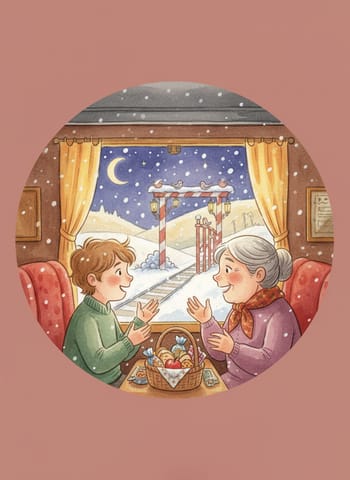
They sat in silence for a while. Then her stomach made a noise that both of them pretended not to hear. Dalibor, who had packed for a journey of six hours and not for a siege, opened his bag. He had a hunk of hard cheese, a packet of rye crackers and an apple that had been rolling around since morning.
"I can offer you the cheese," he said. "The apple is a security risk."
She laughed, and took a small tin of dried apricots from her pocket. "Fair exchange," she said.
Over the next hour, they learned each other's reasons for traveling. He was on his way to meet his newborn nephew, whom the entire family had already described as "very serious." She repaired old clocks, and a small town was paying her to wake up the one in its station tower after thirty years of silence.
"What if you can't fix it?" Dalibor asked.
"Then I will have been paid to be sad in a pleasant place," she said. "There are worse jobs."
Outside, a pale line appeared along the horizon. A guard walked past with a flashlight, and somewhere ahead a door slammed. Dalibor checked his watch. The woman checked hers. They were an hour apart.
"Border time," she said. "We have been sitting between two clocks all night, and neither of them wants us. If I were in charge of the border, I would put a clock in the middle, set to nobody's time."
They talked about that for a long while, starting with the clock in the middle. Did a person belong to the place they had left, or to the place they were heading for? She said she had been moving between towns for eleven years and had never stayed long enough to be asked a hard question. He admitted that he had spent the whole journey afraid of holding the baby wrongly.
"You will hold him wrongly, and he will forgive you," she said. "Babies are surprisingly flexible about it."
By four, the sky had turned the color of weak tea. The apricot tin was empty, the crackers were gone. Dalibor had been laughing for ten minutes at something she had said about customs officers and their stamps.
Then the train gave a long groan, as if waking from the same sleep. Something clanked beneath the floor. Dalibor felt it first in his spine and then in his teeth, and the lights of the platform began to slide slowly past the window.
"We're moving," the woman said. Neither of them reached for a book. She was still halfway through her sentence when the train gathered speed, and Dalibor leaned forward to hear the rest of it.