The Music Program Speech
A free B2-level English story for language learners, readable online in 5 languages, with an option to listen via the free Storyteller app.
Aurora, who dreads public speaking, has three minutes to defend her school's music program in front of the board.
That was the preview! Hear the full story in the free Storyteller app. Get the app
Audio isn't available right now.
The email arrives on a Monday. Because of budget pressures, the school board will vote on Thursday whether to cut the music program at the end of the year. Aurora reads it standing at her locker, and the viola on her back suddenly feels heavier than usual.
Her music teacher is organizing a petition, and a few parents have promised to write letters. But the board meeting has a public comment slot, three minutes per speaker, and nobody has signed up. "Someone should speak," says her teacher, looking around the room. Several students become very interested in their shoes. Aurora is one of them.
She hates speaking in public. In class presentations her voice goes thin and her hands shake so much that the paper rattles. She has played in front of audiences since she was ten, but that is different. When she plays, she doesn't have to be herself. Still, that evening she writes her name on the sign-up sheet in handwriting she hardly recognizes.
For three days she practices. She reads the speech to the bathroom mirror, to her cat and to her viola case, which listens best. The first version takes three minutes and forty seconds, mostly because it contains eleven statistics. She cuts ten of them.
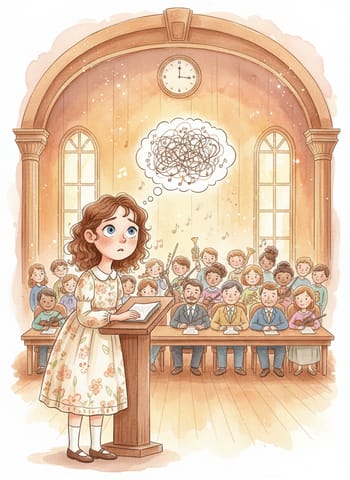
On Thursday evening, the boardroom smells of coffee and carpet cleaner. Six adults sit behind a long table with name cards in front of them. A small digital timer on the lectern glows red. Aurora has been sitting in the second row for forty minutes, listening to a debate about bus routes. She can no longer feel her fingers.
"Next, public comment," says the chair. "Aurora, please come up. You have three minutes."
Her legs carry her to the lectern, though she isn't sure how. She puts down her index cards. The first sentence on the first card is a joke. When she opens her mouth, however, her mind goes white, and the joke is gone. The timer starts. Nobody coughs.
"I don't like speaking," she says, and hears her own voice shake. "So if the program didn't matter to me, I wouldn't be here."
Someone in the audience makes a small sound, almost a laugh. It helps.
She forgets the cards and tells them two things instead. The whole music budget for a year costs less than the new sign the board paid for outside the school entrance. And ninety-four students are in the program, at least a dozen of whom, she thinks, come to school mainly for it. "If the program were cut," she says, "I think some of them would simply stop coming."
The timer beeps. She has used two minutes and fifty-one seconds. She walks back to her seat, and her knees tremble the whole way.
For a moment, the board members look at one another. Then the chair clears her throat. She says the board has heard the comments. The vote will be postponed until the March meeting, so the figures can be reviewed again. She does not say what will happen after that.
In the corridor, her teacher squeezes her shoulder and says nothing, which is exactly right.
On the bus home, Aurora finds the index cards in her pocket. She has not read a single one. On the last card, she had written the sentence she meant to finish with: "Please let us keep playing." She folds the card in half and tucks it into her viola case, next to the spare strings.
She doesn't know what the board will decide in March. But Monday's rehearsal is still on, and she plans to be early.