The Sign for the Park
A free B2-level English story for language learners, readable online in 5 languages, with an option to listen via the free Storyteller app.
When the town plans to turn her neighborhood's only park into a parking lot, Gaia argues with her parents about how to protest.
That was the preview! Hear the full story in the free Storyteller app. Get the app
Audio isn't available right now.
The notice on the lamppost is only a sheet of white paper, but Gaia reads it four times. The council plans to turn Mulberry Square, the only park in her neighborhood, into a parking lot with sixty spaces. A hearing is scheduled for Thursday.
She knows every inch of that park. The mulberry tree with a branch low enough for small children to sit on. The drinking fountain that works only if you hit it. The path where her father once ran behind her bicycle, holding the seat.
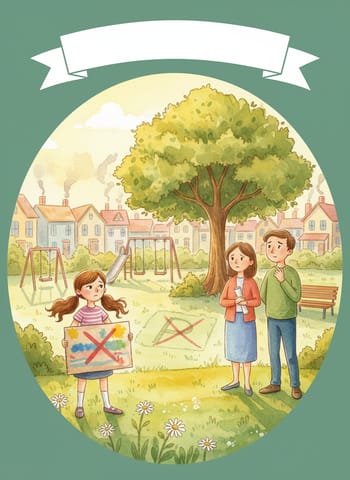
That evening she drags a flattened delivery box into the kitchen and starts painting. "SAVE MULBERRY SQUARE," she writes, in letters that shrink as she runs out of room. The last word nearly climbs off the edge.
Her mother looks up from the table. "What is that for?"
"Thursday. I'm going to stand outside the town hall with it. Everyone should."
Her parents exchange a glance, the particular one that means they have already discussed this without her.
"Gaia," her father says, "I agree with you about the park. I just don't think a sign will change anything. Councils don't read cardboard."
"Then what will? Letters? Nobody reads those either."
"People read facts. How many children use the park, how many cars the lot would bring to your street." He rubs his forehead. "If somebody had spoken at the last hearing about the school, the crossing would have been built years ago."
Her mother shakes her head. "I disagree with both of you. I think the sign is exactly right. People walk past meetings, but they stop for signs. My worry is different. You are fifteen, and these hearings run until ten at night. I would want to be there."
"So you're not against it," Gaia says.
"I was never against it. I was against you doing it alone."
For a while, nobody speaks. The paint on the cardboard is still wet. Gaia realizes that she has been arguing with a version of her parents she invented, one who would simply say no.
"What if I do both?" she says at last. "I hold the sign outside, and I ask to speak inside. Two minutes, with real numbers."
Her father considers this, then slowly pulls out a chair. "Two minutes is hard," he says. "Everyone writes four minutes of material. I'll help you cut it."
"And I'll bring snacks," her mother says, "because I refuse to stand in a cold hallway without them."
Gaia turns the sign around. On the back, in her smallest letters, she writes Thursday's date, and under it a single word: FACTS. Then she picks up a pencil and starts with the first one.