The Grade Appeal
A free B2-level English story for language learners, readable online in 5 languages, with an option to listen via the free Storyteller app.
Dilnoza goes to ask her teacher for a higher mark, but reading the comments line by line changes what she wants from the meeting.
That was the preview! Hear the full story in the free Storyteller app. Get the app
Audio isn't available right now.
Dilnoza had rehearsed her speech all the way to the classroom. She had been practicing it since Monday, in the shower, on the bus, even during maths. "I respectfully believe that this essay deserves a higher mark." The B in the corner of the page had been written in green ink, with a small, calm flourish. It looked like a fact, not an opinion.
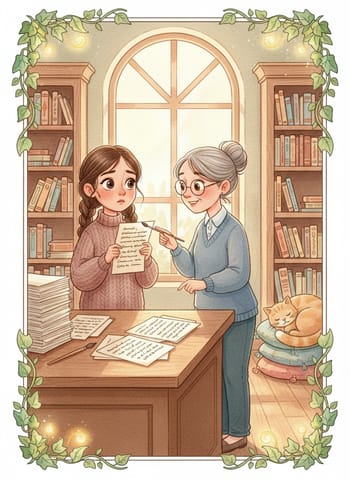
Her teacher was waiting at the desk with the essay already open. "Let's go through it together," she said. "You can stop me whenever you disagree."
The essay was about whether a city should close its center to cars. Dilnoza had written it in a single night, fueled by tea and certainty, and she had been proud of how quickly the sentences had come. "I thought the argument was strong," she began. "It's clear. It's well written."
"It is well written," her teacher agreed. "Let's start with the opening, then." She ran a finger down the first margin note. Where does this statistic come from?
Dilnoza opened her mouth. The figure had come from something she had read, or possibly something someone had said. She couldn't remember. "I think it was an article," she said.
"You think." The teacher said it gently. "If a reader asked you the same question, what would you tell them?"
They moved on. The second paragraph had a note beside a sentence that began "Everybody knows." The third had a bracket around a sentence, with a comment: this contradicts your point in paragraph one. Dilnoza read it twice, then a third time, and felt her ears getting warm.
It did contradict it. She could see it clearly now, the way you see the dust on a table once someone has opened the curtains. In the same essay she had argued that shops would suffer and that shops would benefit. She had never noticed, because she had never read it back.
"I didn't give you a B for the writing," the teacher said. "The writing is an A. Your sentences are simply ahead of your evidence. That is the gap I marked."
Dilnoza put the speech away somewhere at the back of her head. "If I rewrote it," she said slowly, "would it be an A?"
"If you rewrote it with sources, I would happily read it again. I can't promise a grade." The teacher almost smiled. "But I can promise to read the essay you could have written."
They spent the rest of the afternoon with the page between them. The teacher drew a small table on the back: claim, source, counterargument. Dilnoza filled it in with a pencil, three rows at a time, and for once she did not hurry.
By the time the corridor lights switched off, the table had grown into a full plan. It had a new order for the paragraphs and two sources that still had to be found. In the middle, she would argue against herself on purpose.
She thanked her teacher, which she had not expected to do. Then she turned the essay over, plan side up, and read it again all the way down the empty corridor.