The Emoji That Started a Feud
A free B2-level English story for language learners, readable online in English, with an option to listen via the free Storyteller app.
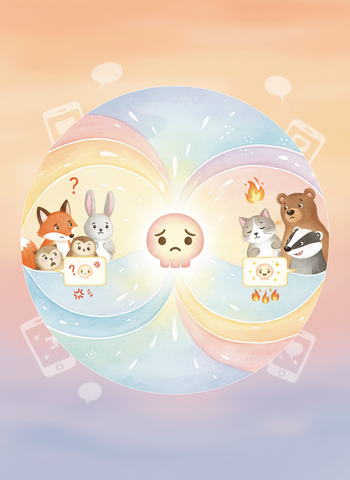
A single misunderstood skull emoji spirals into a three-day group chat feud among friends over what it actually means.
It started with a single emoji. Bridie had texted the group chat a photo of the cake she'd made for her little brother's birthday. Saskia had replied with nothing but a skull emoji.
Bridie stared at it for a long moment, genuinely unsure what it meant. Did the cake look bad? Was Saskia joking? Was this some new meaning of the skull emoji that she simply hadn't learned yet?
She decided, after some deliberation, that it meant the cake looked terrible, and she was not going to let that slide.
"Wow," Bridie typed. "Thanks for the support."
"What?" Saskia replied, genuinely confused. "The skull means it's iconic. It's a compliment. I'm dying, it's so good."
"That is not what I thought it meant," Bridie admitted, though by then Cormac had already jumped into the conversation with his own theory.
"I always thought it meant something was actually bad," Cormac typed. "Like, dead on arrival. This has been a whole misunderstanding for years, apparently."
What followed was three days of increasingly detailed debate, with screenshots of definitions pulled from different corners of the internet. At least one message insisted, quite seriously, that emoji meanings should be regulated by an actual committee.
Bridie polled her entire grade. The results were split almost exactly down the middle, which somehow made everyone more confident in their own interpretation rather than less.
By Thursday, the group chat had been renamed twice: first to "Skull Emoji Court," then to "Skull Emoji Supreme Court." Cormac appointed himself Chief Justice, for reasons nobody had actually agreed to.
"This is genuinely the dumbest argument we've ever had," Saskia typed, "and I include the sixth-grade argument about whether cereal is a soup."
"That argument," Cormac replied immediately, "was extremely valid, and I stand by my position."
Bridie, scrolling back through three days of messages, realized she couldn't actually remember why she had been upset in the first place. She sent a single message to end it: a skull emoji, followed by the word "truce."
Nobody could agree on what that combination meant either, but for once, everyone decided to just let it go.
