The Chess Postcards
A free C1-level English story for language learners, readable online in English, with an option to listen via the free Storyteller app.
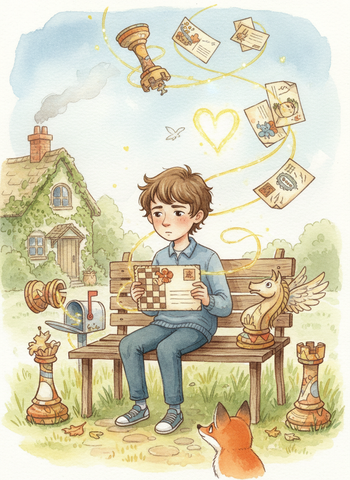
An eleven-year postcard chess game starts producing illegal moves, and Thiago has to decide how to answer once he learns why.
Thiago and Mr. Pruitt had been playing the same game of chess by postcard for eleven years, one move at a time, the board too large now for either of them to hold entirely in memory without notes.
It had started as a joke between neighbors and outlived the neighborliness itself, surviving Thiago's move across the country and, eventually, Mr. Pruitt's move into a care facility that Thiago had never visited. The postcards kept coming regardless: a knight to a particular square, a note about the weather, nothing more. Thiago answered each one within a week, partly out of habit and partly because the game had become, without his quite choosing it, one of the steadier threads in an otherwise unpredictable year.
What he hadn't expected was for the moves to stop making sense.
A bishop appeared where no bishop could legally go. A pawn moved backward. Thiago assumed a slip of the pen at first, a hand less steady than it used to be, and he wrote back gently pointing out the error, expecting a laugh in return. The next postcard repeated the same illegal move, in the same handwriting, as though his correction had never arrived.
It was a phone call from a woman named Dana, not a postcard, that finally explained it. She was Mr. Pruitt's caretaker at the facility, she said, and she had found Thiago's return address on a drawer full of postcards going back years.
"He still asks for the chess set most afternoons," Dana said. "He doesn't always remember your name. But he remembers there's a game."
"Does he know he's not playing it correctly anymore?" Thiago asked, and immediately regretted how clinical the question sounded.
"I don't know that 'correctly' means much to him at this point," Dana said. "I set the pieces up how he tells me to, and I mail whatever he writes. It seems to make him steadier for the rest of the day. Whether that's worth more or less than a fair game, I couldn't tell you."
Thiago sat with the postcard for three days before answering it. Had he written back with the actual rules in mind, he would have had to correct a move that could not be corrected. Doing so would have meant saying, in effect, that the man on the other end was no longer entirely there. He wrote back instead with a queen moving to a square that made no strict sense either, a small illegal answer to an illegal question. He dropped it in the mailbox before he could talk himself out of it.
He has kept doing this for four months now. The board, if either of them were still tracking it properly, would make no sense to any outside judge. Thiago has stopped minding. Some games, he has decided, are not really about who wins.
