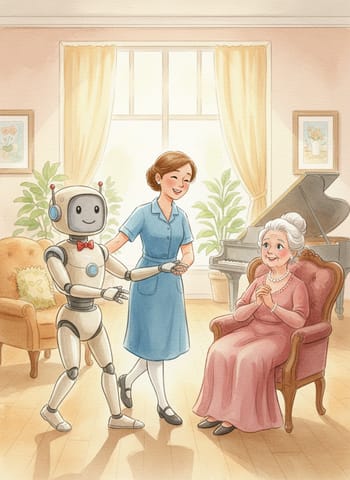
The care home where Mahir worked got a new companion robot in March. It was about the size of a ten-year-old child, with a soft round face and a calm voice. The manager hoped it would help residents who felt lonely in the afternoons.
马希尔工作的养老院在三月来了一个新的陪伴机器人。它大约有十岁孩子那么高,脸圆圆的、软软的,声音平静。院长希望它能帮助那些下午觉得孤单的老人。
Most of the residents were curious. They asked it questions, and a few of them taught it card games. Only Wilma refused to look at it. When the robot rolled into the lounge, she turned her chair toward the window.
大多数老人都很好奇。他们向它提问,有几位还教它打牌。只有威尔玛不肯看它一眼。机器人滑进休息室的时候,她把椅子转向了窗户。
"I don't need a machine," she told Mahir. "I had a whole life before this place."
“我不需要机器,”她对马希尔说,“来这个地方之前,我也过了一辈子。”
Mahir didn't argue. He had worked there for six years, and he knew that pushing people usually made things worse. But he kept thinking about her, and he wondered what he was missing.
马希尔没有争辩。他在这里工作了六年,知道逼着别人做事通常只会把事情搞得更糟。可他还是一直想着她,心里琢磨自己是不是漏掉了什么。
One evening, he was tidying her shelves when he found an old photo in a frame. In it, a young woman in a bright dress was laughing in the middle of a dance floor. On the back, someone had written "First prize, 1968".
一天傍晚,他在整理她的架子,发现了一张装在相框里的旧照片。照片上,一位穿着鲜艳连衣裙的年轻女子正在舞池中央大笑。照片背面有人写着“一等奖,1968年”。
"Is that you?" Mahir asked.
“这是您吗?”马希尔问。
Wilma looked at the photo for a long moment. "That's me," she said. "I danced for thirty years. I haven't heard that music in a very long time."
威尔玛盯着照片看了很久。“是我,”她说,“我跳了三十年舞。这样的音乐,我已经很久没听过了。”
"What was it like?"
“那是什么样的音乐?”
She hummed a few notes of a slow waltz, and her eyes closed for a second.
她轻轻哼了几个缓慢华尔兹的音符,眼睛闭上了片刻。
Mahir searched for the song that night. The next day, he asked the technician how to add music to the robot. It took him an hour to figure out, and he made several mistakes. In the end, the robot learned to play the waltz through its small speaker.
那天晚上,马希尔找到了那首曲子。第二天,他问技术员怎么给机器人加音乐。他花了一个小时才弄明白,中间还出了好几次错。最后,机器人学会了用它小小的扬声器播放那首华尔兹。
He didn't tell Wilma. He only asked the robot to play it quietly at four o'clock. That was when she usually sat by the window.
他没有告诉威尔玛。他只是让机器人在四点钟轻轻地播放。那是她通常坐在窗边的时间。
For three days, nothing changed. Wilma kept her eyes on the garden. On the fourth day, Mahir noticed that her hands had stopped moving in her lap.
三天过去了,什么都没有变。威尔玛的目光一直落在花园里。到了第四天,马希尔发现她放在腿上的双手不再动了。
On the fifth day, her right foot began to tap, very softly, in time with the music.
第五天,她的右脚开始跟着音乐的节拍轻轻地点起来,非常轻。
Mahir said nothing. He stood by the door and watched. After a while, Wilma turned her chair a little. It was just enough to see the robot.
马希尔什么也没说。他站在门边看着。过了一会儿,威尔玛把椅子转过来一点点。刚好够她看见那个机器人。
"It's not a bad speaker," she said. "But it's a bit slow at the end."
“这扬声器还不错,”她说,“不过结尾有点慢。”
"I'll tell it," Mahir said.
“我会跟它说的,”马希尔说。