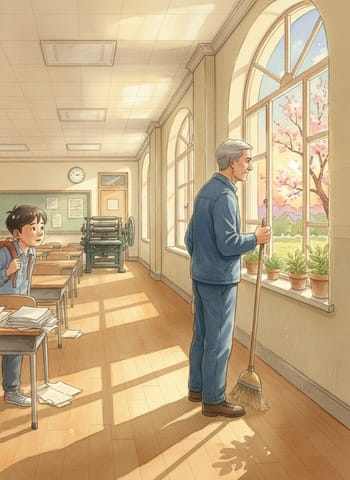
Delphine stayed late most Tuesdays laying out the school paper, which was how she came to notice that Mr. Halvorsen, the custodian, stopped his cart at the same hallway window every week at almost exactly the same minute.
德尔菲娜大多数星期二都留得很晚,给校报排版,所以她才注意到,清洁工哈尔沃森先生,每个星期都在几乎同一分钟,把他的推车停在走廊的同一扇窗前。
He didn't clean anything during that minute. Leaning his broom against his hip, he simply stood there, looking out at a stretch of parking lot and the scrubby trees beyond it. Then, as though a timer somewhere had gone off, he picked his cart back up and moved on to the next classroom.
那一分钟里他什么也不打扫。他把扫帚靠在髋边,只是站在那儿,望着一片停车场和远处稀疏的灌木树丛。然后,就像哪里的计时器响了似的,他重新推起推车,走向下一间教室。
At first Delphine assumed he was catching his breath. Custodial work looked exhausting, and Tuesday was, by her own observation, the day he covered the most ground. It was only after three weeks of watching that she noticed the pattern. Not once did the pause shift from the exact minute on the clock above the office, regardless of how far behind or ahead of schedule he happened to be running that particular week. Something about that precision unsettled the exhaustion theory entirely.
起初,德尔菲娜以为他是在喘口气。清洁工作看上去很累,而且据她观察,星期二是他要走的地方最多的一天。直到观察了三个星期,她才注意到这个规律。不管那一周他的进度是落后还是提前,那个停顿从来没有偏离过办公室上方那座钟上的同一分钟。这种精确,彻底推翻了疲惫的说法。
She asked him directly, eventually, more out of curiosity than any real conviction that a story existed. He didn't answer right away, which she had learned by then to read as him deciding whether the question deserved a real answer or a polite deflection.
最后她直接问了他,更多出于好奇,而不是真的相信这背后有什么故事。他没有立刻回答,到那时她已经学会把这看作他在掂量,这个问题值得一个真正的回答,还是一句礼貌的搪塞。
"There's a bird that used to nest out past those trees," he said finally. "A particular kind. My wife could tell you the name of every bird in this county, but I never could keep them straight, except that one. She used to say it sang loudest around four-fifteen, like it kept its own schedule better than the rest of us did."
“以前有一种鸟,在那片树丛后面筑巢,”他终于说,“是一种特别的鸟。我老伴能说出这个县里每一种鸟的名字,我却始终分不清,除了那一种。她过去常说,它在四点十五分前后唱得最响,就像它守自己的时间表,比我们其他人都守得好。”
"Does it still sing?"
“它现在还唱吗?”
"Not for years. I don't actually know if it's the same trees anymore, or if the bird's even the kind that would still be around." He shrugged, an oddly light gesture for what he'd just said. "I still stop and listen anyway. Habit, I suppose, more than hope."
“好几年没有了。我其实也不知道还是不是那几棵树,也不知道那种鸟是不是还会待在这一带。”他耸了耸肩,对于他刚说的话来说,这个动作轻得出奇。“我还是会停下来听一听。大概是习惯,比希望更多。”
Delphine didn't ask whether his wife was still living, and he didn't offer it, and something about the shape of his sentences told her not to press further than that.
德尔菲娜没有问他老伴是否还在世,他也没有说,他话语的轮廓让她明白,不要再追问下去了。
She still watches for the pause most Tuesdays, though she has stopped thinking of it as a mystery to solve. It has become, instead, something closer to a fact of the hallway: at four-fifteen, a man stops his cart and listens for a bird that may or may not still be there. Nobody, least of all Delphine, has any real reason to interrupt him.
她依然在大多数星期二留意着那个停顿,不过已经不再把它当作一个有待解开的谜。它变成了更像走廊里的一个事实:四点十五分,一个人停下他的推车,听着一只也许还在、也许已经不在的鸟。没有人,尤其是德尔菲娜,有任何真正的理由去打扰他。