The Forged Letter
一个面向英语学习者的免费 C1 级英语故事,可用 7 种语言在线阅读,也可以在免费的 Storyteller 应用中收听。
An archive volunteer finds that the town's most cherished letter was written decades after its supposed date, and tracks down the forger and a gentle motive.
试听结束!在免费的 Storyteller 应用中收听完整故事。 下载应用
音频暂时无法播放。
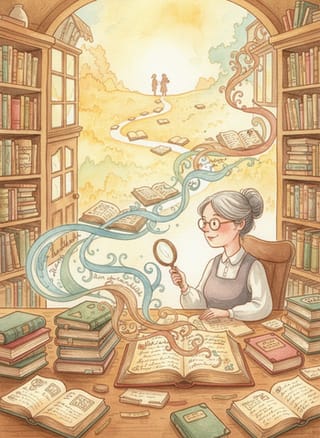
Thaddeus had volunteered at the Harlow Bay Archive for six years, and in that time nothing had been more reliably loved than the letter in the glass case by the door. It was the poet's farewell to the town, written on the eve of his departure in 1931. Every schoolchild in the district could quote its last line: "Keep the lamp lit; I know the way back." Visitors stood in front of it with their hands behind their backs, as though in church. Thaddeus, who dusted the case on Thursdays, had never looked closely at the paper itself until the week the catalogue needed new photographs.
撒迪厄斯在哈洛湾档案馆做了六年志愿者,这些年里,最受人喜爱、从不曾变过的,就是门边玻璃柜里的那封信。那是诗人写给小镇的告别信,写于他1931年离乡的前夜。这一带的每个学童都能背出最后一句:“让灯一直亮着;我知道回来的路。”参观者站在信前,双手背在身后,像在教堂里一样。撒迪厄斯每周四给玻璃柜除尘,却从来没有仔细看过那张纸本身,直到那一周,馆里的目录需要换新照片。
He took the letter to the window for the light, with the committee's permission and a pair of cotton gloves, and it was there, held up against the afternoon, that he saw the watermark. It was a tiny crescent and a number, the mark of a paper mill that, according to the trade directory on the reference shelf, had not begun production until 1958. He checked it twice. Then, because he was the kind of person who checks things a third time, he checked it again. The poet had been dead for nine years by then.
经委员会允许,他戴上棉手套,把信拿到窗边借光,就在那里,对着午后的光举起来的时候,他看见了水印。那是一弯小小的新月和一个数字,属于一家造纸厂。据参考书架上的行业名录记载,那家造纸厂直到1958年才开始生产。他核对了两遍。接着,因为他是那种会核对第三遍的人,他又核对了一遍。那时候,诗人已经去世九年了。
For several days he told no one, which was uncomfortable, since he was a poor liar and a worse keeper of secrets. Never had he wanted so badly to be wrong. Archive work trains the eye to distrust anything too tidy, and the more he looked, the more he found. The ink had faded evenly, as it never does on a genuinely old page, and the handwriting leaned a fraction too carefully, like a signature practised in a mirror. It was not the forgery itself that unsettled him so much as the patience of it. Whoever had made this had wanted it to be believed, and had wanted that for a reason.
好几天里,他没有对任何人说起,这让他很不自在,因为他不擅长说谎,更不擅长保守秘密。他从来没有这样迫切地希望自己错了。档案工作会让人的眼睛养成习惯,对任何过于整齐的东西心存怀疑,他越看,发现的东西就越多。墨迹褪得很均匀,真正的旧纸上从不会这样;笔迹微微斜得过分小心,像对着镜子练过的签名。真正让他不安的,与其说是伪造本身,不如说是伪造者的耐心。不管是谁做了这件东西,他都希望它被人相信,而且这份希望是有缘由的。
The reason took him three weeks. The donation ledger recorded that the letter had arrived in 1968, presented by the poet's sister, with a covering note in a different, rounder hand. The note was signed by the assistant librarian of the day: Rita. Thaddeus found her, after a good deal of asking, in a flat above the hardware shop, eighty-eight years old, sharp-eyed, and entirely unsurprised to see a man holding a folder.
找到这个缘由,花了他三个星期。捐赠登记簿上记着,这封信是1968年由诗人的姐姐送来的,附有一张便条,字迹不同,更圆润。便条的署名是当年的助理馆员:丽塔。撒迪厄斯问了许多人,才在五金店楼上的一间公寓里找到了她。她八十八岁,目光依然锐利,看见一个男人拿着文件夹上门,丝毫不觉得意外。
"You've found the paper," she said, before he had sat down. "I always said it would be the paper."
“你发现了那张纸。”他还没坐下,她就说,“我一直说,露馅的会是那张纸。”
She had made the copy, she told him, because the original was lost in the flood of 1967, along with half of the poet's papers in his sister's cellar. The sister was ill by then and wanted only to read the letter once more. Rita, who had heard it read aloud so often in that house that she could have recited it in her sleep, wrote it out from memory. "Word for word, or near enough," she said. "She read it, and she cried, and she said it was exactly right. Then she gave it to the archive, and nobody asked, and I didn't like to say."
她告诉他,她之所以做了那份复本,是因为原件在1967年的那场洪水中丢了,同被毁掉的还有诗人姐姐地窖里的一半手稿。那时姐姐已经病了,只想再读一遍那封信。丽塔在那间屋子里听人朗读过太多次,睡着了都能背出来,于是凭记忆把它写了下来。“一字不差,或者说差不多。”她说,“她读了,哭了,说这正是原来的样子。后来她把它交给了档案馆,没有人问起,我也不好意思说。”
Thaddeus turned his hat over in his hands. Had Rita confessed in 1968, the letter would have been catalogued as a copy and forgotten within a year; it was precisely the small lie, he understood, that may well have kept the words alive. What he could not decide was whether that made the lie a kindness or merely a very successful one.
撒迪厄斯把帽子在手里翻来覆去。他明白,如果丽塔1968年就坦白了,这封信会被登记为复本,不出一年就被人遗忘;恰恰是这个小小的谎言,也许才让这些话流传了下来。他拿不准的是,这到底让这个谎言成了一种善意,还是仅仅成了一个格外成功的谎言。
"The words are his," Rita said. "The hand is mine. I wouldn't call that a forgery. I'd call it a loan." She waved a thin hand towards the window. "Leave it be, Thaddeus. Nobody ever came to look at the paper."
“话是他的,”丽塔说,“字是我的。我不会管这叫伪造。我管它叫借用。”她抬起一只瘦削的手,朝窗户挥了挥。“别去动它了,撒迪厄斯。从来没有人是来看那张纸的。”
He said he would think about it, and meant it. On Monday he went in early and stood in front of the case for a long time before he switched on the light.
他说他会考虑,而且是认真的。星期一,他早早到馆,在玻璃柜前站了很久,才打开灯。