The Model (variant of Le Modèle)
A free B2-level English story for language learners, readable online in 7 languages, with an option to listen via the free Storyteller app.
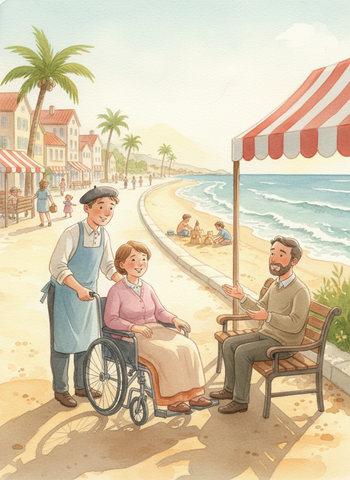
At a seaside resort, a painter silently wheels his crippled wife along the promenade while a friend on a nearby bench tells the reckless act that bound the two together forever.
Curving like a crescent moon, the little town of Etretat, with its white cliffs, its white, shingly beach and its blue sea, lay in the sunlight at high noon one July day. At either extremity of this crescent its two “gates,” the smaller to the right, the larger one at the left, stretched forth—one a dwarf and the other a colossal limb—into the water, and the bell tower, almost as tall as the cliff, wide below, narrowing at the top, raised its pointed summit to the sky.
Curvando-se como uma lua crescente, a pequena cidade de Etretat, com seus penhascos brancos, sua praia branca de seixos e seu mar azul, repousava ao sol em pleno meio-dia de um dia de julho. Em cada extremidade desse crescente, seus dois “portais”, o menor à direita, o maior à esquerda, se estendiam — um como um anão e o outro como um membro colossal — para dentro da água, e o campanário, quase tão alto quanto o penhasco, largo embaixo, estreitando-se no topo, erguia seu cume pontudo para o céu.
On the sands beside the water a crowd was seated watching the bathers. On the terrace of, the Casino another crowd, seated or walking, displayed beneath the brilliant sky a perfect flower patch of bright costumes, with red and blue parasols embroidered with large flowers in silk.
Na areia junto à água, uma multidão estava sentada observando os banhistas. No terraço do Cassino, outra multidão, sentada ou caminhando, exibia sob o céu brilhante um verdadeiro canteiro de flores de trajes vistosos, com sombrinhas vermelhas e azuis bordadas com grandes flores em seda.
On the walk at the end of the terrace, other persons, the restful, quiet ones, were walking slowly, far from the dressy throng.
No passeio no fim do terraço, outras pessoas, as tranquilas, sossegadas, caminhavam devagar, longe da multidão elegante.
A young man, well known and celebrated as a painter, Jean Sumner, was walking with a dejected air beside a wheeled chair in which sat a young woman, his wife. A manservant was gently pushing the chair, and the crippled woman was gazing sadly at the brightness of the sky, the gladness of the day, and the happiness of others.
Um jovem, conhecido e celebrado como pintor, Jean Sumner, estava caminhando com ar abatido ao lado de uma cadeira de rodas em que estava sentada uma jovem mulher, sua esposa. Um criado empurrava a cadeira gentilmente, e a mulher aleijada olhava com tristeza para o brilho do céu, a alegria do dia e a felicidade dos outros.
They did not speak. They did not look at each other.
Não falavam. Não se olhavam.
“Let us stop a while,” said the young woman.
— Vamos parar um pouco — disse a jovem mulher.
They stopped, and the painter sat down on a camp stool that the servant handed him.
Pararam, e o pintor se sentou num banquinho dobrável que o criado lhe entregou.
Those who were passing behind the silent and motionless couple looked at them compassionately. A whole legend of devotion was attached to them. He had married her in spite of her infirmity, touched by her affection for him, it was said.
Os que passavam atrás do casal silencioso e imóvel olhavam para eles com compaixão. Toda uma lenda de devoção estava ligada a eles. Ele a tinha desposado apesar da deficiência dela, tocado por sua afeição por ele, dizia-se.
Not far from there, two young men were chatting, seated on a bench and looking out into the horizon.
Não muito longe dali, dois jovens conversavam, sentados num banco e olhando para o horizonte.
“No, it is not true; I tell you that I am well acquainted with Jean Sumner.”
— Não, não é verdade; eu lhe digo que conheço bem Jean Sumner.
“But then, why did he marry her? For she was a cripple when she married, was she not?”
— Mas então, por que ele se casou com ela? Pois ela já era aleijada quando se casaram, não era?
“Just so. He married her—he married her—just as every one marries, parbleu! because he was an idiot!”
— Justamente. Ele se casou com ela — se casou com ela — como todo mundo se casa, parbleu! porque era um idiota!
“But why?”
— Mas por quê?
“But why—but why, my friend? There is no why. People do stupid things just because they do stupid things. And, besides, you know very well that painters make a specialty of foolish marriages. They almost always marry models, former sweethearts, in fact, women of doubtful reputation, frequently. Why do they do this? Who can say? One would suppose that constant association with the general run of models would disgust them forever with that class of women. Not at all. After having posed them they marry them. Read that little book, so true, so cruel and so beautiful, by Alphonse Daudet: 'Artists' Wives.'
— Mas por quê — mas por quê, meu amigo? Não há por quê. As pessoas fazem coisas estúpidas só porque fazem coisas estúpidas. E, além disso, você sabe muito bem que os pintores têm uma especialidade em casamentos tolos. Quase sempre se casam com modelos, antigas amantes, na verdade, mulheres de reputação duvidosa, com frequência. Por que fazem isso? Quem pode dizer? Seria de supor que o convívio constante com o comum das modelos os enojaria para sempre com essa classe de mulheres. De jeito nenhum. Depois de posá-las, casam-se com elas. Leia aquele livrinho, tão verdadeiro, tão cruel e tão belo, de Alphonse Daudet: 'As Esposas dos Artistas.'
“In the case of the couple you see over there the accident occurred in a special and terrible manner. The little woman played a frightful comedy, or, rather, tragedy. She risked all to win all. Was she sincere? Did she love Jean? Shall we ever know? Who is able to determine precisely how much is put on and how much is real in the actions of a woman? They are always sincere in an eternal mobility of impressions. They are furious, criminal, devoted, admirable and base in obedience to intangible emotions.
— No caso do casal que você vê ali, o acidente ocorreu de forma especial e terrível. A mulherzinha representou uma comédia terrível, ou melhor, uma tragédia. Ela arriscou tudo para ganhar tudo. Será que era sincera? Será que amava Jean? Saberemos algum dia? Quem é capaz de determinar com precisão o quanto é fingido e quanto é real nas ações de uma mulher? Elas são sempre sinceras numa eterna mobilidade de impressões. São furiosas, criminosas, devotadas, admiráveis e vis, obedecendo a emoções intangíveis.
“They tell lies incessantly without intention, without knowing or understanding why, and in spite of it all are absolutely frank in their feelings and sentiments, which they display by violent, unexpected, incomprehensible, foolish resolutions which overthrow our arguments, our customary poise and all our selfish plans. The unforeseenness and suddenness of their determinations will always render them undecipherable enigmas as far as we are concerned. We continually ask ourselves:
— Elas mentem incessantemente sem intenção, sem saber ou entender por quê, e apesar de tudo isso são absolutamente francas em seus sentimentos e emoções, que exibem por meio de resoluções violentas, inesperadas, incompreensíveis, tolas, que derrubam nossos argumentos, nosso equilíbrio habitual e todos os nossos planos egoístas. A imprevisibilidade e a repentinidade de suas decisões sempre as tornarão enigmas indecifráveis para nós. Ficamos sempre nos perguntando:
“'Are they sincere? Are they pretending?'
— 'Elas são sinceras? Estão fingindo?'
“But, my friend, they are sincere and insincere at one and the same time, because it is their nature to be extremists in both and to be neither one nor the other.
— Mas, meu amigo, elas são sinceras e insinceras ao mesmo tempo, porque é da natureza delas serem extremistas nas duas coisas e não serem nem uma coisa nem outra.
“See the methods that even the best of them employ to get what they desire. They are complex and simple, these methods. So complex that we can never guess at them beforehand, and so simple that after having been victimized we cannot help being astonished and exclaiming: 'What! Did she make a fool of me so easily as that?'
— Veja os métodos que até as melhores delas empregam para conseguir o que desejam. São complexos e simples, esses métodos. Tão complexos que nunca conseguimos adivinhá-los de antemão, e tão simples que, depois de termos sido vitimados, não podemos deixar de ficar espantados e exclamar: 'Como! Ela me enganou tão facilmente assim?'
“And they always succeed, old man, especially when it is a question of getting married.
— E elas sempre conseguem, meu velho, especialmente quando é questão de casar.
“But this is Sumner's story:
— Mas esta é a história de Sumner:
“The little woman was a model, of course. She posed for him. She was pretty, very stylish-looking, and had a divine figure, it seems. He fancied that he loved her with his whole soul. That is another strange thing. As soon as one likes a woman one sincerely believes that they could not get along without her for the rest of their life.
— A mulherzinha era modelo, é claro. Ela posava para ele. Era bonita, muito elegante, e tinha uma figura divina, ao que parece. Ele imaginou que a amava com toda a alma. É outra coisa estranha. Assim que se gosta de uma mulher, sinceramente se acredita que não se poderia viver sem ela pelo resto da vida.
“One knows that one has felt the same way before and that disgust invariably succeeded gratification; that in order to pass one's existence side by side with another there must be not a brutal, physical passion which soon dies out, but a sympathy of soul, temperament and temper. One should know how to determine in the enchantment to which one is subjected whether it proceeds from the physical, from a certain sensuous intoxication, or from a deep spiritual charm.
— Sabe-se que já se sentiu o mesmo antes e que o enjoo invariavelmente sucedia à satisfação; que para passar a existência ao lado de outra pessoa não deve haver uma paixão física brutal, que logo se extingue, mas uma afinidade de alma, temperamento e caráter. Deveríamos saber determinar, no encantamento a que estamos submetidos, se ele vem do físico, de uma certa embriaguez sensual, ou de um profundo encanto espiritual.
“Well, he believed himself in love; he made her no end of promises of fidelity, and was devoted to her.
— Pois bem, ele se acreditava apaixonado; fez-lhe inúmeras promessas de fidelidade, e era devotado a ela.
“She was really attractive, gifted with that fashionable flippancy that little Parisians so readily affect. She chattered, babbled, made foolish remarks that sounded witty from the manner in which they were uttered. She used graceful gesture's which were calculated to attract a painter's eye. When she raised her arms, when she bent over, when she got into a carriage, when she held out her hand to you, her gestures were perfect and appropriate.
— Ela era realmente atraente, dotada daquela leviandade elegante que as pequenas parisienses tão facilmente exibem. Tagarelava, balbuciava, fazia observações tolas que soavam espirituosas pela maneira como eram ditas. Usava gestos graciosos calculados para atrair o olhar de um pintor. Quando erguia os braços, quando se inclinava, quando entrava numa carruagem, quando lhe estendia a mão, seus gestos eram perfeitos e apropriados.
“For three months Jean never noticed that, in reality, she was like all other models.
— Durante três meses Jean nunca notou que, na verdade, ela era como todas as outras modelos.
“He rented a little house for her for the summer at Andresy.
— Ele alugou uma casinha para ela no verão, em Andresy.
“I was there one evening when for the first time doubts came into my friend's mind.
— Eu estava lá numa noite em que, pela primeira vez, dúvidas surgiram na mente do meu amigo.
“As it was a beautiful evening we thought we would take a stroll along the bank of the river. The moon poured a flood of light on the trembling water, scattering yellow gleams along its ripples in the currents and all along the course of the wide, slow river.
— Como era uma noite bonita, pensamos em dar uma volta pela margem do rio. A lua derramava uma torrente de luz sobre a água trêmula, espalhando reflexos amarelos ao longo das ondulações nas correntes e por todo o curso do rio largo e lento.
“We strolled along the bank, a little enthused by that vague exaltation that these dreamy evenings produce in us. We would have liked to undertake some wonderful task, to love some unknown, deliciously poetic being. We felt ourselves vibrating with raptures, longings, strange aspirations. And we were silent, our beings pervaded by the serene and living coolness of the beautiful night, the coolness of the moonlight, which seemed to penetrate one's body, permeate it, soothe one's spirit, fill it with fragrance and steep it in happiness.
— Caminhamos pela margem, um pouco tomados por aquela vaga exaltação que essas noites sonhadoras produzem em nós. Teríamos gostado de empreender alguma tarefa maravilhosa, de amar algum ser desconhecido, deliciosamente poético. Sentíamos-nos vibrar de êxtase, anseios, estranhas aspirações. E ficamos em silêncio, nossos seres impregnados pela serena e viva frescura da bela noite, a frescura do luar, que parecia penetrar o corpo, permeá-lo, acalmar o espírito, enchê-lo de perfume e mergulhá-lo em felicidade.
“Suddenly Josephine (that is her name) uttered an exclamation:
— De repente, Josephine (esse é o nome dela) soltou uma exclamação:
“'Oh, did you see the big fish that jumped, over there?'
— 'Ah, você viu o peixe grande que pulou, ali?'
“He replied without looking, without thinking:
— Ele respondeu sem olhar, sem pensar:
“'Yes, dear.'
— 'Sim, querida.'
“She was angry.
— Ela ficou zangada.
“'No, you did not see it, for your back was turned.'
— 'Não, você não viu, pois estava de costas.'
“He smiled.
— Ele sorriu.
“'Yes, that's true. It is so delightful that I am not thinking of anything.'
— 'Sim, é verdade. Está tão delicioso que não estou pensando em nada.'
“She was silent, but at the end of a minute she felt as if she must say something and asked:
— Ela ficou calada, mas ao fim de um minuto sentiu que precisava dizer alguma coisa e perguntou:
“'Are you going to Paris to-morrow?'
— 'Você vai a Paris amanhã?'
“'I do not know,' he replied.
— 'Não sei' — respondeu ele.
“She was annoyed again.
— Ela ficou irritada de novo.
“'Do you think it is very amusing to walk along without speaking? People talk when they are not stupid.'
— 'Você acha muito divertido caminhar sem falar? As pessoas conversam quando não são estúpidas.'
“He did not reply. Then, feeling with her woman's instinct that she was going to make him angry, she began to sing a popular air that had harassed our ears and our minds for two years:
— Ele não respondeu. Então, sentindo com seu instinto de mulher que ia deixá-lo com raiva, ela começou a cantar uma cançãozinha popular que tinha atormentado nossos ouvidos e nossas mentes por dois anos:
“'Je regardais en fair.'
— 'Je regardais en l'air.'
“He murmured:
— Ele murmurou:
“'Please keep quiet.'
— 'Por favor, fique quieta.'
“She replied angrily:
— Ela respondeu com raiva:
“'Why do you wish me to keep quiet?'
— 'Por que quer que eu fique quieta?'
“'You spoil the landscape for us!' he said.
— 'Você estraga a paisagem para nós!' — disse ele.
“Then followed a scene, a hateful, idiotic scene, with unexpected reproaches, unsuitable recriminations, then tears. Nothing was left unsaid. They went back to the house. He had allowed her to talk without replying, enervated by the beauty of the scene and dumfounded by this storm of abuse.
— Seguiu-se então uma cena, uma cena odiosa e idiota, com reprovações inesperadas, recriminações descabidas, depois lágrimas. Nada ficou por dizer. Voltaram para casa. Ele a tinha deixado falar sem responder, enervado pela beleza da cena e atordoado por aquela tempestade de insultos.
“Three months later he strove wildly to free himself from those invincible and invisible bonds with which such a friendship chains our lives. She kept him under her influence, tyrannizing over him, making his life a burden to him. They quarreled continually, vituperating and finally fighting each other.
— Três meses depois, ele se esforçou desesperadamente para se libertar daqueles laços invencíveis e invisíveis com que uma tal ligação acorrenta nossas vidas. Ela o mantinha sob sua influência, tiranizando-o, tornando sua vida um fardo. Brigavam continuamente, insultando-se e por fim brigando fisicamente.
“He wanted to break with her at any cost. He sold all his canvases, borrowed money from his friends, realizing twenty thousand francs (he was not well known then), and left them for her one morning with a note of farewell.
— Ele queria romper com ela custasse o que custasse. Vendeu todas as suas telas, tomou dinheiro emprestado de amigos, reunindo vinte mil francos (ele não era conhecido ainda), e deixou-os para ela numa manhã com um bilhete de despedida.
“He came and took refuge with me.
— Ele veio se refugiar comigo.
“About three o'clock that afternoon there was a ring at the bell. I went to the door. A woman sprang toward me, pushed me aside, came in and went into my atelier. It was she!
— Por volta das três da tarde, tocaram a campainha. Fui até a porta. Uma mulher saltou em minha direção, empurrou-me para o lado, entrou e foi para o meu ateliê. Era ela!
“He had risen when he saw her coming.'
— Ele tinha se levantado ao vê-la chegar.
“She threw the envelope containing the banknotes at his feet with a truly noble gesture and said in a quick tone:
— Ela jogou o envelope com as notas de banco a seus pés, com um gesto verdadeiramente nobre, e disse num tom rápido:
“'There's your money. I don't want it!'
— 'Aqui está seu dinheiro. Não o quero!'
“She was very pale, trembling and ready undoubtedly to commit any folly. As for him, I saw him grow pale also, pale with rage and exasperation, ready also perhaps to commit any violence.
— Ela estava muito pálida, trêmula e sem dúvida pronta para cometer qualquer loucura. Quanto a ele, eu o vi empalidecer também, pálido de raiva e exasperação, pronto também talvez para cometer qualquer violência.
“He asked:
— Ele perguntou:
“'What do you want?'
— 'O que você quer?'
“She replied:
— Ela respondeu:
“'I do not choose to be treated like a common woman. You implored me to accept you. I asked you for nothing. Keep me with you!'
— 'Não escolho ser tratada como uma mulher qualquer. Você implorou que eu o aceitasse. Eu não lhe pedi nada. Fique comigo!'
“He stamped his foot.
— Ele bateu o pé.
“'No, that's a little too much! If you think you are going—'
— 'Não, isso é demais! Se você pensa que vai—'
“I had seized his arm.
— Eu tinha agarrado o braço dele.
“'Keep still, Jean… Let me settle it.'
— 'Fique quieto, Jean… Deixe que eu resolvo isso.'
“I went toward her and quietly, little by little, I began to reason with her, exhausting all the arguments that are used under similar circumstances. She listened to me, motionless, with a fixed gaze, obstinate and silent.
— Fui até ela e, calmamente, pouco a pouco, comecei a argumentar com ela, esgotando todos os argumentos usados em circunstâncias semelhantes. Ela me escutou, imóvel, com o olhar fixo, obstinada e silenciosa.
“Finally, not knowing what more to say, and seeing that there would be a scene, I thought of a last resort and said:
— Por fim, sem saber mais o que dizer, e vendo que haveria uma cena, pensei num último recurso e disse:
“'He loves you still, my dear, but his family want him to marry some one, and you understand—'
— 'Ele ainda a ama, minha cara, mas a família dele quer que ele se case com alguém, e você entende—'
“She gave a start and exclaimed:
— Ela deu um sobressalto e exclamou:
“'Ah! Ah! Now I understand:
— 'Ah! Ah! Agora eu entendo:
“And turning toward him, she said:
— E, virando-se para ele, disse:
“'You are—you are going to get married?'
— 'Você — você vai se casar?'
“He replied decidedly, 'Yes.'
— Ele respondeu com decisão: 'Sim.'
“She took a step forward.
— Ela deu um passo à frente.
“'If you marry, I will kill myself! Do you hear?'
— 'Se você se casar, eu me mato! Está ouvindo?'
“He shrugged his shoulders and replied:
— Ele deu de ombros e respondeu:
“'Well, then kill yourself!'
— 'Pois bem, então mate-se!'
“She stammered out, almost choking with her violent emotion:
— Ela gaguejou, quase sufocada pela violenta emoção:
“'What do you say? What do you say? What do you say? Say it again!'
— 'O que você disse? O que você disse? O que você disse? Diga de novo!'
“He repeated:
— Ele repetiu:
“'Well, then kill yourself if you like!'
— 'Pois bem, então mate-se se quiser!'
“With her face almost livid, she replied:
— Com o rosto quase lívido, ela respondeu:
“'Do not dare me! I will throw myself from the window!'
— 'Não me desafie! Vou me jogar pela janela!'
“He began to laugh, walked toward the window, opened it, and bowing with the gesture of one who desires to let some one else precede him, he said:
— Ele começou a rir, caminhou até a janela, abriu-a, e curvando-se com o gesto de quem deseja deixar outra pessoa passar primeiro, ele disse:
“'This is the way. After you!'
— 'É por aqui. Depois de você!'
“She looked at him for a second with terrible, wild, staring eyes. Then, taking a run as if she were going to jump a hedge in the country, she rushed past me and past him, jumped over the sill and disappeared.
— Ela olhou para ele por um segundo com olhos terríveis, selvagens, fixos. Então, tomando impulso como se fosse pular uma cerca no campo, ela passou correndo por mim e por ele, saltou o peitoril e desapareceu.
“I shall never forget the impression made on me by that open window after I had seen that body pass through it to fall to the ground. It appeared to me in a second to be as large as the heavens and as hollow as space. And I drew back instinctively, not daring to look at it, as though I feared I might fall out myself.
— Nunca esquecerei a impressão que aquela janela aberta me causou depois de ver aquele corpo passar por ela e cair ao chão. Ela me pareceu, num segundo, tão grande quanto os céus e tão vazia quanto o espaço. E recuei instintivamente, sem ousar olhar, como se temesse cair eu mesmo.
“Jean, dumfounded, stood motionless.
— Jean, atordoado, ficou imóvel.
“They brought the poor girl in with both legs broken. She will never walk again.
— Trouxeram a pobre moça com as duas pernas quebradas. Ela nunca mais vai andar.
“Jean, wild with remorse and also possibly touched with gratitude, made up his mind to marry her.
— Jean, tomado de remorso e talvez também tocado pela gratidão, decidiu se casar com ela.
“There you have it, old man.”
— Aí está, meu velho.
It was growing dusk. The young woman felt chilly and wanted to go home, and the servant wheeled the invalid chair in the direction of the village. The painter walked beside his wife, neither of them having exchanged a word for an hour.
Estava escurecendo. A jovem mulher sentiu frio e quis voltar para casa, e o criado empurrou a cadeira de inválida em direção à aldeia. O pintor caminhava ao lado da esposa, sem que nenhum dos dois tivesse trocado uma palavra havia uma hora.
This story appeared in Le Gaulois, December 17, 1883.
Esta história apareceu no Le Gaulois, em 17 de dezembro de 1883.
