Gudbrand on the Hill-Side
A free B1-level English story for language learners, readable online in 7 languages, with an option to listen via the free Storyteller app.
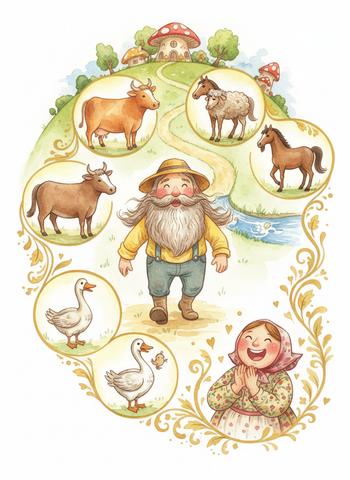
A farmer trades his way down from a cow to almost nothing on the way to market, and his wife is delighted with every single swap.
Once on a time there was a man whose name was Gudbrand; he had a farm which lay far, far away upon a hill-side, and so they called him Gudbrand on the Hill-side.
Era uma vez um homem chamado Gudbrand; ele tinha uma fazenda que ficava bem longe, lá em cima de uma encosta, e por isso o chamavam de Gudbrand da Encosta.
Now, you must know this man and his goodwife lived so happily together, and understood one another so well, that all the husband did the wife thought so well done there was nothing like it in the world, and she was always glad whatever he turned his hand to. The farm was their own land, and they had a hundred dollars lying at the bottom of their chest, and two cows tethered up in a stall in their farm-yard.
Ora, é preciso saber que esse homem e sua boa esposa viviam tão felizes juntos, e se entendiam tão bem, que tudo o que o marido fazia a esposa achava tão bem feito que não havia nada igual no mundo, e ela sempre ficava contente com o que quer que ele se pusesse a fazer. A fazenda era propriedade deles, e tinham cem dólares guardados no fundo do baú, e duas vacas amarradas em um estábulo no quintal da fazenda.
So one day his wife said to Gudbrand:
Um dia, sua esposa disse a Gudbrand:
“Do you know, dear, I think we ought to take one of our cows into town, and sell it; that’s what I think; for then we shall have some money in hand, and such well-to-do people as we ought to have ready money like the rest of the world. As for the hundred dollars at the bottom of the chest yonder, we can’t make a hole in them, and I’m sure I don’t know what we want with more than one cow. Besides, we shall gain a little in another way, for then I shall get off with only looking after one cow, instead of having, as now, to feed and litter and water two.”
— Sabe, querido, acho que deveríamos levar uma de nossas vacas até a cidade e vendê-la; é isso que eu acho; assim teríamos algum dinheiro em mãos, e gente próspera como nós deveria ter dinheiro vivo, como todo mundo. Quanto aos cem dólares no fundo do baú ali, não podemos mexer neles, e tenho certeza de que não sei para que precisamos de mais de uma vaca. Além disso, ganharemos um pouco de outra forma, pois assim eu só terei que cuidar de uma vaca, em vez de, como agora, alimentar, forrar e dar água a duas.
Well, Gudbrand thought his wife talked right good sense, so he set off at once with the cow on his way to town to sell her; but when he got to the town, there was no one who would buy his cow.
Bem, Gudbrand achou que sua esposa falava com muito bom senso, então partiu imediatamente com a vaca a caminho da cidade para vendê-la; mas quando chegou à cidade, não havia ninguém que quisesse comprar sua vaca.
“Well! well! never mind”, said Gudbrand, “at the worst, I can only go back home again with my cow. I’ve both stable and tether for her, I should think, and the road is no farther out than in”; and with that he began to toddle home with his cow.
— Bem! bem! não importa — disse Gudbrand —, na pior das hipóteses, posso apenas voltar para casa com minha vaca. Tenho tanto estábulo quanto corda para ela, acho eu, e o caminho não é mais longo para lá do que para cá; e com isso começou a andar de volta para casa com sua vaca.
But when he had gone a bit of the way, a man met him who had a horse to sell, so Gudbrand thought ’twas better to have a horse than a cow, so he swopped with the man. A little farther on he met a man walking along and driving a fat pig before him, and he thought it better to have a fat pig than a horse, so he swopped with the man.
Mas quando já tinha andado um pouco do caminho, encontrou um homem que tinha um cavalo à venda, e Gudbrand achou que era melhor ter um cavalo do que uma vaca, então trocou com o homem. Um pouco mais adiante encontrou um homem caminhando e conduzindo um porco gordo à sua frente, e achou que era melhor ter um porco gordo do que um cavalo, então trocou com o homem.
After that he went a little farther, and a man met him with a goat; so he thought it better to have a goat than a pig, and he swopped with the man that owned the goat. Then he went on a good bit till he met a man who had a sheep, and he swopped with him too, for he thought it always better to have a sheep than a goat.
Depois disso ele seguiu um pouco mais, e um homem o encontrou com uma cabra; então achou melhor ter uma cabra do que um porco, e trocou com o homem dono da cabra. Depois seguiu um bom trecho até encontrar um homem que tinha uma ovelha, e trocou com ele também, pois achava que era sempre melhor ter uma ovelha do que uma cabra.
After a while he met a man with a goose, and he swopped away the sheep for the goose; and when he had walked a long, long time, he met a man with a cock, and he swopped with him, for he thought in this wise, “’Tis surely better to have a cock than a goose.” Then he went on till the day was far spent, and he began to get very hungry, so he sold the cock for a shilling, and bought food with the money, for, thought Gudbrand on the Hill-side, “’Tis always better to save one’s life than to have a cock.”
Depois de um tempo encontrou um homem com um ganso, e trocou a ovelha pelo ganso; e quando já tinha andado bastante tempo, encontrou um homem com um galo, e trocou com ele, pois pensou assim: "É certamente melhor ter um galo do que um ganso." Então continuou até o dia já estar bem avançado, e começou a ficar muito faminto, então vendeu o galo por um xelim, e comprou comida com o dinheiro, pois, pensou Gudbrand da Encosta, "É sempre melhor salvar a própria vida do que ter um galo."
After that he went on home till he reached his nearest neighbour’s house, where he turned in.
Depois disso, seguiu para casa até chegar à casa do vizinho mais próximo, onde entrou.
“Well”, said the owner of the house, “how did things go with you in town?”
— Bem — disse o dono da casa —, como foram as coisas para você na cidade?
“Rather so so”, said Gudbrand, “I can’t praise my luck, nor do I blame it either”, and with that he told the whole story from first to last.
— Mais ou menos assim assim — disse Gudbrand —, não posso elogiar minha sorte, nem culpá-la tampouco —, e com isso contou toda a história do início ao fim.
“Ah!” said his friend, “you’ll get nicely called over the coals, that one can see, when you get home to your wife. Heaven help you, I wouldn’t stand in your shoes for something.”
— Ah! — disse seu amigo —, você vai levar uma bela bronca, isso dá para ver, quando chegar em casa com sua esposa. Deus te ajude, eu não gostaria de estar no seu lugar por nada.
“Well!” said Gudbrand on the Hill-side, “I think things might have gone much worse with me; but now, whether I have done wrong or not, I have so kind a goodwife, she never has a word to say against anything that I do.”
— Bem! — disse Gudbrand da Encosta —, acho que as coisas poderiam ter ido muito pior comigo; mas agora, tenha eu feito certo ou errado, tenho uma esposa tão boa que ela nunca tem uma palavra contra nada do que eu faço.
“Oh!” answered his neighbour, “I hear what you say, but I don’t believe it for all that.”
— Ah! — respondeu seu vizinho —, ouço o que você diz, mas não acredito nisso de jeito nenhum.
“Shall we lay a bet upon it?” asked Gudbrand on the Hill-side. “I have a hundred dollars at the bottom of my chest at home; will you lay as many against them?”
— Vamos apostar nisso? — perguntou Gudbrand da Encosta. — Tenho cem dólares no fundo do meu baú em casa; você aposta o mesmo contra eles?
Yes! the friend was ready to bet; so Gudbrand stayed there till evening, when it began to get dark, and then they went together to his house, and the neighbour was to stand outside the door and listen, while the man went in to see his wife.
Sim! o amigo estava disposto a apostar; então Gudbrand ficou ali até o anoitecer, quando começou a escurecer, e então foram juntos até sua casa, e o vizinho ficaria do lado de fora da porta para escutar, enquanto o homem entrava para ver sua esposa.
“Good evening!” said Gudbrand on the Hill-side.
— Boa noite! — disse Gudbrand da Encosta.
“Good evening!” said the goodwife. “Oh! is that you? now God be praised.”
— Boa noite! — disse a boa esposa. — Ah! é você? Agora Deus seja louvado.
Yes! it was he. So the wife asked how things had gone with him in town?
Sim! era ele. Então a esposa perguntou como as coisas tinham ido para ele na cidade.
“Oh! only so so”, answered Gudbrand; “not much to brag of. When I got to the town there was no one who would buy the cow, so you must know I swopped it away for a horse.”
— Ah! mais ou menos — respondeu Gudbrand —, nada de que me gabar. Quando cheguei à cidade não havia ninguém que quisesse comprar a vaca, então saiba que eu a troquei por um cavalo.
“For a horse”, said his wife; “well that is good of you; thanks with all my heart. We are so well to do that we may drive to church, just as well as other people; and if we choose to keep a horse we have a right to get one, I should think. So run out, child, and put up the horse.”
— Por um cavalo — disse sua esposa —, bem, isso foi muito bom da sua parte; obrigada com todo o meu coração. Somos gente próspera o bastante para ir de carruagem à igreja, assim como os outros; e se quisermos ter um cavalo, temos todo o direito de ter um, eu acho. Então corra lá fora, filho, e ponha o cavalo no estábulo.
“Ah!” said Gudbrand, “but you see I’ve not got the horse after all; for when I got a bit farther on the road, I swopped it away for a pig.”
— Ah! — disse Gudbrand —, mas veja bem, eu não tenho mais o cavalo; pois quando andei um pouco mais na estrada, troquei-o por um porco.
“Think of that, now!” said the wife; “you did just as I should have done myself; a thousand thanks! Now I can have a bit of bacon in the house to set before people when they come to see me, that I can. What do we want with a horse? People would only say we had got so proud that we couldn’t walk to church. Go out, child, and put up the pig in the sty.”
— Pensa só nisso! — disse a esposa —, você fez exatamente o que eu teria feito; mil vezes obrigada! Agora posso ter um pedaço de toucinho em casa para oferecer às pessoas quando vierem me visitar, isso sim. Para que queremos um cavalo? As pessoas só diriam que ficamos tão orgulhosos que não podemos mais andar a pé até a igreja. Vá lá fora, filho, e ponha o porco no chiqueiro.
“But I’ve not got the pig either”, said Gudbrand; “for when I got a little farther on, I swopped it away for a milch goat.”
— Mas eu não tenho o porco também — disse Gudbrand —, pois quando andei um pouco mais, troquei-o por uma cabra leiteira.
“Bless us!” cried his wife, “how well you manage everything! Now I think it over, what should I do with a pig? People would only point at us and say, ‘Yonder they eat up all they have got.’ No! now I have got a goat, and I shall have milk and cheese, and keep the goat too. Run out, child, and put up the goat.”
— Deus nos abençoe! — exclamou a esposa —, como você administra bem tudo! Agora pensando bem, o que eu faria com um porco? As pessoas só apontariam para nós e diriam: "Ali eles comem tudo o que têm." Não! agora tenho uma cabra, e terei leite e queijo, e ainda ficarei com a cabra. Corra lá fora, filho, e ponha a cabra no lugar.
“Nay, but I haven’t got the goat either”, said Gudbrand, “for a little farther on I swopped it away, and got a fine sheep instead.”
— Não, mas eu também não tenho a cabra — disse Gudbrand —, pois um pouco mais adiante troquei-a, e ganhei uma bela ovelha em vez dela.
“You don’t say so!” cried his wife; “why, you do everything to please me, just as if I had been with you; what do we want with a goat? If I had it I should lose half my time in climbing up the hills to get it down. No! if I have a sheep, I shall have both wool and clothing, and fresh meat in the house. Run out, child, and put up the sheep.”
— Não me diga! — exclamou a esposa —, ora, você faz tudo para me agradar, exatamente como se eu estivesse com você; para que queremos uma cabra? Se eu a tivesse, perderia metade do meu tempo subindo os morros para trazê-la de volta. Não! se eu tiver uma ovelha, terei tanto lã quanto roupa, e carne fresca em casa. Corra lá fora, filho, e ponha a ovelha no lugar.
“But I haven’t got the sheep any more than the rest”, said Gudbrand; “for when I had gone a bit farther, I swopped it away for a goose.”
— Mas eu não tenho a ovelha, assim como não tinha o resto — disse Gudbrand —; pois quando andei mais um pouco, troquei-a por um ganso.
“Thank you! thank you! with all my heart”, cried his wife; “what should I do with a sheep? I have no spinning-wheel, nor carding-comb, nor should I care to worry myself with cutting, and shaping, and sewing clothes. We can buy clothes now, as we have always done; and now I shall have roast goose, which I have longed for so often; and, besides, down to stuff my little pillow with. Run out, child, and put up the goose.”
— Obrigada! obrigada! de todo o coração — exclamou a esposa —; o que eu faria com uma ovelha? Não tenho roca de fiar, nem pente de cardar, nem me daria ao trabalho de cortar, moldar e costurar roupas. Podemos comprar roupas agora, como sempre fizemos; e agora terei ganso assado, que há tanto tempo desejo; e, além disso, penas para encher meu travesseirinho. Corra lá fora, filho, e ponha o ganso no lugar.
“Ah!” said Gudbrand, “but I haven’t the goose either; for when I had gone a bit farther I swopped it away for a cock.”
— Ah! — disse Gudbrand —, mas eu não tenho o ganso também; pois quando tinha andado mais um pouco, troquei-o por um galo.
“Dear me!” cried his wife, “how you think of everything! just as I should have done myself. A cock! think of that! why it’s as good as an eight-day clock, for every morning the cock crows at four o’clock, and we shall be able to stir our stumps in good time. What should we do with a goose? I don’t know how to cook it; and as for my pillow, I can stuff it with cotton-grass. Run out, child, and put up the cock.”
— Minha nossa! — exclamou a esposa —, como você pensa em tudo! exatamente como eu teria feito. Um galo! pensa só nisso! ora, é tão bom quanto um relógio de oito dias, pois toda manhã o galo canta às quatro horas, e poderemos nos mexer bem cedo. Para que faríamos com um ganso? Não sei como cozinhá-lo; e quanto ao meu travesseiro, posso enchê-lo com capim-de-algodão. Corra lá fora, filho, e ponha o galo no lugar.
“But, after all, I haven’t got the cock”, said Gudbrand; “for when I had gone a bit farther, I got as hungry as a hunter, so I was forced to sell the cock for a shilling, for fear I should starve.”
— Mas, no final das contas, eu não tenho o galo — disse Gudbrand —; pois quando andei mais um pouco, fiquei com tanta fome que fui obrigado a vender o galo por um xelim, com medo de passar fome.
“Now, God be praised that you did so!” cried his wife; “whatever you do, you do it always just after my own heart. What should we do with the cock? We are our own masters, I should think, and can lie a-bed in the morning as long as we like. Heaven be thanked that I have got you safe back again; you who do everything so well that I want neither cock nor goose; neither pigs nor kine.”
— Agora, Deus seja louvado por você ter feito isso! — exclamou a esposa —; o que quer que você faça, sempre faz exatamente como eu gostaria. Para que faríamos com o galo? Somos donos de nós mesmos, eu acho, e podemos ficar deitados até tarde de manhã, se quisermos. Bendito seja o Céu por ter você de volta são e salvo; você que faz tudo tão bem que não preciso nem de galo nem de ganso; nem de porcos nem de vacas.
Then Gudbrand opened the door and said; “Well, what do you say now? Have I won the hundred dollars?” and his neighbour was forced to allow that he had.
Então Gudbrand abriu a porta e disse: — Bem, o que você diz agora? Ganhei os cem dólares? — e seu vizinho foi obrigado a admitir que sim.
