Clever Hans
A free A2-level English story for language learners, readable online in 7 languages, with an option to listen via the free Storyteller app.
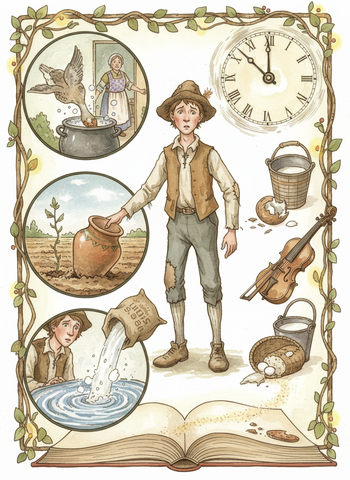
A foolish young man follows his mother's advice so literally, one gift at a time, that he manages to ruin every single one.
The mother of Hans said, “Whither away, Hans?” Hans answered, “To Grethel.” “Behave well, Hans.” “Oh, I’ll behave well. Good-bye, mother.” “Good-bye, Hans.” Hans comes to Grethel, “Good day, Grethel.” “Good day, Hans. What dost thou bring that is good?” “I bring nothing, I want to have something given me.” Grethel presents Hans with a needle. Hans says, “Good-bye, Grethel.” “Good-bye, Hans.”
A mãe de Hans perguntou: "Aonde vais, Hans?" Hans respondeu: "À casa da Grethel." "Comporta-te bem, Hans." "Ah, vou me comportar bem. Adeus, mãe." "Adeus, Hans." Hans chega à casa da Grethel. "Bom dia, Grethel." "Bom dia, Hans. Que coisa boa trazes?" "Não trago nada, quero que me deem alguma coisa." Grethel dá a Hans uma agulha. Hans diz: "Adeus, Grethel." "Adeus, Hans."
Hans takes the needle, sticks it into a hay-cart, and follows the cart home. “Good evening, mother.” “Good evening, Hans. Where hast thou been?” “With Grethel.” “What didst thou take her?” “Took nothing; had something given me.” “What did Grethel give thee?” “Gave me a needle.” “Where is the needle, Hans?” “Stuck it in the hay-cart.” “That was ill done, Hans. Thou shouldst have stuck the needle in thy sleeve.” “Never mind, I’ll do better next time.”
Hans pega a agulha, espeta-a numa carroça de feno e segue a carroça até em casa. "Boa noite, mãe." "Boa noite, Hans. Onde estiveste?" "Na casa da Grethel." "O que lhe levaste?" "Não levei nada; me deram uma coisa." "O que a Grethel te deu?" "Deu-me uma agulha." "Onde está a agulha, Hans?" "Espetei-a na carroça de feno." "Isso foi mal feito, Hans. Devias ter espetado a agulha na manga." "Não faz mal, da próxima vez farei melhor."
“Whither away, Hans?” “To Grethel, mother.” “Behave well, Hans.” “Oh, I’ll behave well. Good-bye, mother.” “Good-bye, Hans.”
"Aonde vais, Hans?" "À casa da Grethel, mãe." "Comporta-te bem, Hans." "Ah, vou me comportar bem. Adeus, mãe." "Adeus, Hans."
Hans comes to Grethel. “Good day, Grethel.” “Good day, Hans. What dost thou bring that is good?” “I bring nothing; I want to have something given to me.” Grethel presents Hans with a knife. “Good-bye, Grethel.” “Good-bye Hans.”
Hans chega à casa da Grethel. "Bom dia, Grethel." "Bom dia, Hans. Que coisa boa trazes?" "Não trago nada; quero que me deem alguma coisa." Grethel dá a Hans uma faca. "Adeus, Grethel." "Adeus, Hans."
Hans takes the knife, sticks it in his sleeve, and goes home. “Good evening, mother.” “Good evening, Hans. Where hast thou been?” “With Grethel.” “What didst thou take her?” “Took her nothing, she gave me something.” “What did Grethel give thee?” “Gave me a knife.” “Where is the knife, Hans?” “Stuck in my sleeve.” “That’s ill done, Hans, thou shouldst have put the knife in thy pocket.” “Never mind, will do better next time.” “Whither away, Hans?” “To Grethel, mother.” “Behave well, Hans.” “Oh, I’ll behave well. Good-bye, mother.” “Good-bye, Hans.”
Hans pega a faca, espeta-a na manga e vai para casa. "Boa noite, mãe." "Boa noite, Hans. Onde estiveste?" "Na casa da Grethel." "O que lhe levaste?" "Não levei nada, ela me deu uma coisa." "O que a Grethel te deu?" "Deu-me uma faca." "Onde está a faca, Hans?" "Espetada na minha manga." "Isso foi mal feito, Hans, devias ter posto a faca no bolso." "Não faz mal, da próxima vez farei melhor." "Aonde vais, Hans?" "À casa da Grethel, mãe." "Comporta-te bem, Hans." "Ah, vou me comportar bem. Adeus, mãe." "Adeus, Hans."
Hans comes to Grethel. “Good day, Grethel.” “Good day, Hans. What good thing dost thou bring?” “I bring nothing, I want something given me.” Grethel presents Hans with a young goat. “Good-bye, Grethel.” “Good-bye, Hans.” Hans takes the goat, ties its legs, and puts it in his pocket. When he gets home it is suffocated. “Good evening, mother.” “Good evening, Hans. Where hast thou been?” “With Grethel.” “What didst thou take her?” “Took nothing, she gave me something.” “What did Grethel give thee?” “She gave me a goat.” “Where is the goat, Hans?” “Put it in my pocket.” “That was ill done, Hans, thou shouldst have put a rope round the goat’s neck.” “Never mind, will do better next time.”
Hans chega à casa da Grethel. "Bom dia, Grethel." "Bom dia, Hans. Que coisa boa trazes?" "Não trago nada, quero que me deem alguma coisa." Grethel dá a Hans um cabritinho. "Adeus, Grethel." "Adeus, Hans." Hans pega o cabrito, amarra-lhe as patas e o põe no bolso. Quando chega em casa, o bicho está sufocado. "Boa noite, mãe." "Boa noite, Hans. Onde estiveste?" "Na casa da Grethel." "O que lhe levaste?" "Não levei nada, ela me deu uma coisa." "O que a Grethel te deu?" "Ela me deu um cabrito." "Onde está o cabrito, Hans?" "Pus no meu bolso." "Isso foi mal feito, Hans, devias ter posto uma corda no pescoço do cabrito." "Não faz mal, da próxima vez farei melhor."
“Whither away, Hans?” “To Grethel, mother.” “Behave well, Hans.” “Oh, I’ll behave well. Good-bye, mother.” “Good-bye, Hans.” Hans comes to Grethel. “Good day, Grethel.” “Good day, Hans. What good thing dost thou bring?” “I bring nothing, I want something given me.” Grethel presents Hans with a piece of bacon. “Good-bye, Grethel.” “Good-bye, Hans.”
"Aonde vais, Hans?" "À casa da Grethel, mãe." "Comporta-te bem, Hans." "Ah, vou me comportar bem. Adeus, mãe." "Adeus, Hans." Hans chega à casa da Grethel. "Bom dia, Grethel." "Bom dia, Hans. Que coisa boa trazes?" "Não trago nada, quero que me deem alguma coisa." Grethel dá a Hans um pedaço de toucinho. "Adeus, Grethel." "Adeus, Hans."
Hans takes the bacon, ties it to a rope, and drags it away behind him. The dogs come and devour the bacon. When he gets home, he has the rope in his hand, and there is no longer anything hanging to it.
Hans pega o toucinho, amarra-o numa corda e o arrasta atrás de si. Os cachorros vêm e devoram o toucinho. Quando chega em casa, tem a corda na mão, e já não há mais nada pendurado nela.
“Good evening, mother.” “Good evening, Hans.” “Where hast thou been?” “With Grethel.” “What didst thou take her?” “I took her nothing, she gave me something.” “What did Grethel give thee?” “Gave me a bit of bacon.” “Where is the bacon, Hans?” “I tied it to a rope, brought it home, dogs took it.” “That was ill done, Hans, thou shouldst have carried the bacon on thy head.” “Never mind, will do better next time.” “Whither away, Hans?” “To Grethel, mother.” “Behave well, Hans.” “I’ll behave well. Good-bye, mother.” “Good-bye, Hans.”
"Boa noite, mãe." "Boa noite, Hans." "Onde estiveste?" "Na casa da Grethel." "O que lhe levaste?" "Não levei nada, ela me deu uma coisa." "O que a Grethel te deu?" "Deu-me um pedaço de toucinho." "Onde está o toucinho, Hans?" "Amarrei-o numa corda, trouxe para casa, os cachorros levaram." "Isso foi mal feito, Hans, devias ter carregado o toucinho na cabeça." "Não faz mal, da próxima vez farei melhor." "Aonde vais, Hans?" "À casa da Grethel, mãe." "Comporta-te bem, Hans." "Vou me comportar bem. Adeus, mãe." "Adeus, Hans."
Hans comes to Grethel. “Good day, Grethel.” “Good day, Hans.” “What good thing dost thou bring?” “I bring nothing, but would have something given.” Grethel presents Hans with a calf. “Good-bye, Grethel.” “Good-bye, Hans.”
Hans chega à casa da Grethel. "Bom dia, Grethel." "Bom dia, Hans." "Que coisa boa trazes?" "Não trago nada, mas queria que me dessem alguma coisa." Grethel dá a Hans um bezerro. "Adeus, Grethel." "Adeus, Hans."
Hans takes the calf, puts it on his head, and the calf kicks his face. “Good evening, mother.” “Good evening, Hans. Where hast thou been?” “With Grethel.” “What didst thou take her?” “I took nothing, but had something given me.” “What did Grethel give thee?” “A calf.” “Where hast thou the calf, Hans?” “I set it on my head and it kicked my face.” “That was ill done, Hans, thou shouldst have led the calf, and put it in the stall.” “Never mind, will do better next time.”
Hans pega o bezerro, põe-no na cabeça, e o bezerro dá-lhe um coice na cara. "Boa noite, mãe." "Boa noite, Hans. Onde estiveste?" "Na casa da Grethel." "O que lhe levaste?" "Não levei nada, mas me deram uma coisa." "O que a Grethel te deu?" "Um bezerro." "Onde está o bezerro, Hans?" "Pus na cabeça e ele deu-me um coice na cara." "Isso foi mal feito, Hans, devias ter levado o bezerro pela guia, e posto no estábulo." "Não faz mal, da próxima vez farei melhor."
“Whither away, Hans?” “To Grethel, mother.” “Behave well, Hans.” “I’ll behave well. Good-bye, mother.” “Good-bye, Hans.”
"Aonde vais, Hans?" "À casa da Grethel, mãe." "Comporta-te bem, Hans." "Vou me comportar bem. Adeus, mãe." "Adeus, Hans."
Hans comes to Grethel. “Good day, Grethel.” “Good day, Hans. What good thing dost thou bring?” “I bring nothing, but would have something given.” Grethel says to Hans, “I will go with thee.”
Hans chega à casa da Grethel. "Bom dia, Grethel." "Bom dia, Hans. Que coisa boa trazes?" "Não trago nada, mas queria que me dessem alguma coisa." Grethel diz a Hans: "Eu vou contigo."
Hans takes Grethel, ties her to a rope, leads her to the rack and binds her fast. Then Hans goes to his mother. “Good evening, mother.” “Good evening, Hans. Where hast thou been?” “With Grethel.” “What didst thou take her?” “I took her nothing.” “What did Grethel give thee?” “She gave me nothing, she came with me.” “Where hast thou left Grethel?” “I led her by the rope, tied her to the rack, and scattered some grass for her.” “That was ill done, Hans, thou shouldst have cast friendly eyes on her.” “Never mind, will do better.”
Hans pega Grethel, amarra-a numa corda, leva-a até a manjedoura e a prende bem firme. Depois Hans vai à casa da mãe. "Boa noite, mãe." "Boa noite, Hans. Onde estiveste?" "Na casa da Grethel." "O que lhe levaste?" "Não lhe levei nada." "O que a Grethel te deu?" "Ela não me deu nada, ela veio comigo." "Onde deixaste a Grethel?" "Eu a levei pela corda, amarrei-a na manjedoura e espalhei um pouco de capim para ela." "Isso foi mal feito, Hans, devias ter lançado olhares amigáveis para ela." "Não faz mal, farei melhor."
Hans went into the stable, gathered up all the calves’ and sheep’s eyes he could find, and tossed them to Grethel as a token of his goodwill. Then Grethel became angry, tore herself loose and ran away, and became the bride of Hans.
Hans foi ao estábulo, recolheu todos os olhos de bezerros e ovelhas que conseguiu encontrar, e os levou a Grethel como um gesto de boa vontade. Então Grethel ficou zangada, soltou-se e fugiu correndo, e tornou-se a noiva de Hans.
