The Swineherd
A free B1-level English story for language learners, readable online in 7 languages, with an option to listen via the free Storyteller app.
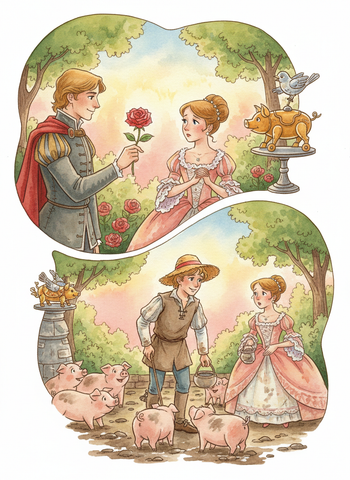
A poor prince offers a princess a beautiful rose and a nightingale, but she scorns real gifts for clever toys. Disguised as a swineherd, the prince teaches her a lesson about what truly matters.
There was once a poor Prince, who had a kingdom. His kingdom was very small, but still quite large enough to marry upon; and he wished to marry.
Había una vez un Príncipe pobre, que tenía un reino. Su reino era muy pequeño, pero de todos modos bastante grande para casarse; y él quería casarse.
It was certainly rather cool of him to say to the Emperor's daughter, “Will you have me?” But so he did; for his name was renowned far and wide; and there were a hundred princesses who would have answered, “Yes!” and “Thank you kindly.” We shall see what this princess said.
Ciertamente fue bastante osado de su parte decirle a la hija del Emperador, «¿Quieres casarte conmigo?» Pero así lo hizo; porque su nombre era conocido por todas partes; y había cien princesas que habrían respondido: «¡Sí!» y «Muchas gracias». Veremos qué dijo esta princesa.
Listen!
¡Escuchad!
It happened that where the Prince's father lay buried, there grew a rose tree—a most beautiful rose tree, which blossomed only once in every five years, and even then bore only one flower, but that was a rose! It smelt so sweet that all cares and sorrows were forgotten by him who inhaled its fragrance.
Sucedió que donde estaba enterrado el padre del Príncipe, crecía un rosal, un rosal hermosísimo, que florecía solo una vez cada cinco años, y aun entonces daba una sola flor, ¡pero era una rosa! Olía tan dulce que todas las preocupaciones y penas eran olvidadas por quien inhalaba su fragancia.
And furthermore, the Prince had a nightingale, who could sing in such a manner that it seemed as though all sweet melodies dwelt in her little throat. So the Princess was to have the rose, and the nightingale; and they were accordingly put into large silver caskets, and sent to her.
Y además, el Príncipe tenía un ruiseñor, que cantaba de tal manera que parecía que todas las melodías dulces habitaban en su pequeña garganta. Así que la Princesa recibiría la rosa y el ruiseñor; y fueron puestos en sendos grandes cofres de plata, y enviados a ella.
The Emperor had them brought into a large hall, where the Princess was playing at “Visiting,” with the ladies of the court; and when she saw the caskets with the presents, she clapped her hands for joy.
El Emperador los hizo traer a un gran salón, donde la Princesa jugaba a las «visitas» con las damas de la corte; y cuando vio los cofres con los regalos, aplaudió de alegría.
“Ah, if it were but a little pussy-cat!” said she; but the rose tree, with its beautiful rose came to view.
«¡Ay, ojalá fuera un gatito!», dijo ella; pero el rosal, con su hermosa rosa, apareció ante su vista.
“Oh, how prettily it is made!” said all the court ladies.
«¡Ay, qué bien hecho está!», dijeron todas las damas de la corte.
“It is more than pretty,” said the Emperor, “it is charming!”
«Es más que bonito», dijo el Emperador, «¡es encantador!»
But the Princess touched it, and was almost ready to cry.
Pero la Princesa lo tocó, y estuvo a punto de llorar.
“Fie, papa!” said she. “It is not made at all, it is natural!”
«¡Vaya, papá!», dijo ella. «¡No está hecho en absoluto, es natural!»
“Let us see what is in the other casket, before we get into a bad humor,” said the Emperor. So the nightingale came forth and sang so delightfully that at first no one could say anything ill-humored of her.
«Veamos qué hay en el otro cofre, antes de que nos pongamos de mal humor», dijo el Emperador. Así que el ruiseñor salió y cantó tan deliciosamente que al principio nadie pudo decir nada de mal gusto sobre él.
“Superbe! Charmant!” exclaimed the ladies; for they all used to chatter French, each one worse than her neighbor.
«¡Superbe! ¡Charmant!», exclamaron las damas; pues todas solían parlotear en francés, cada una peor que la otra.
“How much the bird reminds me of the musical box that belonged to our blessed Empress,” said an old knight. “Oh yes! These are the same tones, the same execution.”
«Cuánto me recuerda ese pájaro a la caja de música que perteneció a nuestra bendita Emperatriz», dijo un viejo caballero. «¡Ay, sí! Son los mismos tonos, la misma ejecución».
“Yes! yes!” said the Emperor, and he wept like a child at the remembrance.
«¡Sí! ¡Sí!», dijo el Emperador, y lloró como un niño al recordarlo.
“I will still hope that it is not a real bird,” said the Princess.
«Aún tengo la esperanza de que no sea un pájaro de verdad», dijo la Princesa.
“Yes, it is a real bird,” said those who had brought it. “Well then let the bird fly,” said the Princess; and she positively refused to see the Prince.
«Sí, es un pájaro de verdad», dijeron quienes lo habían traído. «Bueno, entonces dejad que el pájaro vuele», dijo la Princesa; y se negó rotundamente a ver al Príncipe.
However, he was not to be discouraged; he daubed his face over brown and black; pulled his cap over his ears, and knocked at the door.
Sin embargo, él no se dejó desanimar; se untó la cara de marrón y negro; se caló la gorra hasta las orejas, y llamó a la puerta.
“Good day to my lord, the Emperor!” said he. “Can I have employment at the palace?”
«¡Buenos días a mi señor, el Emperador!», dijo él. «¿Podría tener empleo en el palacio?»
“Why, yes,” said the Emperor. “I want some one to take care of the pigs, for we have a great many of them.”
«Pues, sí», dijo el Emperador. «Necesito a alguien que cuide de los cerdos, pues tenemos muchísimos».
So the Prince was appointed “Imperial Swineherd.” He had a dirty little room close by the pigsty; and there he sat the whole day, and worked. By the evening he had made a pretty little kitchen-pot. Little bells were hung all round it; and when the pot was boiling, these bells tinkled in the most charming manner, and played the old melody,
Así que el Príncipe fue nombrado «Porquerizo Imperial». Tenía una habitacioncita sucia junto a la pocilga; y allí se sentaba todo el día, y trabajaba. Para la noche había hecho una linda ollita de cocina. Le colgó campanitas por todo alrededor; y cuando la olla hervía, esas campanitas tintineaban de la manera más encantadora, y tocaban la vieja melodía,
“Ach! du lieber Augustin, Alles ist weg, weg, weg!”*
"Ach! du lieber Augustin, Alles ist weg, weg, weg!"*
* “Ah! dear Augustine! All is gone, gone, gone!”
* "¡Ay, querido Augustín! ¡Todo se ha ido, ido, ido!"
But what was still more curious, whoever held his finger in the smoke of the kitchen-pot, immediately smelt all the dishes that were cooking on every hearth in the city—this, you see, was something quite different from the rose.
Pero lo que era aún más curioso, quien pusiera el dedo en el humo de la ollita, inmediatamente olía todos los platos que se cocinaban en cada hogar de la ciudad; esto, ya veis, era algo bastante diferente de la rosa.
Now the Princess happened to walk that way; and when she heard the tune, she stood quite still, and seemed pleased; for she could play “Lieber Augustine”; it was the only piece she knew; and she played it with one finger.
Ahora bien, la Princesa pasó por allí; y cuando oyó la melodía, se quedó completamente quieta, y pareció complacida; pues sabía tocar «Lieber Augustin»; era la única pieza que sabía; y la tocaba con un solo dedo.
“Why there is my piece,” said the Princess. “That swineherd must certainly have been well educated! Go in and ask him the price of the instrument.”
«Vaya, esa es mi pieza», dijo la Princesa. «¡Ese porquerizo debe de haber sido bien educado! Entrad y preguntadle el precio del instrumento».
So one of the court-ladies must run in; however, she drew on wooden slippers first.
Así que una de las damas de la corte tuvo que entrar corriendo; sin embargo, se puso primero unas zapatillas de madera.
“What will you take for the kitchen-pot?” said the lady.
«¿Qué pedís por la ollita de cocina?», dijo la dama.
“I will have ten kisses from the Princess,” said the swineherd.
«Quiero diez besos de la Princesa», dijo el porquerizo.
“Yes, indeed!” said the lady.
«¡Sí, claro!», dijo la dama.
“I cannot sell it for less,” rejoined the swineherd.
«No puedo venderla por menos», replicó el porquerizo.
“He is an impudent fellow!” said the Princess, and she walked on; but when she had gone a little way, the bells tinkled so prettily
«¡Es un tipo insolente!», dijo la Princesa, y siguió caminando; pero cuando ya había andado un poco, las campanitas tintinearon tan bonito
“Ach! du lieber Augustin, Alles ist weg, weg, weg!”
"Ach! du lieber Augustin, Alles ist weg, weg, weg!"
“Stay,” said the Princess. “Ask him if he will have ten kisses from the ladies of my court.”
«Esperad», dijo la Princesa. «Preguntadle si aceptaría diez besos de las damas de mi corte».
“No, thank you!” said the swineherd. “Ten kisses from the Princess, or I keep the kitchen-pot myself.”
«¡No, gracias!», dijo el porquerizo. «Diez besos de la Princesa, o me quedo la ollita para mí».
“That must not be, either!” said the Princess. “But do you all stand before me that no one may see us.”
«¡Eso tampoco puede ser!», dijo la Princesa. «Pero poneos todas delante de mí para que nadie nos vea».
And the court-ladies placed themselves in front of her, and spread out their dresses—the swineherd got ten kisses, and the Princess—the kitchen-pot.
Y las damas de la corte se colocaron frente a ella, y extendieron sus vestidos: el porquerizo consiguió diez besos, y la Princesa, la ollita de cocina.
That was delightful! The pot was boiling the whole evening, and the whole of the following day. They knew perfectly well what was cooking at every fire throughout the city, from the chamberlain's to the cobbler's; the court-ladies danced and clapped their hands.
¡Aquello fue delicioso! La olla estuvo hirviendo toda la tarde, y todo el día siguiente. Sabían perfectamente qué se cocinaba en cada fuego de toda la ciudad, desde el del chambelán hasta el del zapatero; las damas de la corte bailaban y aplaudían.
“We know who has soup, and who has pancakes for dinner to-day, who has cutlets, and who has eggs. How interesting!”
«Sabemos quién tiene sopa, y quién tiene panqueques de cena hoy, quién tiene chuletas, y quién tiene huevos. ¡Qué interesante!»
“Yes, but keep my secret, for I am an Emperor's daughter.”
«Sí, pero guardad mi secreto, pues soy hija de un Emperador».
The swineherd—that is to say—the Prince, for no one knew that he was other than an ill-favored swineherd, let not a day pass without working at something; he at last constructed a rattle, which, when it was swung round, played all the waltzes and jig tunes, which have ever been heard since the creation of the world.
El porquerizo, es decir, el Príncipe, pues nadie sabía que era otra cosa que un porquerizo de mal aspecto, no dejaba pasar un día sin trabajar en algo; al fin construyó una matraca, que, al girarla, tocaba todos los valses y giga que jamás se hayan oído desde la creación del mundo.
“Ah, that is superbe!” said the Princess when she passed by. “I have never heard prettier compositions! Go in and ask him the price of the instrument; but mind, he shall have no more kisses!”
«¡Ay, eso es superbe!», dijo la Princesa cuando pasó por allí. «¡Jamás he oído composiciones más bonitas! Entrad y preguntadle el precio del instrumento; pero cuidado, que no reciba más besos!»
“He will have a hundred kisses from the Princess!” said the lady who had been to ask.
«¡Quiere cien besos de la Princesa!», dijo la dama que había ido a preguntar.
“I think he is not in his right senses!” said the Princess, and walked on, but when she had gone a little way, she stopped again. “One must encourage art,” said she, “I am the Emperor's daughter. Tell him he shall, as on yesterday, have ten kisses from me, and may take the rest from the ladies of the court.”
«¡Creo que no está en sus cabales!», dijo la Princesa, y siguió caminando, pero cuando ya había andado un poco, se detuvo de nuevo. «Hay que alentar el arte», dijo, «soy la hija del Emperador. Decidle que tendrá, como ayer, diez besos míos, y puede tomar el resto de las damas de la corte».
“Oh—but we should not like that at all!” said they. “What are you muttering?” asked the Princess. “If I can kiss him, surely you can. Remember that you owe everything to me.” So the ladies were obliged to go to him again.
«¡Ay, pero eso no nos gustaría nada!», dijeron ellas. «¿Qué estáis murmurando?», preguntó la Princesa. «Si yo puedo besarlo, seguro que vosotras también podéis. Recordad que me debéis todo». Así que las damas se vieron obligadas a ir a verlo de nuevo.
“A hundred kisses from the Princess,” said he, “or else let everyone keep his own!”
«Cien besos de la Princesa», dijo él, «¡o si no que cada uno se quede con lo suyo!»
“Stand round!” said she; and all the ladies stood round her whilst the kissing was going on.
«¡Poneos alrededor!», dijo ella; y todas las damas se pusieron a su alrededor mientras tenía lugar el besuqueo.
“What can be the reason for such a crowd close by the pigsty?” said the Emperor, who happened just then to step out on the balcony; he rubbed his eyes, and put on his spectacles. “They are the ladies of the court; I must go down and see what they are about!” So he pulled up his slippers at the heel, for he had trodden them down.
«¿Cuál puede ser la razón de tal multitud junto a la pocilga?», dijo el Emperador, que justo entonces salió al balcón; se frotó los ojos, y se puso los anteojos. «Son las damas de la corte; ¡debo bajar a ver qué están haciendo!» Así que se subió las zapatillas por el talón, pues las llevaba pisadas.
As soon as he had got into the court-yard, he moved very softly, and the ladies were so much engrossed with counting the kisses, that all might go on fairly, that they did not perceive the Emperor. He rose on his tiptoes.
En cuanto llegó al patio, se movió muy suavemente, y las damas estaban tan absortas contando los besos, para que todo saliera bien, que no se percataron del Emperador. Él se puso de puntillas.
“What is all this?” said he, when he saw what was going on, and he boxed the Princess's ears with his slipper, just as the swineherd was taking the eighty-sixth kiss.
«¿Qué es todo esto?», dijo, cuando vio lo que ocurría, y le dio a la Princesa un golpe en las orejas con su zapatilla, justo cuando el porquerizo tomaba el octogésimo sexto beso.
“March out!” said the Emperor, for he was very angry; and both Princess and swineherd were thrust out of the city.
«¡Marchaos!», dijo el Emperador, pues estaba muy enojado; y tanto la Princesa como el porquerizo fueron expulsados de la ciudad.
The Princess now stood and wept, the swineherd scolded, and the rain poured down.
La Princesa se quedó de pie llorando, el porquerizo refunfuñaba, y la lluvia caía a cántaros.
“Alas! Unhappy creature that I am!” said the Princess. “If I had but married the handsome young Prince! Ah! how unfortunate I am!”
«¡Ay! ¡Qué criatura tan infeliz soy!», dijo la Princesa. «¡Si tan solo me hubiera casado con el apuesto joven Príncipe! ¡Ay, qué desdichada soy!»
And the swineherd went behind a tree, washed the black and brown color from his face, threw off his dirty clothes, and stepped forth in his princely robes; he looked so noble that the Princess could not help bowing before him.
Y el porquerizo se fue detrás de un árbol, se lavó el color negro y marrón de la cara, se quitó sus ropas sucias, y salió vestido con sus ropajes principescos; se veía tan noble que la Princesa no pudo evitar inclinarse ante él.
“I am come to despise thee,” said he. “Thou would'st not have an honorable Prince! Thou could'st not prize the rose and the nightingale, but thou wast ready to kiss the swineherd for the sake of a trumpery plaything. Thou art rightly served.”
«He venido a despreciarte», dijo él. «¡No quisiste a un Príncipe honorable! No supiste apreciar la rosa ni el ruiseñor, pero estabas dispuesta a besar al porquerizo por un juguete insignificante. Bien merecido lo tienes».
He then went back to his own little kingdom, and shut the door of his palace in her face. Now she might well sing,
Entonces regresó a su propio reinito, y le cerró la puerta de su palacio en la cara. Ahora bien podía ella cantar,
“Ach! du lieber Augustin, Alles ist weg, weg, weg!”
"Ach! du lieber Augustin, Alles ist weg, weg, weg!"
