The Shift Nobody Wanted
Una historia gratuita en inglés de nivel B2 para estudiantes, para leer en línea en 3 idiomas, con opción de escucharla en la app gratuita Storyteller.
When an automated scheduling system assigns him four closing shifts in a row, Toma documents the pattern until his manager forces a human check back into the process.
¡Ese fue el avance! Escucha la historia completa en la app gratuita Storyteller. Descargar la app
El audio no está disponible en este momento.
Toma had worked the same closing shift at the store for three years, trading it occasionally with coworkers whenever life required it. The new scheduling system had been installed to make that kind of trading easier, not harder.
Toma había trabajado el mismo turno de cierre en la tienda durante tres años, y lo intercambiaba de vez en cuando con sus compañeros cuando la vida lo exigía. El nuevo sistema de horarios se había instalado para hacer ese tipo de intercambio más fácil, no más difícil.
Instead, it had started assigning shifts by an algorithm nobody fully understood, optimizing for something the company called "coverage efficiency."
En cambio, había empezado a asignar turnos mediante un algoritmo que nadie entendía del todo, optimizando algo que la empresa llamaba «eficiencia de cobertura».
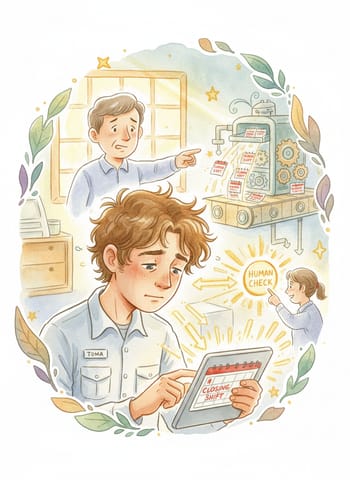
"It gave me four closes in a row this week," Toma told his manager, staring at the app's neat, color-coded calendar. "I haven't had that happen since I started here."
«Me dio cuatro cierres seguidos esta semana», le dijo Toma a su gerente, mirando fijamente el calendario ordenado y codificado por colores de la aplicación. «No me había pasado esto desde que empecé a trabajar aquí».
"The system says it's balancing everyone's availability," his manager said, sounding almost as confused as Toma felt. "I don't actually control the assignments anymore."
«El sistema dice que está equilibrando la disponibilidad de todos», dijo su gerente, sonando casi tan confundido como se sentía Toma. «Ya no controlo realmente las asignaciones».
If a human had built this schedule, Toma thought, someone would have noticed a person working four closing shifts straight. The algorithm had simply optimized around the constraints it was given, and fairness hadn't been one of them.
Si un humano hubiera hecho este horario, pensó Toma, alguien habría notado que una persona trabajaba cuatro cierres seguidos. El algoritmo simplemente había optimizado según las restricciones que se le dieron, y la equidad no había sido una de ellas.
He tried requesting a swap through the app, but the system rejected it automatically, citing "insufficient coverage" for the shift he wanted to give away. A coworker had reportedly been told the same thing the previous month.
Intentó solicitar un cambio a través de la aplicación, pero el sistema lo rechazó automáticamente, citando «cobertura insuficiente» para el turno que quería ceder. Según decían, a un compañero le habían dicho lo mismo el mes anterior.
"Has anyone actually complained to the company directly?" Toma asked during break, looking around at the tired faces of his coworkers.
«¿Alguien se ha quejado realmente a la empresa de forma directa?», preguntó Toma durante el descanso, mirando los rostros cansados de sus compañeros.
"I did, once," said a woman from the bakery counter. "Got a message back saying the system 'learns from patterns over time.' Didn't say what that meant."
«Yo lo hice, una vez», dijo una mujer del mostrador de la panadería. «Recibí un mensaje que decía que el sistema "aprende de los patrones con el tiempo". No decía qué significaba eso».
Toma decided to keep a written log instead, documenting exactly which shifts he'd been assigned and when he'd requested swaps that got rejected. If the algorithm wouldn't listen, maybe a manager reading actual evidence would.
Toma decidió llevar un registro escrito en su lugar, documentando exactamente qué turnos le habían asignado y cuándo había solicitado cambios que fueron rechazados. Si el algoritmo no iba a escuchar, tal vez un gerente que leyera pruebas reales sí lo haría.
Three weeks and one detailed log later, his manager brought the printed pages into a meeting with regional management.
Tres semanas y un registro detallado después, su gerente llevó las páginas impresas a una reunión con la dirección regional.
"This isn't sustainable," she said, pointing to the pattern. "Someone should have caught this months ago. We need a human to review the schedule before it's finalized, every week."
«Esto no es sostenible», dijo ella, señalando el patrón. «Alguien debería haberse dado cuenta de esto hace meses. Necesitamos que una persona revise el horario antes de que se finalice, cada semana».
The change wasn't instant, but within a month, a manager's approval step had been added before any schedule went live.
El cambio no fue inmediato, pero en un mes se había añadido un paso de aprobación por parte de un gerente antes de que cualquier horario se publicara.
"Still not perfect," Toma said. "But at least a person looks at it now, not just a number."
«Todavía no es perfecto», dijo Toma. «Pero al menos ahora una persona lo revisa, no solo un número».