Hudden and Dudden and Donald O'Neary
A free B1-level English story for language learners, readable online in 7 languages, with an option to listen via the free Storyteller app.
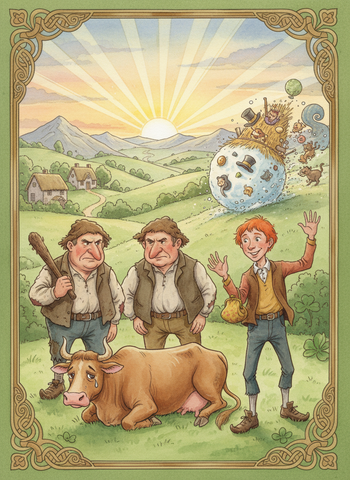
When two greedy farmers kill his only cow out of spite, poor Donald O'Neary turns the loss into a wild trick — one that keeps snowballing further than anyone expects.
There was once upon a time two farmers, and their names were Hudden and Dudden. They had poultry in their yards, sheep on the uplands, and scores of cattle in the meadow-land alongside the river. But for all that they weren't happy. For just between their two farms there lived a poor man by the name of Donald O'Neary. He had a hovel over his head and a strip of grass that was barely enough to keep his one cow, Daisy, from starving, and, though she did her best, it was but seldom that Donald got a drink of milk or a roll of butter from Daisy.
Había una vez dos granjeros, y se llamaban Hudden y Dudden. Tenían aves de corral en sus corrales, ovejas en las tierras altas, y docenas de reses en los prados junto al río. Pero con todo eso no eran felices. Pues justo entre sus dos granjas vivía un hombre pobre llamado Donald O'Neary. Tenía una choza sobre la cabeza y una franja de hierba que apenas bastaba para evitar que su única vaca, Margarita, se muriera de hambre, y, aunque ella hacía lo posible, era raro que Donald consiguiera un trago de leche o una porción de mantequilla de Margarita.
You would think there was little here to make Hudden and Dudden jealous, but so it is, the more one has the more one wants, and Donald's neighbours lay awake of nights scheming how they might get hold of his little strip of grass-land. Daisy, poor thing, they never thought of; she was just a bag of bones.
Uno pensaría que había poco aquí para dar celos a Hudden y Dudden, pero así es: cuanto más se tiene, más se quiere, y los vecinos de Donald pasaban las noches en vela maquinando cómo apoderarse de su pequeña franja de tierra de pastoreo. En cuanto a la pobre Margarita, nunca pensaron en ella; era solo un saco de huesos.
One day Hudden met Dudden, and they were soon grumbling as usual, and all to the tune of "If only we could get that vagabond Donald O'Neary out of the country."
Un día Hudden se encontró con Dudden, y pronto se pusieron a refunfuñar como de costumbre, todo con el mismo estribillo: «Si tan solo pudiéramos sacar a ese vagabundo de Donald O'Neary del país».
"Let's kill Daisy," said Hudden at last; "if that doesn't make him clear out, nothing will."
—Matemos a Margarita —dijo Hudden por fin—; si eso no lo hace largarse, nada lo hará.
No sooner said than agreed, and it wasn't dark before Hudden and Dudden crept up to the little shed where lay poor Daisy trying her best to chew the cud, though she hadn't had as much grass in the day as would cover your hand. And when Donald came to see if Daisy was all snug for the night, the poor beast had only time to lick his hand once before she died.
Dicho y hecho, y no había oscurecido aún cuando Hudden y Dudden se arrastraron hasta el pequeño cobertizo donde yacía la pobre Margarita, tratando de rumiar lo mejor que podía, aunque no había tenido en todo el día tanta hierba como cabría en una mano. Y cuando Donald fue a ver si Margarita estaba bien resguardada para la noche, la pobre bestia apenas tuvo tiempo de lamerle la mano una vez antes de morir.
Well, Donald was a shrewd fellow, and downhearted though he was, began to think if he could get any good out of Daisy's death. He thought and he thought, and the next day you could have seen him trudging off early to the fair, Daisy's hide over his shoulder, every penny he had jingling in his pockets. Just before he got to the fair, he made several slits in the hide, put a penny in each slit, walked into the best inn of the town as bold as if it belonged to him, and, hanging the hide up to a nail in the wall, sat down.
Bueno, Donald era un tipo astuto, y aunque estaba desanimado, empezó a pensar si podría sacar algún provecho de la muerte de Margarita. Pensó y pensó, y al día siguiente se le podía ver marchando muy temprano hacia la feria, con la piel de Margarita al hombro, y cada moneda que tenía tintineando en sus bolsillos. Justo antes de llegar a la feria, hizo varios cortes en la piel, puso una moneda en cada corte, entró en la mejor posada del pueblo tan audaz como si fuera suya, y, colgando la piel de un clavo en la pared, se sentó.
"Some of your best whisky," says he to the landlord.
—Un poco de su mejor whisky —le dijo al posadero.
But the landlord didn't like his looks. "Is it fearing I won't pay you, you are?" says Donald; "why I have a hide here that gives me all the money I want." And with that he hit it a whack with his stick and out hopped a penny. The landlord opened his eyes, as you may fancy.
Pero al posadero no le gustaron sus modales. —¿Es que teme que no le pague, verdad? —dijo Donald—; pues tengo aquí una piel que me da todo el dinero que necesito. —Y con eso le dio un golpe con su bastón y saltó una moneda. El posadero abrió los ojos como se puede imaginar.
"What'll you take for that hide?"
—¿Cuánto pide por esa piel?
"It's not for sale, my good man."
—No está en venta, buen hombre.
"Will you take a gold piece?"
—¿Aceptaría una moneda de oro?
"It's not for sale, I tell you. Hasn't it kept me and mine for years?" and with that Donald hit the hide another whack and out jumped a second penny.
—No está en venta, le digo. ¿Acaso no me ha mantenido a mí y a los míos durante años? —y con eso Donald le dio a la piel otro golpe y saltó una segunda moneda.
Well, the long and the short of it was that Donald let the hide go, and, that very evening, who but he should walk up to Hudden's door?
Bueno, para resumir, Donald acabó vendiendo la piel, y, esa misma tarde, ¿quién sino él fue a llamar a la puerta de Hudden?
"Good-evening, Hudden. Will you lend me your best pair of scales?"
—Buenas tardes, Hudden. ¿Me prestaría su mejor balanza?
Hudden stared and Hudden scratched his head, but he lent the scales.
Hudden se quedó mirando y se rascó la cabeza, pero le prestó la balanza.
When Donald was safe at home, he pulled out his pocketful of bright gold and began to weigh each piece in the scales. But Hudden had put a lump of butter at the bottom, and so the last piece of gold stuck fast to the scales when he took them back to Hudden.
Cuando Donald estuvo a salvo en su casa, sacó su bolsillo lleno de reluciente oro y empezó a pesar cada moneda en la balanza. Pero Hudden había puesto un trozo de mantequilla en el fondo, y así la última moneda de oro se quedó pegada a la balanza cuando se la devolvió a Hudden.
If Hudden had stared before, he stared ten times more now, and no sooner was Donald's back turned, than he was of as hard as he could pelt to Dudden's.
Si antes Hudden se había quedado mirando, ahora se quedó mirando diez veces más, y en cuanto Donald le dio la espalda, corrió lo más rápido que pudo hacia la casa de Dudden.
"Good-evening, Dudden. That vagabond, bad luck to him—"
—Buenas tardes, Dudden. Ese vagabundo, mala suerte tenga—
"You mean Donald O'Neary?"
—¿Te refieres a Donald O'Neary?
"And who else should I mean? He's back here weighing out sackfuls of gold."
—¿Y a quién más habría de referirme? Está en su casa pesando sacos enteros de oro.
"How do you know that?"
—¿Cómo lo sabes?
"Here are my scales that he borrowed, and here's a gold piece still sticking to them."
—Aquí está mi balanza que él pidió prestada, y aquí hay una moneda de oro aún pegada a ella.
Off they went together, and they came to Donald's door. Donald had finished making the last pile of ten gold pieces. And he couldn't finish because a piece had stuck to the scales.
Se fueron juntos, y llegaron a la puerta de Donald. Donald acababa de terminar de hacer la última pila de diez monedas de oro. Y no podía terminar porque una moneda se había quedado pegada a la balanza.
In they walked without an "If you please" or "By your leave."
Entraron sin un «con permiso» ni un «si me disculpa».
"Well, I never!" that was all they could say.
—¡Vaya, no puedo creerlo! —fue todo lo que pudieron decir.
"Good-evening, Hudden; good-evening, Dudden. Ah! you thought you had played me a fine trick, but you never did me a better turn in all your lives. When I found poor Daisy dead, I thought to myself, 'Well, her hide may fetch something;' and it did. Hides are worth their weight in gold in the market just now."
—Buenas tardes, Hudden; buenas tardes, Dudden. ¡Ah! Creyeron que me habían jugado una buena treta, pero nunca me hicieron mejor favor en toda su vida. Cuando encontré a la pobre Margarita muerta, pensé para mis adentros: «Bueno, su piel quizás me traiga algo»; y así fue. Las pieles valen su peso en oro en el mercado ahora mismo.
Hudden nudged Dudden, and Dudden winked at Hudden.
Hudden le dio un codazo a Dudden, y Dudden le guiñó un ojo a Hudden.
"Good-evening, Donald O'Neary."
—Buenas tardes, Donald O'Neary.
"Good-evening, kind friends."
—Buenas tardes, amables amigos.
The next day there wasn't a cow or a calf that belonged to Hudden or Dudden but her hide was going to the fair in Hudden's biggest cart drawn by Dudden's strongest pair of horses.
Al día siguiente no quedó vaca ni ternero que perteneciera a Hudden ni a Dudden cuya piel no fuera camino a la feria en el carro más grande de Hudden, tirado por el par de caballos más fuerte de Dudden.
When they came to the fair, each one took a hide over his arm, and there they were walking through the fair, bawling out at the top of their voices: "Hides to sell! hides to sell!"
Cuando llegaron a la feria, cada uno tomó una piel bajo el brazo, y allí anduvieron caminando por la feria, gritando a todo pulmón: «¡Pieles para vender! ¡Pieles para vender!».
Out came the tanner:
Salió el curtidor:
"How much for your hides, my good men?"
—¿Cuánto por sus pieles, buenos hombres?
"Their weight in gold."
—Su peso en oro.
"It's early in the day to come out of the tavern."
—Es temprano para haber salido ya de la taberna.
That was all the tanner said, and back he went to his yard.
Eso fue todo lo que dijo el curtidor, y volvió a su patio.
"Hides to sell! Fine fresh hides to sell!"
—¡Pieles para vender! ¡Finas pieles frescas para vender!
Out came the cobbler.
Salió el zapatero.
"How much for your hides, my men?"
—¿Cuánto por sus pieles, muchachos?
"Their weight in gold."
—Su peso en oro.
"Is it making game of me you are! Take that for your pains," and the cobbler dealt Hudden a blow that made him stagger.
—¿Se están burlando de mí? Tomen esto por sus molestias —y el zapatero le dio a Hudden un golpe que lo hizo tambalear.
Up the people came running from one end of the fair to the other. "What's the matter? What's the matter?" cried they.
La gente vino corriendo de un extremo al otro de la feria. —¿Qué pasa? ¿Qué pasa? —gritaban.
"Here are a couple of vagabonds selling hides at their weight in gold," said the cobbler.
—Aquí hay un par de vagabundos vendiendo pieles a su peso en oro —dijo el zapatero.
"Hold 'em fast; hold 'em fast!" bawled the innkeeper, who was the last to come up, he was so fat. "I'll wager it's one of the rogues who tricked me out of thirty gold pieces yesterday for a wretched hide."
—¡Agárrenlos bien, agárrenlos bien! —bramó el posadero, que fue el último en llegar, de lo gordo que estaba—. Apuesto a que es uno de los pícaros que me engañó ayer sacándome treinta monedas de oro por una piel miserable.
It was more kicks than halfpence that Hudden and Dudden got before they were well on their way home again, and they didn't run the slower because all the dogs of the town were at their heels.
Fueron más patadas que monedas lo que Hudden y Dudden recibieron antes de estar bien encaminados de vuelta a casa, y no corrieron más despacio porque todos los perros del pueblo les pisaban los talones.
Well, as you may fancy, if they loved Donald little before, they loved him less now.
Bueno, como pueden imaginar, si antes querían poco a Donald, ahora lo querían aún menos.
"What's the matter, friends?" said he, as he saw them tearing along, their hats knocked in, and their coats torn off, and their faces black and blue. "Is it fighting you've been? or mayhap you met the police, ill luck to them?"
—¿Qué pasa, amigos? —dijo él, al verlos llegar corriendo, con los sombreros hundidos, los abrigos rasgados, y los rostros amoratados. —¿Han estado peleando? ¿O quizás se encontraron con la policía, mala suerte para ellos?
"We'll police you, you vagabond. It's mighty smart you thought yourself, deluding us with your lying tales."
—Te vamos a dar policía a ti, vagabundo. Muy listo te creíste al engañarnos con tus cuentos mentirosos.
"Who deluded you? Didn't you see the gold with your own two eyes?"
—¿Quién los engañó? ¿Acaso no vieron el oro con sus propios ojos?
But it was no use talking. Pay for it he must, and should. There was a meal-sack handy, and into it Hudden and Dudden popped Donald O'Neary, tied him up tight, ran a pole through the knot, and off they started for the Brown Lake of the Bog, each with a pole-end on his shoulder, and Donald O'Neary between.
Pero de nada servía hablar. Debía pagarlo, y lo pagaría. Había un saco de harina a mano, y en él Hudden y Dudden metieron a Donald O'Neary, lo ataron bien fuerte, pasaron un palo por el nudo, y se pusieron en marcha hacia el Lago Pardo del Pantano, cada uno con un extremo del palo sobre el hombro, y Donald O'Neary en medio.
But the Brown Lake was far, the road was dusty, Hudden and Dudden were sore and weary, and parched with thirst. There was an inn by the roadside.
Pero el Lago Pardo quedaba lejos, el camino era polvoriento, Hudden y Dudden estaban doloridos y cansados, y resecos de sed. Había una posada junto al camino.
"Let's go in," said Hudden; "I'm dead beat. It's heavy he is for the little he had to eat."
—Entremos —dijo Hudden—; estoy agotado. Pesa bastante para lo poco que comía.
If Hudden was willing, so was Dudden. As for Donald, you may be sure his leave wasn't asked, but he was lumped down at the inn door for all the world as if he had been a sack of potatoes.
Si Hudden estaba dispuesto, Dudden también. En cuanto a Donald, pueden estar seguros de que no le pidieron permiso, sino que lo dejaron tirado a la puerta de la posada como si fuera un saco de patatas.
"Sit still, you vagabond," said Dudden; "if we don't mind waiting, you needn't."
—Quédate quieto, vagabundo —dijo Dudden—; si a nosotros no nos importa esperar, a ti tampoco debería.
Donald held his peace, but after a while he heard the glasses clink, and Hudden singing away at the top of his voice.
Donald guardó silencio, pero al cabo de un rato oyó tintinear los vasos, y a Hudden cantando a todo pulmón.
"I won't have her, I tell you; I won't have her!" said Donald. But nobody heeded what he said.
—¡No la quiero, les digo; no la quiero! —dijo Donald. Pero nadie prestó atención a lo que decía.
"I won't have her, I tell you; I won't have her!" said Donald, and this time he said it louder; but nobody heeded what he said.
—¡No la quiero, les digo; no la quiero! —dijo Donald, y esta vez lo dijo más fuerte; pero nadie prestó atención a lo que decía.
"I won't have her, I tell you; I won't have her!" said Donald; and this time he said it as loud as he could.
—¡No la quiero, les digo; no la quiero! —dijo Donald; y esta vez lo dijo tan fuerte como pudo.
"And who won't you have, may I be so bold as to ask?" said a farmer, who had just come up with a drove of cattle, and was turning in for a glass.
—¿Y a quién no quieres, si se puede saber? —preguntó un granjero, que acababa de llegar con una manada de ganado, y entraba a tomarse un vaso.
"It's the king's daughter. They are bothering the life out of me to marry her."
—Es la hija del rey. Me están amargando la vida para que me case con ella.
"You're the lucky fellow. I'd give something to be in your shoes."
—Eres un tipo con suerte. Daría algo por estar en tu lugar.
"Do you see that now! Wouldn't it be a fine thing for a farmer to be marrying a princess, all dressed in gold and jewels?"
—¿Ve usted eso? ¿No sería estupendo que un granjero se casara con una princesa, toda vestida de oro y joyas?
"Jewels, do you say? Ah, now, couldn't you take me with you?"
—¿Joyas, dice? Ah, entonces, ¿no podría llevarme con usted?
"Well, you're an honest fellow, and as I don't care for the king's daughter, though she's as beautiful as the day, and is covered with jewels from top to toe, you shall have her. Just undo the cord, and let me out; they tied me up tight, as they knew I'd run away from her."
—Bueno, es usted un hombre honesto, y como a mí no me interesa la hija del rey, aunque sea hermosa como el día, y esté cubierta de joyas de pies a cabeza, se la cedo. Solo desate la cuerda, y déjeme salir; me ataron bien fuerte, pues sabían que huiría de ella.
Out crawled Donald; in crept the farmer.
Salió reptando Donald; entró a rastras el granjero.
"Now lie still, and don't mind the shaking; it's only rumbling over the palace steps you'll be. And maybe they'll abuse you for a vagabond, who won't have the king's daughter; but you needn't mind that. Ah! it's a deal I'm giving up for you, sure as it is that I don't care for the princess."
—Ahora quédese quieto, y no le importe el zarandeo; solo será el traqueteo sobre los escalones del palacio. Y quizás lo insulten llamándolo vagabundo, por no querer a la hija del rey; pero no le haga caso a eso. ¡Ah! Es mucho lo que estoy renunciando por usted, seguro que sí, ya que a mí no me interesa la princesa.
"Take my cattle in exchange," said the farmer; and you may guess it wasn't long before Donald was at their tails driving them homewards.
—Tome mi ganado a cambio —dijo el granjero; y pueden imaginar que no pasó mucho antes de que Donald estuviera detrás de ellos, arreándolos hacia casa.
Out came Hudden and Dudden, and the one took one end of the pole, and the other the other.
Salieron Hudden y Dudden, y uno tomó un extremo del palo, y el otro el otro.
"I'm thinking he's heavier," said Hudden.
—Me parece que pesa más —dijo Hudden.
"Ah, never mind," said Dudden; "it's only a step now to the Brown Lake."
—Ah, no importa —dijo Dudden—; ya falta poco para el Lago Pardo.
"I'll have her now! I'll have her now!" bawled the farmer, from inside the sack.
—¡La quiero ahora! ¡La quiero ahora! —bramó el granjero, desde dentro del saco.
"By my faith, and you shall though," said Hudden, and he laid his stick across the sack.
—Por mi fe, que la tendrás —dijo Hudden, y le dio un golpe con su bastón al saco.
"I'll have her! I'll have her!" bawled the farmer, louder than ever.
—¡La quiero! ¡La quiero! —bramó el granjero, más fuerte que nunca.
"Well, here you are," said Dudden, for they were now come to the Brown Lake, and, unslinging the sack, they pitched it plump into the lake.
—Bueno, aquí lo tienes —dijo Dudden, pues ya habían llegado al Lago Pardo, y, quitándose el saco de encima, lo arrojaron de lleno al lago.
"You'll not be playing your tricks on us any longer," said Hudden.
—Ya no nos jugarás más tus trucos —dijo Hudden.
"True for you," said Dudden. "Ah, Donald, my boy, it was an ill day when you borrowed my scales."
—Cierto —dijo Dudden—. Ah, Donald, muchacho, qué mal día fue aquel en que pediste prestada mi balanza.
Off they went, with a light step and an easy heart, but when they were near home, who should they see but Donald O'Neary, and all around him the cows were grazing, and the calves were kicking up their heels and butting their heads together.
Se marcharon, con paso ligero y el corazón tranquilo, pero cuando estuvieron cerca de casa, ¿a quién vieron sino a Donald O'Neary, y a su alrededor las vacas pastando, y los terneros dando coces y topándose las cabezas unos con otros?
"Is it you, Donald?" said Dudden. "Faith, you've been quicker than we have."
—¿Eres tú, Donald? —dijo Dudden—. A fe mía, has sido más rápido que nosotros.
"True for you, Dudden, and let me thank you kindly; the turn was good, if the will was ill. You'll have heard, like me, that the Brown Lake leads to the Land of Promise. I always put it down as lies, but it is just as true as my word. Look at the cattle."
—Cierto, Dudden, y déjenme agradecerles amablemente; la vuelta fue buena, aunque la intención fuera mala. Habrán oído, como yo, que el Lago Pardo lleva a la Tierra de la Promesa. Yo siempre lo tomé por mentiras, pero es tan cierto como mi palabra. Miren el ganado.
Hudden stared, and Dudden gaped; but they couldn't get over the cattle; fine fat cattle they were too.
Hudden se quedó mirando, y Dudden se quedó boquiabierto; pero no podían dejar de admirar el ganado; y por cierto, eran reses gordas y hermosas.
"It's only the worst I could bring up with me," said Donald O'Neary; "the others were so fat, there was no driving them. Faith, too, it's little wonder they didn't care to leave, with grass as far as you could see, and as sweet and juicy as fresh butter."
—Solo pude traer conmigo las peores —dijo Donald O'Neary—; las demás estaban tan gordas que no había manera de arrearlas. A fe mía, además, no es de extrañar que no quisieran irse, con hierba hasta donde alcanza la vista, y tan dulce y jugosa como mantequilla fresca.
"Ah, now, Donald, we haven't always been friends," said Dudden, "but, as I was just saying, you were ever a decent lad, and you'll show us the way, won't you?"
—Ah, ahora, Donald, no siempre hemos sido amigos —dijo Dudden—, pero, como decía, siempre has sido un buen muchacho, y nos mostrarás el camino, ¿verdad?
"I don't see that I'm called upon to do that; there is a power more cattle down there. Why shouldn't I have them all to myself?"
—No veo que esté obligado a hacer eso; hay muchísimo más ganado allá abajo. ¿Por qué no habría de quedármelo todo para mí?
"Faith, they may well say, the richer you get, the harder the heart. You always were a neighbourly lad, Donald. You wouldn't wish to keep the luck all to yourself?"
—A fe mía, bien dicen que cuanto más rico se hace uno, más duro se vuelve el corazón. Siempre fuiste un muchacho generoso con los vecinos, Donald. No querrás quedarte con toda la suerte para ti solo, ¿verdad?
"True for you, Hudden, though 'tis a bad example you set me. But I'll not be thinking of old times. There is plenty for all there, so come along with me."
—Cierto, Hudden, aunque es un mal ejemplo el que me diste. Pero no pensaré en los viejos tiempos. Hay de sobra para todos allá, así que vengan conmigo.
Off they trudged, with a light heart and an eager step. When they came to the Brown Lake, the sky was full of little white clouds, and, if the sky was full, the lake was as full.
Se pusieron en marcha, con el corazón ligero y paso animado. Cuando llegaron al Lago Pardo, el cielo estaba lleno de nubecitas blancas, y, si el cielo estaba lleno, el lago lo estaba igual.
"Ah! now, look, there they are," cried Donald, as he pointed to the clouds in the lake.
—¡Ah, ahora, miren, ahí están! —exclamó Donald, señalando las nubes en el lago.
"Where? where?" cried Hudden, and "Don't be greedy!" cried Dudden, as he jumped his hardest to be up first with the fat cattle. But if he jumped first, Hudden wasn't long behind.
—¿Dónde? ¿Dónde? —gritó Hudden, y —¡No sea codicioso! —gritó Dudden, mientras saltaba con todas sus fuerzas para llegar primero al ganado gordo. Pero si él saltó primero, Hudden no se quedó atrás mucho tiempo.
They never came back. Maybe they got too fat, like the cattle. As for Donald O'Neary, he had cattle and sheep all his days to his heart's content.
Nunca regresaron. Quizás engordaron demasiado, como el ganado. En cuanto a Donald O'Neary, tuvo vacas y ovejas todos sus días a placer de su corazón.
