Two Families, One Dog
A free B2-level English story for language learners, readable online in 5 languages, with an option to listen via the free Storyteller app.
Two families both claim the same lost dog, and a shelter volunteer designs a fair test to find out where he really belongs.
That was the preview! Hear the full story in the free Storyteller app. Get the app
Audio isn't available right now.
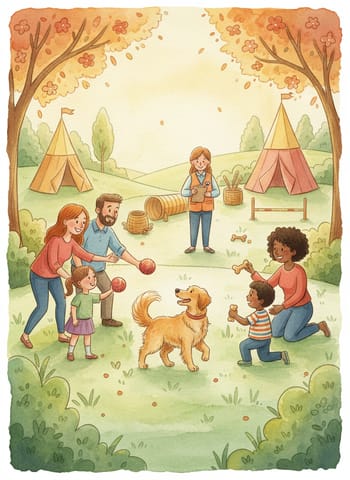
Bertil has volunteered at the animal shelter for three years, and he has never seen two families claim the same dog. He sees it now. The dog, a medium-sized brown mutt with one white ear, sits in the middle of the front office, wagging his tail at everybody.
"His name is Pilot," says the first family, a father and two teenagers, holding out a phone. "Here he is at the beach. Here he is on the sofa. He has been missing since Thursday."
"His name is Toast," says the second family, a mother and a small girl. "We have had him for two years. Here he is in the garden. Here he is asleep under the table." The photos on her phone show the same white ear and the same crooked tail.
Bertil does what any sensible volunteer would do. He fetches the scanner to check the microchip. It beeps, flashes an error and falls silent. The vet tries two more machines and then shakes her head. "The chip has been damaged, or it has moved," she says. "I can't read it. He could belong to either of you."
The dog yawns.
Both families begin to speak at once. The little girl starts to cry, and the teenagers fold their arms. For a full minute, nobody listens to anybody. Bertil, who was a schoolteacher for thirty years, recognizes the noise immediately.
"I have a proposal," he says. "A fair test. Nobody calls him and nobody touches him. At a quarter to six we take him to the park gate, drop the leash and see where he goes. If he is yours, he will go home."
Both families agree, mostly because neither can think of a reason to refuse. Bertil has a private reason for choosing that hour. According to the other volunteers, the dog has stood at the shelter's back door at six sharp every evening since Friday. He looks like someone with a reservation.
At 5:45, the park is quiet. The dog sniffs the gatepost. He looks at the first family, then at the second, then at nothing in particular. At 5:52, he stands, stretches and trots out of the gate without looking back. Everyone follows.
He crosses the road, climbs the hill and scratches at the first family's front door. "You see?" says the father, almost in tears. The dog goes inside and empties a bowl in under a minute. He accepts a pat on the head and leaves through a gap in the back hedge, which nobody in the family has ever noticed.
Down the hill he goes, toward the street by the river, with two families hurrying behind him. He stops on the second family's front step, where a bowl is already waiting.
"I always put it out at six," the mother says weakly. "I thought he was just late."
The dog begins his second dinner of the evening. He must have been doing this for two years, Bertil thinks. The families should have compared photos long ago. However, their lost-dog posters, which carried different names, were put up in different neighborhoods.
"Two dinners," the father says at last. "No wonder he has put on weight."
The little girl wipes her nose. "Can he be Pilot on weekdays and Toast on weekends?"
Nobody has a better suggestion. Bertil writes a new tag with two phone numbers and no name at all. The dog, lying on the pavement between the two families, has already fallen asleep.