The Uncorrected Tape
A free C1-level English story for language learners, readable online in English, with an option to listen via the free Storyteller app.
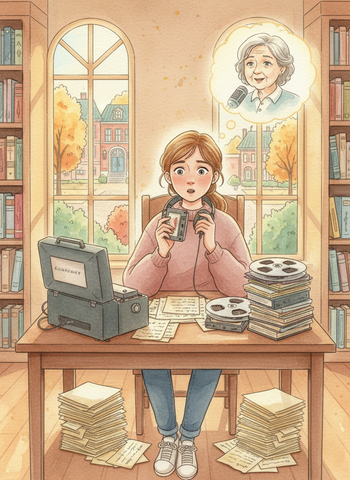
A teenage volunteer who has been quietly polishing elderly interviewees' words for a town oral-history archive has to decide what to do when her own grandmother's unedited voice arrives in the stack.
Dahlia had transcribed nineteen interviews for the archive by the end of July, and by then she had a private system nobody at the historical society had asked for: she removed the false starts.
If a speaker said "I was, well, I suppose I was maybe nineteen, twenty," Dahlia typed "I was nineteen or twenty." If someone trailed into silence mid-sentence, she supplied the ending the silence seemed to be reaching for. It was, she told herself, a kindness: a way of letting people sound the way they had surely meant to sound, had nerves and the tape recorder not gotten in the way.
Nobody had noticed. Or if the archivist, Mr. Halloran, had noticed, he had said nothing beyond thanking her for how clean her transcripts were, which she had taken, not unreasonably, as approval.
Then her grandmother's tape arrived in the stack, and Dahlia understood immediately why: Mr. Halloran hadn't known they were related until she had mentioned it that morning, apologizing, offering to trade with another volunteer. He told her it was fine. It was, after all, only a transcript.
Esther's recording had been made two years earlier, before the stroke that had since taken most of the fine motor control in her right hand. It had also taken, Dahlia suspected without ever being told outright, some of her confidence in speaking at length. On tape, her grandmother circled the same memory three times before landing anywhere near its center. There was a flooded basement, a lost photograph, a husband who had waded in after it and come out laughing, soaked to the shoulders, holding nothing.
Had it been anyone else's tape, Dahlia would already have smoothed it — cut the false starts, resolved the circling into one clean paragraph a stranger could read in thirty seconds and feel they understood. What stopped her, headphones still on and cursor blinking at the end of an unfinished sentence, was a sudden, uncomfortable suspicion. She had been doing this to everyone — quietly editing an entire archive of real people into a slightly more convenient version of themselves. Calling it kindness was easier than admitting the alternative was simply listening.
She typed what her grandmother had actually said. The false starts stayed. The unfinished sentence stayed unfinished, exactly as it had been left, a hand raised mid-gesture and never lowered. Somewhere in the circling, unedited, was a version of the flood that no clean paragraph would have kept. Twice, her grandmother corrected herself about which summer it had been, unwilling to let even a wrong date pass without saying so.
Dahlia saved the file under her grandmother's name and did not go back to fix the other nineteen. She thought, more than once over the following weeks, about telling Mr. Halloran that the earlier transcripts weren't quite what the tapes actually held. Each time, she decided the sentence could wait for a better moment. She was aware, even as she postponed it, that this might well be a kindness of exactly the same shape she had just stopped extending to her grandmother.
