The Marginalia
A free C1-level English story for language learners, readable online in English, with an option to listen via the free Storyteller app.
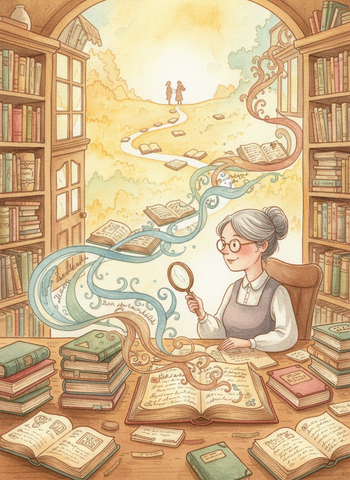
A secondhand bookshop owner traces a decade-long argument written in the margins of used books between two readers she can never identify.
Priya had owned the secondhand bookshop for six years before she noticed the handwriting.
It appeared first in a battered copy of an old travel memoir: a single line in blue ink, cramped and slanted, disagreeing with something the author had written about the loneliness of long journeys. A few shelves over, in an entirely different book by an entirely different author, the same hand had written something else, this time about grief. It read as if continuing a conversation no one else had been invited to. Having sorted secondhand stock for years without once paying attention to marginalia, Priya found herself, almost against her will, reading the edges of every book that came through the door.
Not until the sixth book did she realize the two hands were arguing with one another, rather than simply annotating alone. What unsettled her was not the handwriting itself but the fact that it argued with a second hand. In a paperback of poems, the blue ink had underlined a stanza and written, "This is sentimental and Marta knows it." Three books later, a looser hand, in pencil, replied in the margin of an entirely separate novel: "Sentimental is not the same as false. You always did confuse the two." Neither writer signed a name. Neither, as far as Priya could tell, had ever left so much as an initial.
She began keeping the books aside instead of shelving them, a small and growing pile on the counter that her assistant teased her about. It was the dates, once she started checking them against the shop's old purchase records, that told her the truth. The exchange had run for the better part of nine years. Two readers had been buying and presumably trading these same secondhand books, arguing in the margins across a decade without, so far as she could reconstruct it, ever meeting in person.
Then, as abruptly as it had started, it stopped. The last book she found, a thin volume of essays bought at an estate sale eighteen months ago, carried only the blue ink. It held only one line: "I don't think you're going to read this one. I'm leaving it here anyway."
Priya spent a full week trying to trace the estate sale back to a name, a family, anyone who might explain who "Marta" had been. She wondered, too, who had written to her so faithfully for so long without ever once identifying himself. The trail went nowhere useful. Wills are not public record in any way a bookshop owner can easily search, and the auction house that had handled the sale had long since closed.
She still has the books, six of them now, kept together on a shelf behind the register that is not for sale. Customers sometimes ask about them, and she tells them the truth, which is that she doesn't know who the writers were, only that they had once, apparently, known each other very well.
Not knowing, she has come to think, is not quite the same as the story being unfinished. Some conversations end because someone stops answering. This one, as best she can tell, ended because someone finally did.
