The Hidden Frame
A free C1-level English story for language learners, readable online in 5 languages, with an option to listen via the free Storyteller app.
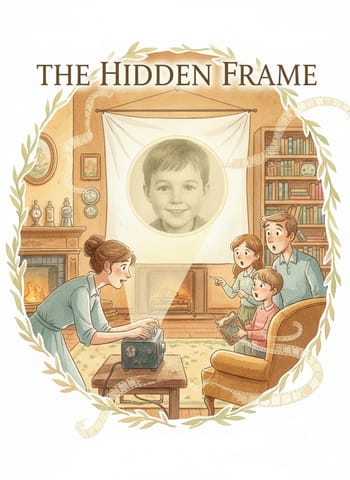
While restoring a family’s home movie, a film restorer finds a single frame showing a face that nobody in the family can name.
That was the preview! Hear the full story in the free Storyteller app. Get the app
Audio isn't available right now.
The reel arrives in a biscuit tin, wound on a plastic core that has begun to smell of vinegar. That tells Samira, before she has threaded a single inch, that she has perhaps a year to save it. Its owner is Ruben, a retired surveyor with careful hands, who wants his late father's home movies digitised in time for a family gathering in the spring. Forty minutes of picnics, a christening, a wedding, a dog chasing a ball it never quite catches. Nothing in it, he assures her, could interest anyone outside the family.
She works the way she always does: slowly, a frame at a time, cleaning each splice and coaxing the faded dyes back until the grass turns from rust to green. Twenty-four frames make a second, and after eleven days she has learned to read them like words. Most repeat the one before. A few carry a flaw, a scratch or a thumbprint. It is in the middle of the wedding sequence, at frame eleven thousand two hundred and eight, that she meets a face that should not be there.
It lasts one twenty-fourth of a second. A young woman looks straight into the lens and laughs, her head thrown back, her hair coming loose from a clip, in a light brighter and bluer than anything around her. Then the film returns to the cake and the shuffling guests. At normal speed the frame is invisible; only someone who stops to look would ever see it.
Samira stops. What gives the frame away is its edge. The markings beside the sprocket holes belong to a different year, and the film on either side is joined by narrow strips of tape, gone amber. Someone cut here with great care and, she suspects, more than once.
When she sends Ruben the still, he rings within the hour. He does not know the woman. Neither do his two aunts, or the cousin who remembers everyone. "A friend of my father's, possibly," he says, and the word stays on the line between them, unconvincing.
She does not let it go. Going back through the tin, she finds a second, much shorter roll that Ruben had set aside as ruined: overexposed, mostly white, a thumb across the lens for most of its length. Only when she holds it up to the light box does she see the thumb slip aside for a moment, and the same young woman laughing behind it. The man who shot it had saved the single good frame and spliced it, by hand, into a film made years later.
It is the gap between the front teeth that settles the question. In the christening sequence the woman holding the baby is older and careful, and she smiles with her lips closed in every shot. Samira would never have connected the two had the younger woman not laughed hard enough to show everything. If the tape had been newer, she thinks, she might have missed the join altogether.
She rings Ruben again and tells him whose face it is. For a while she hears only the small noises of a kitchen, a tap, a chair.
"She never laughed like that," he says at last. "Not once that I saw."
Samira looks at the frozen face on her screen, caught mid-breath, a stranger to her own son. "It would seem your father saw it," she says.
She finishes the transfer and leaves the frame exactly where he put it, at its true length of one twenty-fourth of a second. In the delivery notes, under Remarks, she types a single line: Frame 11,208 is not damage. Please leave it in.