The Wrong Label in the Gallery
Uma história gratuita em inglês de nível B2 para estudantes, para ler online em 5 idiomas, com opção de ouvir no app gratuito Storyteller.
A museum intern spots a tiny signature that contradicts a painting's label and must persuade a doubtful curator to take another look.
Essa foi a prévia! Ouça a história completa no app gratuito Storyteller. Baixar o app
O áudio não está disponível no momento.
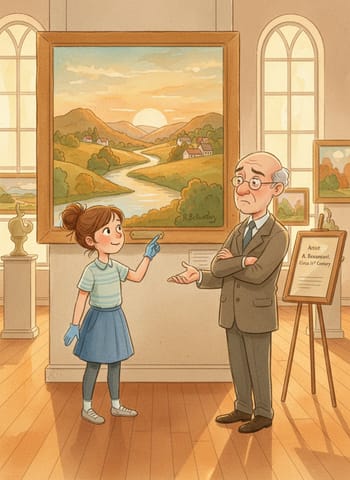
Eugenie had been working at the museum for eleven weeks when she began to doubt a painting. It hung in the second gallery, a small oil of a tidal river at dusk. The label beside it read: "Attributed to the Master of the Grey Estuary, c. 1840."
Eugenie trabalhava no museu havia onze semanas quando começou a duvidar de uma pintura. Ela ficava na segunda galeria, um pequeno óleo de um rio de maré ao entardecer. A etiqueta ao lado dizia: "Atribuído ao Mestre do Estuário Cinzento, c. 1840."
She passed it every morning on her way to the archive. Only during a lighting check, with a cloth in her hand, did she notice the mark in the lower corner. It was a tiny fish, drawn in two curved strokes, no longer than a grain of rice.
Ela passava por ela toda manhã a caminho do arquivo. Só durante uma verificação da iluminação, com um pano na mão, reparou na marca no canto inferior. Era um peixinho minúsculo, desenhado em dois traços curvos, não maior que um grão de arroz.
Nobody knew who the Master of the Grey Estuary really was. Scholars had invented the name because none of his paintings were signed. A signature, then, should not have been there at all.
Ninguém sabia quem era realmente o Mestre do Estuário Cinzento. Os estudiosos tinham inventado o nome porque nenhuma de suas pinturas era assinada. Uma assinatura, portanto, nem deveria estar ali.
In the east wing, however, hung a harbor scene by a painter who put a small fish on every canvas. Eugenie stood in front of it for ten minutes. The skies matched: both were built from short, dry dabs of paint rather than smooth blending.
Na ala leste, porém, pendia uma cena de porto de um pintor que punha um peixinho em cada tela. Eugenie ficou dez minutos diante dela. Os céus combinavam: ambos eram construídos com pinceladas curtas e secas, em vez de misturas suaves.
She photographed both corners through a magnifying lens and spent two afternoons in the archive. In a box of unsorted papers she found a dealer's receipt dated 1843. It listed "one estuary view at dusk, small, signed with the fish," sold for three marks.
Ela fotografou os dois cantos por uma lupa e passou duas tardes no arquivo. Numa caixa de papéis não classificados, encontrou um recibo de um negociante datado de 1843. Listava "uma vista de estuário ao entardecer, pequena, assinada com o peixe", vendida por três marcos.
Lennart, the senior curator, had run the gallery for twenty years. He listened to her with his arms crossed.
Lennart, o curador-chefe, dirigia a galeria havia vinte anos. Ouviu-a de braços cruzados.
"That label has been on the wall for sixty years," he said. "People far more experienced than you have walked past that painting."
"Essa etiqueta está na parede há sessenta anos", disse. "Gente muito mais experiente do que você já passou por aquela pintura."
"I know," Eugenie said. "But if I were wrong, checking would cost us one afternoon."
"Eu sei", disse Eugenie. "Mas se eu estiver errada, conferir nos custaria uma tarde."
"A fish could mean anything. Half the painters of that period doodled in the corners."
"Um peixe pode significar qualquer coisa. Metade dos pintores dessa época rabiscava nos cantos."
"Perhaps. However, the receipt says 'signed with the fish,' and the date agrees with the conservation report." She slid the photographs across the desk. "Someone must have looked at this before, but nobody wrote it down."
"Talvez. No entanto, o recibo diz 'assinada com o peixe', e a data bate com o relatório de conservação." Ela deslizou as fotografias sobre a mesa. "Alguém deve ter olhado para isso antes, mas ninguém anotou."
Lennart said that the museum would look foolish if it changed the label and then had to change it back. Eugenie answered that it would look much more foolish to keep a wrong one after being shown the evidence.
Lennart disse que o museu pareceria tolo se trocasse a etiqueta e depois tivesse de trocá-la de volta. Eugenie respondeu que pareceria muito mais tolo manter uma etiqueta errada depois de ver as provas.
Neither of them spoke for a while. Down the corridor, a cart rattled past, and a school group was being led toward the east wing.
Nenhum dos dois falou por um tempo. Corredor abaixo, um carrinho passou chacoalhando, e um grupo escolar era conduzido para a ala leste.
At last, Lennart held out his hand. "Give me the lens," he said.
Por fim, Lennart estendeu a mão. "Me dê a lupa", disse.
He bent over the photographs for a long time. Then he walked into the gallery, lifted the old label off its hook and turned it over. On the back, in pencil, he wrote: "Fish. See receipt, 1843."
Ele se debruçou sobre as fotografias por um longo tempo. Depois entrou na galeria, tirou a etiqueta antiga do gancho e a virou. No verso, a lápis, escreveu: "Peixe. Ver recibo, 1843."
"Now get me the other file," he said. "And bring a second chair. If we are going to do this, we should do it properly."
"Agora me traga o outro arquivo", disse. "E traga uma segunda cadeira. Se vamos fazer isso, vamos fazer direito."