The Recurring House
Uma história gratuita em inglês de nível C1 para estudantes, para ler online em 4 idiomas, com opção de ouvir no app gratuito Storyteller.
A photo restorer keeps finding the same unremarkable house in the background of unrelated clients' photographs across four decades and never fully identifies it.
Essa foi a prévia! Ouça a história completa no app gratuito Storyteller. Baixar o app
O áudio não está disponível no momento.
Elise restored other people's photographs for a living, which meant she spent most of her working life looking closely at houses she would never visit and faces she would never meet.
Elise restaurava fotografias de outras pessoas para viver, o que significava que passava a maior parte da vida profissional observando de perto casas que jamais visitaria e rostos que jamais conheceria.
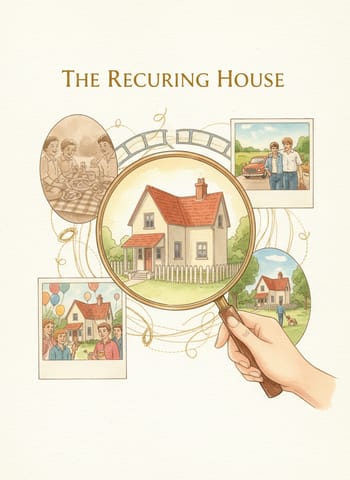
The house first caught her attention in a client's water-damaged wedding photograph from the 1970s: a plain two-story building with a crooked shutter on the upper left window. It was visible only at the edge of the frame, barely relevant to the scene it belonged to. She noticed it mainly because the shutter was so obviously broken, hanging at an angle that would have annoyed her if it were her own house. She thought nothing more of it until, six weeks later, restoring an entirely unrelated client's photograph, she found the same crooked shutter again.
A casa chamou sua atenção pela primeira vez numa fotografia de casamento danificada pela água, de um cliente, da década de 1970: um prédio simples de dois andares com uma veneziana torta na janela superior esquerda. Ela era visível apenas na borda do quadro, quase irrelevante para a cena à qual pertencia. Elise reparou nela principalmente porque a veneziana estava visivelmente quebrada, pendendo num ângulo que a teria incomodado se fosse a casa dela mesma. Ela não pensou mais nisso até que, seis semanas depois, ao restaurar a fotografia de um cliente completamente diferente, encontrou a mesma veneziana torta de novo.
Different family. Different decade, judging by the car parked outside. Same house, same broken shutter, caught this time in the background of somebody's christening photo.
Família diferente. Década diferente, a julgar pelo carro estacionado na frente. Mesma casa, mesma veneziana quebrada, capturada dessa vez no fundo da foto de um batizado de alguém.
Having spent fifteen years around old photographs, Elise knew coincidence when she saw it, and this did not feel like coincidence. She began keeping a folder, quietly, of every unrelated client photograph in which the house appeared. By the time she had four more examples, spanning what she now guessed was nearly forty years, she had stopped believing in an innocent explanation. Two unrelated houses, she had decided, do not simply look this alike.
Depois de quinze anos lidando com fotografias antigas, Elise sabia reconhecer uma coincidência quando via uma, e aquilo não parecia coincidência. Ela começou a guardar, discretamente, uma pasta com todas as fotografias de clientes sem relação nenhuma entre si nas quais a casa aparecia. Quando já tinha mais quatro exemplos, abrangendo o que ela agora calculava serem quase quarenta anos, tinha deixado de acreditar numa explicação inocente. Duas casas sem relação alguma, ela concluiu, simplesmente não se parecem tanto assim.
What troubled her was not that the house kept appearing, but that none of her clients seemed to know it was there. She asked, carefully, whenever she returned a restored photograph: did they recognize this building, this street, this shutter? Not once did anybody recognize it. Whatever the house had meant to the families in the foreground, it had meant nothing to them at all. They had been photographing a wedding, a christening, a birthday, and the house had simply happened to be standing behind them.
O que a incomodava não era o fato de a casa continuar aparecendo, mas que nenhum de seus clientes parecia saber que ela estava ali. Ela perguntava, com cuidado, sempre que devolvia uma fotografia restaurada: eles reconheciam aquele prédio, aquela rua, aquela veneziana? Nem uma única vez alguém reconheceu. Fosse o que fosse que a casa tivesse significado para as famílias em primeiro plano, para elas não significava absolutamente nada. Estavam fotografando um casamento, um batizado, um aniversário, e a casa simplesmente calhou de estar ali atrás.
Elise never worked out whose house it actually was. A search of old city directories turned up three streets with buildings of a similar shape. None of these she could confirm from a corner of a photograph, taken decades ago by someone who hadn't been aiming at it. What she did work out, eventually, was the span of years the house had shown up across: from a photograph dated 1968 to one dated 2011. After that, it never appeared again in anything she restored.
Elise nunca descobriu de quem era a casa de fato. Uma busca em antigas listas telefônicas da cidade revelou três ruas com prédios de formato semelhante. Nenhuma delas ela conseguiu confirmar a partir do canto de uma fotografia, tirada décadas atrás por alguém que nem sequer mirava naquele ponto. O que ela conseguiu descobrir, eventualmente, foi o período de anos em que a casa havia aparecido: de uma fotografia datada de 1968 até uma datada de 2011. Depois disso, nunca mais apareceu em nada que ela restaurou.
She keeps the folder still, seven photographs now, not because she expects to solve anything, but because there is something in the not-solving that she has come to find restful rather than frustrating. Somewhere, for forty-three years, a house stood quietly at the edge of other people's important days, watching, in its way, everyone but itself.
Ela ainda guarda a pasta, com sete fotografias agora, não porque espera resolver alguma coisa, mas porque há algo em não resolver que ela passou a achar repousante em vez de frustrante. Em algum lugar, por quarenta e três anos, uma casa ficou silenciosamente à margem dos dias importantes de outras pessoas, observando, à sua maneira, todo mundo menos a si mesma.