How the Rhinoceros Got His Skin
A free B2-level English story for language learners, readable online in 7 languages, with an option to listen via the free Storyteller app.
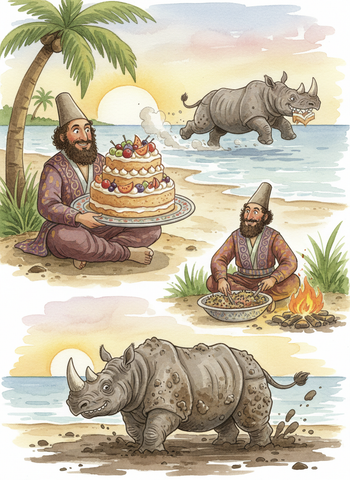
A Parsee bakes a magnificent cake all for himself — until a bad-mannered Rhinoceros steals it, sparking a prank with an itchy, unforgettable payback.
Once upon a time, on an uninhabited island on the shores of the Red Sea, there lived a Parsee from whose hat the rays of the sun were reflected in more-than-oriental splendour. And the Parsee lived by the Red Sea with nothing but his hat and his knife and a cooking-stove of the kind that you must particularly never touch. And one day he took flour and water and currants and plums and sugar and things, and made himself one cake which was two feet across and three feet thick.
Hace mucho tiempo, en una isla deshabitada de las costas del Mar Rojo, vivía un parsi de cuyo sombrero se reflejaban los rayos del sol con un esplendor más que oriental. Y el parsi vivía junto al Mar Rojo sin nada más que su sombrero, su cuchillo y una estufa de cocina de esas que uno nunca, jamás, debe tocar. Y un día tomó harina y agua y pasas y ciruelas y azúcar y otras cosas, y se hizo un pastel de dos pies de ancho y tres pies de grosor.
It was indeed a Superior Comestible (that’s magic), and he put it on stove because he was allowed to cook on the stove, and he baked it and he baked it till it was all done brown and smelt most sentimental. But just as he was going to eat it there came down to the beach from the Altogether Uninhabited Interior one Rhinoceros with a horn on his nose, two piggy eyes, and few manners. In those days the Rhinoceros’s skin fitted him quite tight.
Era, en efecto, un Comestible Superior (eso es magia), y lo puso sobre la estufa porque tenía permiso para cocinar en ella, y lo horneó y lo horneó hasta que quedó bien dorado y olía de un modo de lo más sentimental. Pero justo cuando se disponía a comerlo, bajó a la playa, desde el Interior Completamente Deshabitado, un Rinoceronte con un cuerno en la nariz, dos ojillos de cerdo y ninguna educación. En aquellos días, la piel del Rinoceronte le quedaba bastante ajustada.
There were no wrinkles in it anywhere. He looked exactly like a Noah’s Ark Rhinoceros, but of course much bigger. All the same, he had no manners then, and he has no manners now, and he never will have any manners. He said, ‘How!’ and the Parsee left that cake and climbed to the top of a palm tree with nothing on but his hat, from which the rays of the sun were always reflected in more-than-oriental splendour.
No tenía ni una sola arruga en ninguna parte. Se parecía exactamente a un Rinoceronte del Arca de Noé, aunque, claro está, mucho más grande. Con todo, no tenía modales entonces, ni los tiene ahora, ni jamás los tendrá. Dijo: «¡Ajá!», y el parsi dejó ahí el pastel y trepó hasta lo alto de una palmera, sin más que su sombrero, del cual siempre se reflejaban los rayos del sol con un esplendor más que oriental.
And the Rhinoceros upset the oil-stove with his nose, and the cake rolled on the sand, and he spiked that cake on the horn of his nose, and he ate it, and he went away, waving his tail, to the desolate and Exclusively Uninhabited Interior which abuts on the islands of Mazanderan, Socotra, and Promontories of the Larger Equinox. Then the Parsee came down from his palm-tree and put the stove on its legs and recited the following Sloka, which, as you have not heard, I will now proceed to relate:—
Y el Rinoceronte volcó la estufa de aceite con su hocico, y el pastel rodó por la arena, y él lo ensartó en el cuerno de su nariz, y se lo comió, y se marchó, agitando la cola, hacia el desolado Interior Exclusivamente Deshabitado que colinda con las islas de Mazanderán, Socotra y los Promontorios del Gran Equinoccio. Entonces el parsi bajó de su palmera, puso la estufa de nuevo sobre sus patas y recitó el siguiente Sloka, que, como no lo has oído, paso ahora a relatarte:
Them that takes cakes Which the Parsee-man bakes Makes dreadful mistakes.
Quien toma los pasteles que el parsi hace y cuece comete un grave error.
And there was a great deal more in that than you would think.
Y había mucho más en aquello de lo que uno pensaría.
Because, five weeks later, there was a heat wave in the Red Sea, and everybody took off all the clothes they had. The Parsee took off his hat; but the Rhinoceros took off his skin and carried it over his shoulder as he came down to the beach to bathe. In those days it buttoned underneath with three buttons and looked like a waterproof. He said nothing whatever about the Parsee’s cake, because he had eaten it all; and he never had any manners, then, since, or henceforward. He waddled straight into the water and blew bubbles through his nose, leaving his skin on the beach.
Porque, cinco semanas después, hubo una ola de calor en el Mar Rojo, y todo el mundo se quitó toda la ropa que tenía. El parsi se quitó el sombrero; pero el Rinoceronte se quitó la piel y la llevó al hombro mientras bajaba a la playa a bañarse. En aquellos días se abrochaba por debajo con tres botones y parecía un impermeable. No dijo ni una palabra sobre el pastel del parsi, porque se lo había comido entero; y jamás tuvo modales, ni antes, ni entonces, ni después. Se metió en el agua sin más y se puso a soplar burbujas por la nariz, dejando su piel en la playa.
Presently the Parsee came by and found the skin, and he smiled one smile that ran all round his face two times. Then he danced three times round the skin and rubbed his hands. Then he went to his camp and filled his hat with cake-crumbs, for the Parsee never ate anything but cake, and never swept out his camp.
Poco después pasó el parsi y encontró la piel, y sonrió una sonrisa que le dio dos vueltas alrededor de toda la cara. Luego bailó tres veces alrededor de la piel y se frotó las manos. Después fue a su campamento y llenó su sombrero de migajas de pastel, pues el parsi nunca comía otra cosa que no fuera pastel, y nunca barría su campamento.
He took that skin, and he shook that skin, and he scrubbed that skin, and he rubbed that skin just as full of old, dry, stale, tickly cake-crumbs and some burned currants as ever it could possibly hold. Then he climbed to the top of his palm-tree and waited for the Rhinoceros to come out of the water and put it on.
Tomó aquella piel, y sacudió aquella piel, y restregó aquella piel, y frotó aquella piel hasta llenarla tanto como fuera posible de migajas de pastel viejas, secas, rancias y que picaban, y de algunas pasas quemadas. Luego trepó a lo alto de su palmera y esperó a que el Rinoceronte saliera del agua y se la pusiera.
And the Rhinoceros did. He buttoned it up with the three buttons, and it tickled like cake crumbs in bed. Then he wanted to scratch, but that made it worse; and then he lay down on the sands and rolled and rolled and rolled, and every time he rolled the cake crumbs tickled him worse and worse and worse. Then he ran to the palm-tree and rubbed and rubbed and rubbed himself against it.
Y el Rinoceronte lo hizo. Se la abrochó con los tres botones, y le picaba como si tuviera migajas de pastel en la cama. Entonces quiso rascarse, pero eso lo empeoró; y luego se tendió en la arena y rodó y rodó y rodó, y cada vez que rodaba, las migajas de pastel le picaban cada vez peor. Entonces corrió hacia la palmera y se frotó y se frotó y se frotó contra ella.
He rubbed so much and so hard that he rubbed his skin into a great fold over his shoulders, and another fold underneath, where the buttons used to be (but he rubbed the buttons off), and he rubbed some more folds over his legs. And it spoiled his temper, but it didn’t make the least difference to the cake-crumbs. They were inside his skin and they tickled. So he went home, very angry indeed and horribly scratchy; and from that day to this every rhinoceros has great folds in his skin and a very bad temper, all on account of the cake-crumbs inside.
Se frotó tanto y con tanta fuerza que se formó un gran pliegue de piel sobre los hombros, y otro pliegue debajo, donde antes estaban los botones (pero se los frotó hasta arrancárselos), y se formó algunos pliegues más sobre las patas. Y aquello le agrió el carácter, pero no cambió en lo más mínimo el asunto de las migajas de pastel. Estaban dentro de su piel y le seguían picando. Así que se fue a casa, muy enojado en verdad y terriblemente irritado; y desde ese día hasta hoy, todo rinoceronte tiene grandes pliegues en la piel y muy mal carácter, todo por culpa de las migajas de pastel de adentro.
But the Parsee came down from his palm-tree, wearing his hat, from which the rays of the sun were reflected in more-than-oriental splendour, packed up his cooking-stove, and went away in the direction of Orotavo, Amygdala, the Upland Meadows of Anantarivo, and the Marshes of Sonaput.
Pero el parsi bajó de su palmera, con su sombrero puesto, del cual se reflejaban los rayos del sol con un esplendor más que oriental, empacó su estufa de cocina, y se marchó en dirección a Orotavo, Amígdala, los Prados Altos de Anantarivo y los Pantanos de Sonaput.
This Uninhabited Island Is off Cape Gardafui, By the Beaches of Socotra And the Pink Arabian Sea: But it’s hot—too hot from Suez For the likes of you and me Ever to go In a P. and O. And call on the Cake-Parsee!
ESTA Isla Deshabitada está frente al Cabo Gardafui, junto a las Playas de Socotra y el Rosado Mar Arábigo: pero hace calor, demasiado calor desde Suez para que gente como tú o como yo alguna vez vaya en un barco de la P. and O. ¡a visitar al Parsi del Pastel!
