The Dinner Table Language
A free C1-level English story for language learners, readable online in English, with an option to listen via the free Storyteller app.
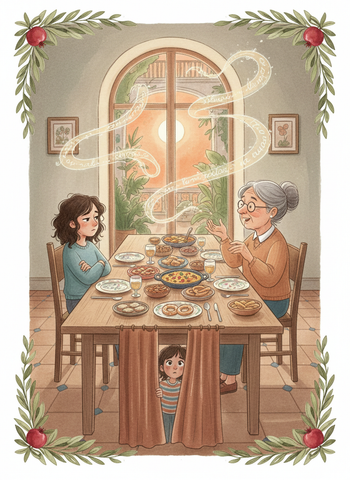
A teenager resents her grandmother's insistence on Spanish at dinner until she overhears the real reason behind the rule.
By ninth grade, Rosa had quietly stopped speaking Spanish at home, not out of any decision she could name. It was more a slow drift toward the language that felt, day to day, easier and more truly hers.
Her grandmother Soledad noticed immediately and never once let it pass without comment. Every dinner became a small negotiation: Rosa answering in English, Soledad repeating the question in Spanish. Then Soledad would wait, her patience visibly thinning, for the same answer in the language she had chosen for this house.
"You understand me fine," Soledad said, most nights. "I know you do. So answer me the way I asked."
Rosa found this exhausting in a way she struggled to explain to her friends, whose grandparents, as far as she could tell, made no such demands. It felt less like a rule about language and more like a test she was quietly failing at her own family's table, every single evening.
It was only in October, overhearing a phone call she was not meant to hear, that Rosa understood what the dinner table ritual had actually been protecting. Soledad was talking to her own sister, back in the country she had left forty years earlier. Her Spanish on that call was different from the Spanish at dinner: faster, looser, full of jokes Rosa didn't fully catch.
"I forget words now," Soledad admitted to her sister, in a voice Rosa had never heard her use, "when I go too many days without saying them out loud to someone who talks back."
Had Rosa never overheard that call, she might have spent years assuming the dinner table rule was simply about her, about correcting some failure of hers to stay connected to where her family came from. What she realized instead, standing frozen in the hallway, was that the rule had never really been about her at all.
Soledad was not trying to preserve Rosa's Spanish. She was trying to preserve her own, one dinner conversation at a time, in a house where English had slowly become the language of everyone around her, including, more and more, her own granddaughter.
This did not resolve anything cleanly. Rosa did not suddenly answer every question in fluent Spanish the following night, and Soledad did not soften the small, persistent pressure she applied at every meal. What changed was quieter than that. Rosa began, without announcing it, to notice which of her own words were disappearing too. She started reaching for the Spanish ones on purpose, sometimes badly, before they could follow her grandmother's into the space where a language goes when nobody insists on using it.
She never told Soledad what she had overheard. Some understandings, she decided, work better lived out slowly across a hundred ordinary dinners than spoken aloud and settled all at once.
